
What To Do After A DUI Arrest: A Florida Guide

The ride home is over. The car may be in impound. Your paperwork is on the kitchen table. Your phone has missed calls, and your mind is racing through the stop, the roadside questions, the breath test, the booking desk, and what happens next.
That reaction is normal. A Florida DUI arrest throws people into two problems at once. One affects your ability to drive. The other affects your criminal record, your job, your insurance, and your future. If you want to know what to do after a dui arrest, the answer starts with speed, organization, and silence.
A DUI arrest is not a conviction. But it is a moment where small decisions matter. The people who protect themselves best are usually the ones who stop talking, start documenting, and get legal guidance before deadlines close.
Your First 24 Hours After A Florida DUI Arrest

The first day after a DUI arrest feels disorganized because it is. You were likely given papers quickly, your normal routine got interrupted, and you may still be replaying every word you said. The best move now is to get control over facts, dates, and communication.
One point matters immediately. In the first 24 to 48 hours, contacting an experienced DUI attorney is critical because early evidence review can shape the defense, and one source notes that around 60% of cases hinge on evidence preservation and actions taken in that initial window (early DUI evidence preservation guidance).
Get Your Papers And Memory In One Place
Start a single file today. Use a folder, a notes app, or both. Put every document in it, including your citation, bond paperwork, property receipt, tow information, court date notice, and any temporary driving paperwork.
Then write down your own timeline while it's still fresh.
- Start with the stop: Where were you coming from, where were you going, and what time did the officer first make contact?
- Record the conversation: Note what the officer asked, what you answered, and whether you were asked to perform roadside exercises.
- Include conditions: Lighting, traffic, weather, footwear, injuries, fatigue, medications, and anything else that could have affected how you looked or performed.
- List witnesses: Anyone who saw you before the stop or during the encounter may matter later.
If alcohol testing is part of the case, it also helps to understand how numbers are discussed in DUI cases. A plain-language review of blood alcohol level issues in Florida can help you follow later conversations with counsel.
Practical rule: Your memory will get worse, not better. Write first, edit later.
Stay Quiet After Release
A lot of damage happens after people get home. They call friends and explain too much. They text apologies. They post vague things online. They answer follow-up questions from law enforcement because they think cooperation will make the case disappear.
It won't.
Use your right to remain silent after release just as seriously as during the stop. If an officer, investigator, or anyone acting for the state contacts you, the safe answer is that your lawyer will handle communication. That isn't rude. It's disciplined.
Deal With The Car And Daily Logistics
If your car was towed, locate it quickly. Storage charges and paperwork problems don't help your defense, and they create stress you don't need. Have a licensed driver retrieve it if your driving status is unclear.
Also make practical arrangements right away:
- Fix transportation for the week. Court and work issues get worse when people miss appointments.
- Calendar every date on your paperwork. Don't trust memory.
- Save receipts and notices. Tow, impound, bond, and program-related documents often become important later.
The first day isn't about solving the entire case. It's about preventing avoidable mistakes and giving your defense a clean starting point.
The Critical 10-Day Deadline For Your Driver's License

The most urgent deadline in many Florida DUI cases isn't your court date. It's the short window to address your license. People often assume the criminal case controls everything. It doesn't.
Florida treats the license issue as its own fight. A source addressing this Florida-specific issue states that you have 10 days to request a DMV hearing to challenge the automatic suspension, and missing that deadline leads to a 180-day suspension for a first-time refusal or failure of a breath test. That process is separate from the criminal case (Florida 10-day DUI hearing deadline discussion).
Why This Deadline Matters More Than Most People Think
If you do nothing, time keeps moving even while you're still trying to understand what happened at the arrest. That is why waiting to "see what court says" is usually a bad plan.
The administrative suspension affects daily life fast. Work, childcare, school, medical appointments, and basic errands all get harder when driving privileges disappear. Once the deadline passes, your options narrow.
A lot of people searching for what to do after a dui arrest focus on the criminal charge first because it feels more serious. That's understandable. But if you want the broadest set of options, the license issue needs immediate attention.
Missing the administrative deadline doesn't mean the criminal case is lost. It does mean you've given up a valuable opportunity on the driving side.
The Real Choice You Need To Make
Within that short period, people usually face a strategic decision. They can fight the suspension through the administrative process, or they can make choices aimed at limited driving relief sooner. Which path makes sense depends on the facts, your driving needs, and the strength of the evidence.
That decision shouldn't be made casually. It should be made with a clear view of both fronts of the case. The facts that help in one setting don't always play out the same way in the other.
For a broader look at defense strategy, this overview on how to fight a DUI charge explains some of the legal pressure points that often matter.
What Works And What Doesn't
What usually works:
- Acting immediately: Fast action preserves options.
- Reviewing the paperwork carefully: The exact notice matters.
- Making a deliberate choice: Don't let the deadline pass by accident.
What usually doesn't work:
- Assuming your first court date fixes your license
- Waiting for the state to send something clearer
- Thinking a polite explanation to the DMV will undo a missed deadline
This is one of the few moments in a DUI case where inaction can create damage before the prosecution has even started showing its hand.
Navigating Florida's Two Parallel Legal Paths
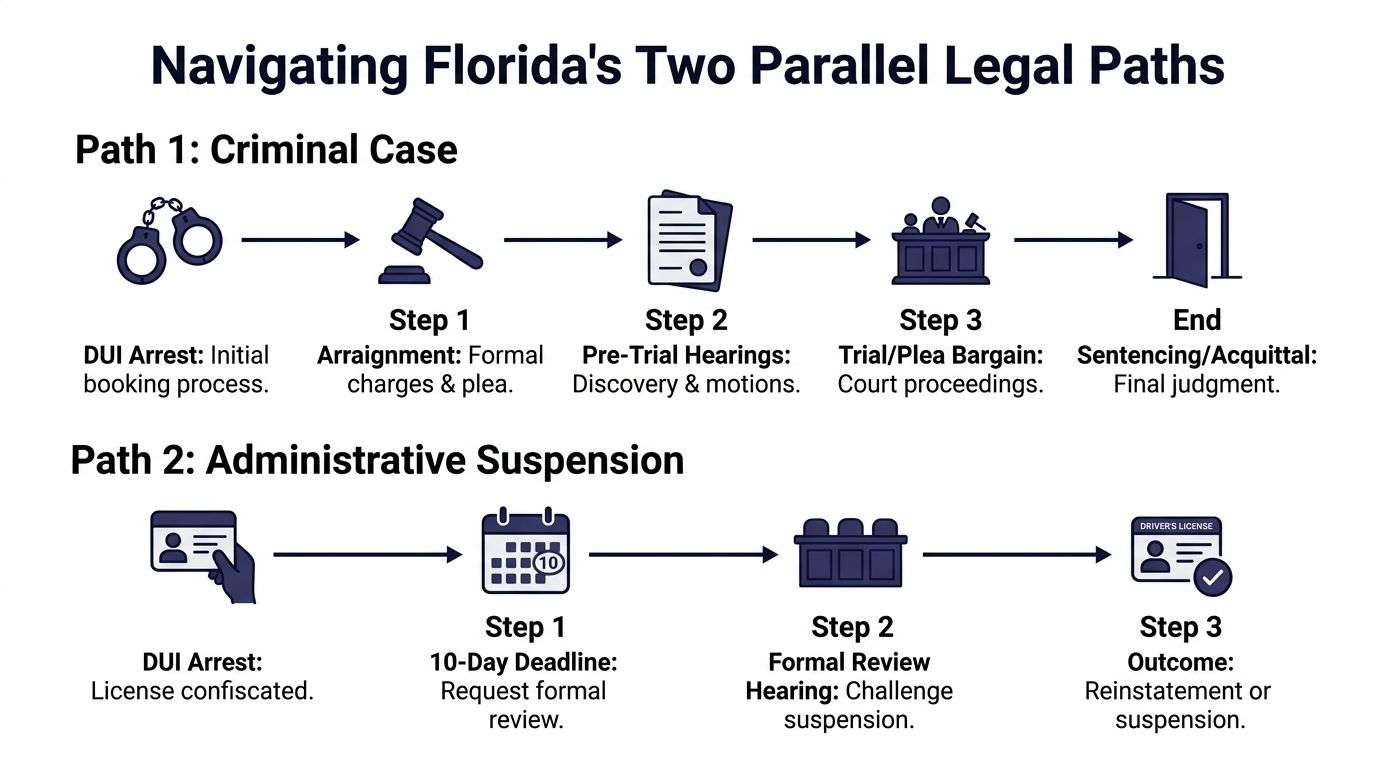
The hardest thing for many clients to understand is that a Florida DUI case is really two separate matters moving at the same time. One is the administrative license case. The other is the criminal court case. They overlap in facts, but they don't serve the same purpose.
That distinction explains why someone can be dealing with license consequences even though the criminal case is still in its early stages.
The Administrative Track
The administrative side is about driving privileges. It moves fast. The first major question is whether you act within the short deadline after arrest. That early choice can affect whether you keep driving in some form while the criminal case continues.
This track is narrow, but it matters. For many people, the ability to drive is what keeps life stable enough to deal with everything else.
The Criminal Track
The criminal case is broader and usually slower. It includes charging, arraignment, evidence review, negotiations, motion practice, and sometimes trial preparation. A source discussing the criminal and administrative split notes that 95% of criminal DUI cases are resolved through plea bargains, while the separate administrative matter still requires its own action, and the criminal case may continue for 3 to 12 months (DUI administrative and criminal timeline overview).
That doesn't mean every case should be pled out quickly. It means most cases are resolved through negotiation rather than trial, which is why careful evidence review matters so much. The strength of the stop, the testing, the officer's observations, and the paperwork all affect the negotiating position.
A fuller overview of this area is available on this Florida DUI defense page.
Why The Two Tracks Must Be Managed Together
People get into trouble when they treat one path as the "real" case and the other as a side issue. That's backwards. Good strategy comes from coordinating both.
Here is the practical perspective:
- The license track affects your immediate ability to function.
- The criminal track affects long-term penalties, record consequences, and negotiating advantage.
- Facts cross over, strategy doesn't always. A move that sounds good emotionally may be unhelpful legally.
- Timing matters differently on each side. One side is deadline-driven right away. The other often rewards patient review.
Handle a DUI like a two-front battle. If you ignore one front, problems build there while you're distracted by the other.
A Better Way To Think About The First Few Weeks
The first few weeks are not just "waiting for court." They are the period where your lawyer starts testing the state's case, preserving favorable evidence, and deciding where pressure should be applied first.
Some cases turn on the stop. Others turn on statements. Others turn on testing procedure, video, witness context, or whether the driver's presentation matched the officer's written narrative. Prosecutors build cases from reports, video, and chemical evidence. Defense counsel should be pulling those pieces apart just as methodically.
That is why smart early action feels calm from the outside. It isn't dramatic. It is organized.
How To Find And Work With A DUI Defense Attorney

Hiring a DUI lawyer shouldn't feel like buying a slogan. You need someone who can explain risk clearly, move quickly on deadlines, and spot weaknesses in the state's file before they harden into assumptions.
A good consultation should leave you with more clarity than you had before. If you leave more confused, that's a warning sign.
Questions Worth Asking In The Consultation
Ask direct questions. You're not being difficult. You're testing whether this lawyer handles these cases in a hands-on way.
- How do you approach the license issue early? You want someone who treats the administrative side as part of the strategy, not an afterthought.
- What do you review first? Good answers usually involve video, reports, statements, testing, and timeline reconstruction.
- Who handles communication? You should know whether you'll be dealing with the attorney, staff, or a rotating team.
- How do you evaluate whether to negotiate or fight? The answer should sound fact-specific, not canned.
Why Former Prosecutor Experience Can Matter
Former prosecutors know how charging decisions get made, what details tend to move negotiations, and which weaknesses in a DUI case matter to the other side. That doesn't guarantee a result, but it can sharpen strategy.
From the defense side, that experience often helps in three ways:
Issue spotting
A lawyer who has reviewed DUI files from the state's side usually recognizes quickly which facts prosecutors rely on most.Negotiation judgment
Not every case should posture aggressively at the start. Not every case should rush toward a plea either.Credibility with the court
Lawyers who know local practice often present cleaner, more focused arguments because they understand what the judge will want addressed.
You can learn more about attorney backgrounds and courtroom experience by reviewing the firm's team page.
The right lawyer doesn't just tell you what could happen. They tell you what they plan to do next and why.
How To Be A Good Client In A DUI Case
Working well with counsel helps. The best defense is harder to build when the client leaves out facts, misses calls, or keeps talking about the case to other people.
Bring your lawyer the full picture:
- All paperwork
- Your written timeline
- Names of witnesses
- Medical issues or medications
- Any photos, texts, receipts, or location history that might help
Don't edit facts to make them sound better. A defense attorney can work with difficult facts. Hidden facts are the problem.
Understanding Potential Penalties And Long-Term Impacts
People usually focus first on court fines or whether they might face probation. Those are serious concerns, but they aren't the whole picture. A DUI can affect your finances, mobility, employment options, and reputation long after the court process ends.
One Florida-focused source states that DUI convictions can cause auto insurance rates to increase by 30% to 50% for 3 to 5 years, and that the overall financial impact, including lost wages and insurance costs, can exceed $10,000 (Florida DUI financial impact discussion). That is why the long-term strategy matters as much as the immediate response.
The Court Penalties People Expect
For many first-time DUI defendants, the most visible concerns are the standard court consequences. These can include fines, supervision, classes, community-based requirements, and restrictions tied to driving.
The exact outcome depends on the facts. Testing evidence, prior history, accident allegations, statements to officers, and county-specific practice all matter. What looks "routine" from the outside can become more serious if the file includes aggravating details.
The Hidden Costs People Underestimate
The costs that surprise people usually arrive after the first hearing.
- Insurance pressure: This is often one of the longest-lasting effects.
- Work disruption: Missed time, transportation issues, and employer concerns can build quickly.
- Professional consequences: Some jobs are more sensitive to driving-related charges than others.
- Future charges: Even a later traffic stop can become more complicated if your license status changes.
If your case leads to license problems, related issues can snowball. That is one reason people often end up facing additional trouble tied to suspended driving status. This overview of driving with a suspended license shows how quickly one unresolved problem can turn into another.
What Actually Reduces Long-Term Damage
Good outcomes usually come from strategy, not panic. That means handling the case in a way that considers both legal exposure and collateral consequences.
What tends to help:
- Early legal review of the evidence
- Careful handling of the license side
- Avoiding new violations while the case is pending
- Making decisions based on your real goals, not just fear of the next court date
What often hurts:
- Treating the case as minor because nobody was injured
- Waiting too long to get advice
- Missing deadlines and then trying to repair preventable damage
- Talking about the case casually at work or online
A DUI case is rarely just about one hearing. It is about protecting the next several years of your life from becoming more expensive and more restrictive than they need to be.
Take Control Of Your Case Today
After a DUI arrest, people often feel like the system is already too far in motion to influence. That isn't true. The earliest days of the case are often where the most important decisions get made. Silence, documentation, license action, and fast legal review can change the direction of the case.
The stakes are real. One source notes that over 1 million DUI arrests occur annually in the United States, and that conviction rates in many areas hover around 73%, which is exactly why immediate action matters (national DUI arrest and conviction overview). Those numbers are a reminder that hoping for the best is not a defense plan.
If you're trying to figure out what to do after a dui arrest, keep the priorities simple.
Your Immediate Priorities
- Stop talking about the case
- Preserve your memory and paperwork
- Address the driver's license issue quickly
- Get a defense lawyer involved before opportunities are lost
What A Strong Start Looks Like
A strong start doesn't mean rushing into random action. It means making deliberate moves on the problems that matter most first. In Florida, that usually means recognizing the two-front battle early and treating it that way from day one.
That approach is often the difference between reacting to your case and managing it effectively.
If you need help taking the next step, you can schedule a consultation and get a focused review of what happened, what deadlines apply, and what strategy makes sense now.
If you were arrested for DUI in St. Petersburg, Pinellas Park, or the greater Tampa Bay area, Oldham Law PLLC can help you take control of the next steps. The firm’s trial attorneys, including former prosecutors, build practical defense strategies for both the license issue and the criminal case. Reach out for a free, confidential consultation and get a clear plan for protecting your record, your ability to drive, and your future.
