
What to Do After a Car Accident Not Your Fault

Being in a car accident that is not your fault is disorienting, frustrating, and often physically painful. Knowing what to do after a car accident not your fault can mean the difference between a full financial recovery and walking away with nothing. Florida drivers face specific legal deadlines, insurance rules, and documentation requirements that make the first hours after a crash especially critical. This guide walks you through every step, from the moment the collision happens to the point where you decide whether to accept a settlement or pursue legal action.
What to do after a car accident not your fault: scene response
The first 30 minutes after a crash are the most important. Your actions at the scene directly affect your ability to recover damages later.
Start by checking yourself and your passengers for injuries. Call 911 immediately, even for what seems like a minor accident. Florida law requires you to report accidents to police when there is injury, death, or property damage above a certain threshold. Getting the police report number and the responding officer’s name and badge number is critical for your insurance claim.
Once you have confirmed everyone is safe, take these steps before leaving the scene:
- Turn on your hazard lights and move vehicles out of traffic if it is safe to do so.
- Exchange name, contact information, driver’s license number, license plate, and insurance details with the other driver.
- Photograph every vehicle from multiple angles, the road conditions, skid marks, traffic signals, and any visible injuries.
- Collect names and phone numbers from any witnesses.
- Never apologize or say anything that sound like an admission of fault. Admitting fault, even casually, can limit your ability to recover damages later.
Police reports are critical evidence, but they are not the final word on fault. Adjusters conduct independent investigations, so your own photos, witness contacts, and time-stamped documentation strengthen your claim significantly.
Pro Tip: Use your phone’s camera to record a short video walkthrough of the entire scene. Video captures details that still photos miss, including road conditions, sight lines, and the position of both vehicles.
Why you need a medical evaluation within 72 hours
Adrenaline is your body’s natural painkiller. After a crash, it can mask injuries like whiplash, soft tissue damage, or internal trauma for 24–72 hours. You may feel fine at the scene and wake up the next morning unable to turn your head.

Seeing a doctor within 24–72 hours of the accident serves two purposes. First, it protects your health by catching injuries before they worsen. Second, it creates a medical record that directly links your injuries to the crash. Insurance adjusters look for gaps in treatment. A delay of even a few days gives them grounds to argue your injuries were caused by something else.
When you see a doctor, describe every symptom in full, including headaches, neck stiffness, back pain, dizziness, and any emotional distress. Do not minimize anything. Your medical records become the foundation of your personal injury claim, and incomplete records translate directly into lower settlement offers.
Pro Tip: Keep a daily symptom journal starting the day of the accident. Write down pain levels, sleep disruption, and any activities you cannot perform. This journal becomes powerful evidence if your case goes to negotiation or litigation.
How to notify your insurance company and handle adjusters
You must notify your own insurance company promptly after an accident, even when you are not at fault. Prompt reporting allows your insurer to begin the subrogation process, which means they can pursue the at-fault driver’s insurer to recover costs paid on your behalf. Failing to report quickly can complicate your own coverage.
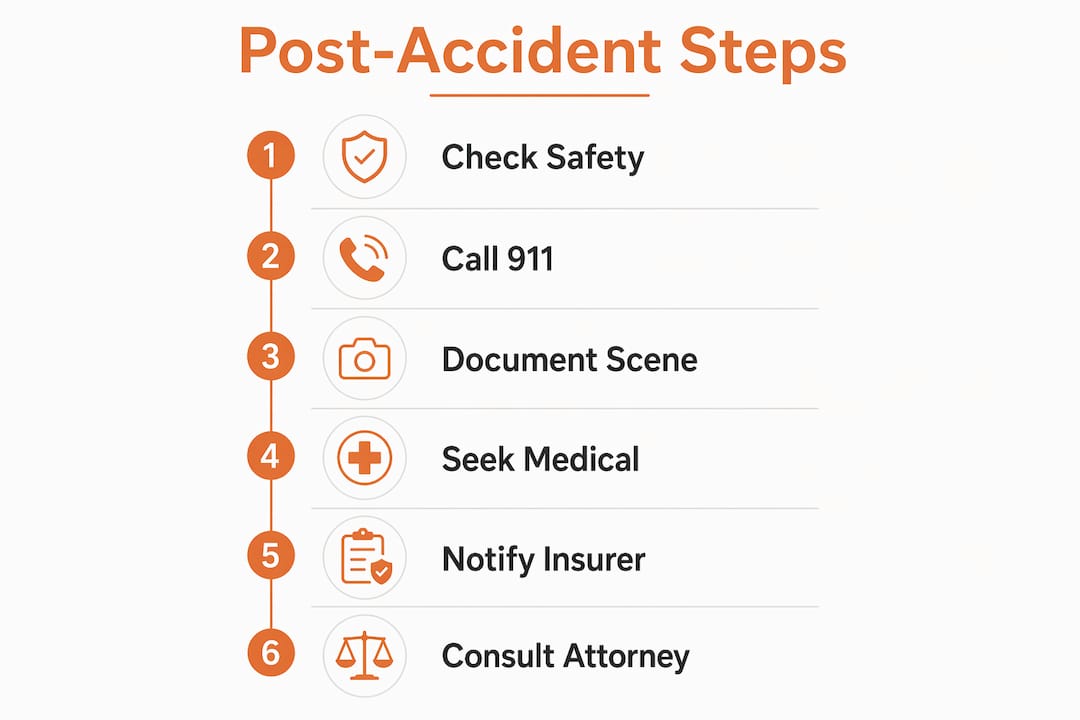
When you call your insurer, stick to the facts. Describe what happened without speculating about fault or assigning blame. The adjuster’s job is to minimize the payout. Your job is to provide accurate information without giving them material to use against you.
Watch out for these common insurance pitfalls:
- Recorded statements to the at-fault driver’s insurer. Recorded statements often contain leading questions designed to minimize your injuries or shift blame. Do not give one without speaking to an attorney first.
- Quick settlement offers. A fast offer almost always means the insurer knows your claim is worth more.
- Signing medical authorizations. Broad medical releases give adjusters access to your entire health history, not just the accident-related records.
- Accepting a check without legal review. Cashing a settlement check typically releases all future claims, even if new injuries emerge later.
Pro Tip: Before speaking with any adjuster from the at-fault driver’s insurance company, read Oldfllaw’s guide on dealing with insurance adjusters. It explains exactly what adjusters are trained to ask and how to respond.
Managing vehicle repairs and related expenses
You have the right to choose your own repair shop. Insurance companies cannot force you to use their preferred vendors. Using an independent shop you trust helps protect your vehicle’s safety and resale value.
Follow this process to protect yourself financially:
- Get at least two itemized written repair estimates that break down parts and labor separately.
- Document all repair-related costs, including towing, storage fees, and rental car expenses.
- Ask your insurer about rental car coverage and coordinate the rental before your vehicle goes into the shop.
- Request that the shop retain any damaged parts removed during repair. Those parts can support your claim if there is a dispute about the extent of damage.
- Photograph the damage before any repairs begin and again after the vehicle is returned to you.
| Expense type | Why it matters |
|---|---|
| Repair estimates | Establishes the documented cost of damage for your claim |
| Rental car costs | Recoverable from the at-fault driver’s insurer in most cases |
| Towing and storage | Often overlooked but fully reimbursable with receipts |
| Retained damaged parts | Physical evidence for repair disputes or legal proceedings |
Keep every receipt. Maintain a detailed log of all accident-related expenses, including transportation to medical appointments and any out-of-pocket costs for minor treatments. Every documented expense adds to the total value of your claim.
What are the legal deadlines and when should you consult an attorney?
Florida’s statute of limitations for personal injury claims is generally 4 years from the accident date. Missing that deadline means losing your right to compensation permanently, regardless of how strong your case is. Florida’s personal injury filing deadline is one of the most important facts any accident victim needs to know.
Four years sounds like plenty of time. It is not. Building a strong claim takes months. Evidence disappears. Witnesses move or forget details. Medical treatment needs to reach a point of maximum medical improvement before you can accurately calculate damages. Starting the legal process early gives your attorney time to gather evidence, negotiate effectively, and prepare for litigation if needed.
Claimants with attorney representation consistently receive higher settlements than those who handle claims alone. According to Injury Research Council data, represented claimants receive settlements roughly 3.5 times larger than unrepresented claimants. That gap reflects the difference between knowing what a claim is worth and accepting whatever the insurer offers.
Start a claim diary on the day of the accident. Record every phone call, every medical appointment, every expense, and every conversation with an insurer. Note the date, time, and name of every person you speak with. This diary becomes your most organized piece of evidence if the case goes to litigation.
If you receive a settlement offer, do not accept it without legal review. Read Oldfllaw’s breakdown of what to do with a settlement offer before signing anything.
Key Takeaways
After a car accident that is not your fault in Florida, your recovery depends on fast action, thorough documentation, and understanding your legal rights before the insurer shapes the narrative.
| Point | Details |
|---|---|
| Document the scene immediately | Photograph vehicles, road conditions, and injuries before anything is moved or cleaned up. |
| Seek medical care within 72 hours | Adrenaline masks injuries; delayed treatment gives insurers grounds to deny or reduce your claim. |
| Report to your own insurer promptly | Prompt reporting enables subrogation and protects you against counter-claims from the at-fault driver. |
| Never give a recorded statement alone | Recorded statements to the at-fault insurer can be used to minimize your injuries or shift blame. |
| Know Florida’s 4-year deadline | Missing the statute of limitations permanently forfeits your right to compensation. |
What I’ve learned after years of watching accident claims go wrong
I have seen clients walk into our office months after an accident with a thin folder of documents and a settlement offer they almost signed. The pattern is almost always the same. They felt fine at the scene, they figured the other driver’s insurance would handle everything, and they did not think they needed legal help for what seemed like a straightforward situation.
The uncomfortable truth is that insurance adjusters are trained negotiators working for a company with a financial interest in paying you as little as possible. They are not your advocates. The moment you report a claim, the insurer begins building a file designed to limit its exposure. Every gap in your medical treatment, every vague statement you make, and every delay in documentation becomes a tool they use against you.
What actually works is treating your claim like a business transaction from the first minute. Document everything. See a doctor the same day or the next morning. Keep receipts for every expense. Do not speak to the at-fault driver’s insurer without understanding exactly what you are agreeing to. And do not assume a quick settlement offer is fair just because it arrives fast.
The clients who recover the most are the ones who stayed organized, sought medical care early, and got legal advice before accepting anything. That combination is not complicated. It just requires knowing what the process actually looks like before you are in the middle of it.
— Gordon
Oldfllaw is ready to help with your accident claim
If you were injured in a car accident that was not your fault, you deserve focused legal attention, not a generic intake form.
Oldfllaw, the team at Oldham Law PLLC in Pinellas Park, represents accident victims across St. Petersburg, Pinellas County, and the greater Tampa Bay area. The attorneys at Oldfllaw bring prior experience as prosecutors and insurance defense lawyers, which means they know exactly how insurers build their cases and how to counter those strategies. Whether you need help understanding your rights, negotiating with an adjuster, or filing a personal injury claim, Oldfllaw provides personalized legal guidance tailored to your specific situation. Contact Oldfllaw today for a case evaluation.
FAQ
What should I do immediately after a car accident?
Call 911, check for injuries, document the scene with photos, and exchange insurance information with the other driver. Never admit fault or apologize, even casually.
How long do I have to file a claim in Florida?
Florida’s statute of limitations for personal injury claims is generally 4 years from the accident date. Missing this deadline permanently eliminates your right to compensation.
Should I give a recorded statement to the other driver’s insurer?
No. Recorded statements to the at-fault driver’s insurer can contain leading questions that weaken your claim. Consult an attorney before providing any recorded statement.
What if I feel fine after the accident?
See a doctor within 24–72 hours regardless. Adrenaline can mask injuries like whiplash or internal trauma, and delayed treatment gives insurers grounds to dispute your claim.
Can I choose my own repair shop after an accident?
Yes. Insurance companies cannot force you to use their preferred vendors. Choose a shop you trust and obtain itemized written estimates before any repairs begin.
