
What Does Warrant Recall Mean in Florida?

TL;DR:
- A warrant recall is a court order that cancels an active arrest warrant and removes law enforcement’s authority to detain you based on it. It does not dismiss the charges or end your case, only removes the immediate arrest risk; the legal process continues.
A warrant recall is defined as a formal court order that cancels an active arrest or bench warrant, removing law enforcement’s legal authority to detain you under that specific warrant. If you are searching for what does warrant recall mean, the short answer is this: the court has officially withdrawn the warrant, and police can no longer arrest you based on it. That said, a recall does not end your legal case. Understanding this distinction is the most important thing you can take from this article, and Oldham Law PLLC has guided many clients through exactly this situation in Pinellas County and across the Tampa Bay area.
What does warrant recall mean, and how is it different from a quash?
A warrant recall is the court’s formal withdrawal of a previously issued warrant. Once recalled, the warrant is removed from law enforcement databases like the National Crime Information Center (NCIC), and officers no longer have authorization to arrest you based on that order. Think of it as the court pressing “undo” on the arrest instruction, not on the case itself.

A Motion to Quash is a different tool entirely. A quash challenges warrant validity by arguing the warrant was defective from the start, such as cases involving mistaken identity or a lack of probable cause. A recall, by contrast, withdraws a valid warrant based on discretionary or procedural factors. Quash motions are harder to win because they require proof of a legal defect, not just a good reason for the court to reverse course.
Warrants do not expire on their own. Florida law tolls the statute of limitations while a defendant is out of state or otherwise unreachable, meaning an old warrant stays fully active and enforceable regardless of how much time has passed. Moving to another county or another state does not cancel a Florida warrant.
How does the warrant recall process work in Florida?
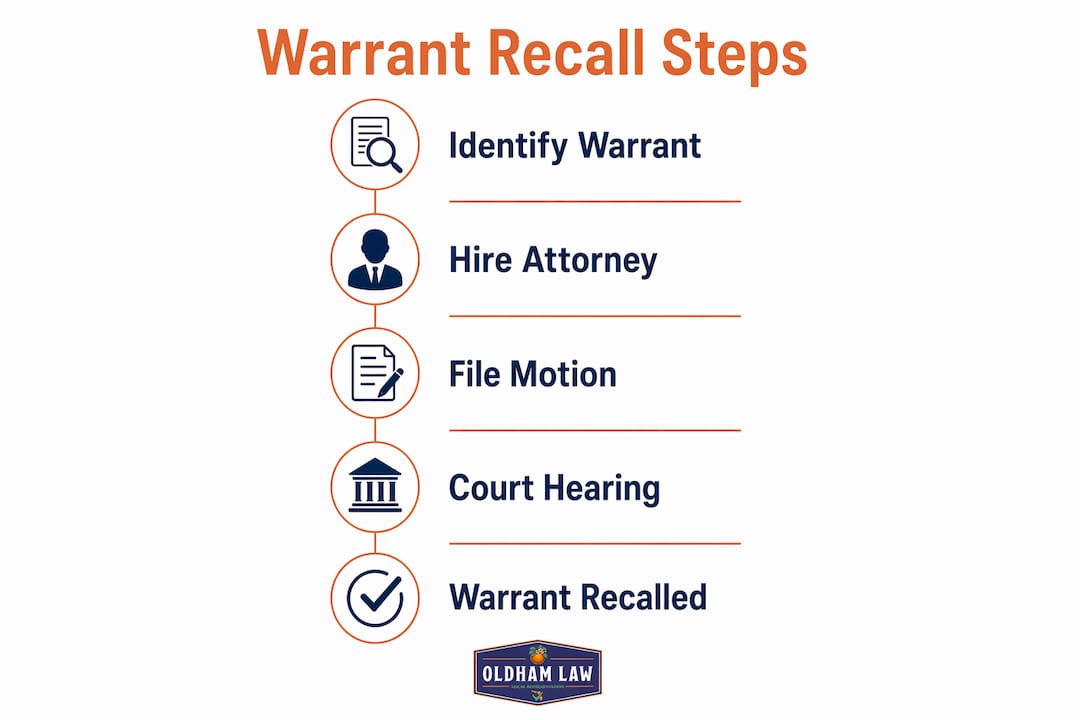
The recall process begins with your criminal defense attorney filing a formal motion with the court. The most common filing is called a “Motion to Recall Capias” or a “Motion to Withdraw Warrant.” A capias is the technical term for a court-issued arrest warrant, most often issued after a failure to appear (FTA) at a scheduled hearing.
Courts in Florida consider several factors before granting a recall:
- Reason for the missed appearance. Judges are more likely to grant recall motions when defendants provide documented evidence of good cause, such as a medical emergency, a family crisis, or proof that the defendant never received proper notice of the court date.
- Type of charge. Misdemeanor warrant recalls move faster and often do not require the defendant to appear in person. Felony recalls almost always require a personal court appearance and may come with bail conditions attached.
- Criminal history and flight risk. A judge with discretion will weigh whether the defendant has a pattern of missing court dates or whether this appears to be an isolated, explainable incident.
- Voluntary surrender. Defendants who surrender proactively with an attorney signal to the court that they are not flight risks. This posture consistently improves bail outcomes and the judge’s willingness to grant the recall.
Pro Tip: Never contact the court clerk directly to try to resolve a warrant. Court clerks have no authority to recall warrants, and calling them can reveal your location to law enforcement before your attorney has had a chance to file a motion.
The success rate for recall motions is higher when the absence was genuinely inadvertent and backed by documentation. Your attorney’s job is to present that narrative clearly and file before you are picked up.
What are the legal implications of having a warrant recalled?
A recalled warrant removes the immediate risk of arrest. That is real and meaningful relief. But it does not dismiss your case, erase your charges, or cancel any fines, probation terms, or other obligations you had before the warrant was issued.
A warrant recall is procedural, not substantive. The court resets the clock on your case, but the underlying charges remain fully active and must still be resolved through the legal process.
Courts typically set new hearing dates after recalling a warrant and may impose new conditions, such as a bail requirement or check-in supervision, to make sure you appear going forward. Missing those new dates will result in another warrant being issued, often with stricter conditions the second time around.
Many defendants misunderstand that a warrant recall stops prosecution entirely. This is one of the most common and costly misconceptions in Florida criminal cases. The recall simply gives you a structured path back into the legal process rather than having that process catch up to you through an arrest.
Key legal realities to keep in mind after a recall:
- Your underlying charges remain active and must be addressed in court.
- Any probation violations that triggered the warrant still need to be resolved.
- New bail conditions set at the recall hearing are legally binding.
- A second failure to appear will almost certainly result in a new warrant with harsher terms.
- Fines and court costs do not disappear because a warrant was recalled.
How long does warrant recall take in Florida?
There is no fixed timeline for a warrant recall. The process depends on the court’s schedule, the type of charge, the reason the warrant was issued, and how quickly your attorney can file and argue the motion.
Misdemeanor recalls are generally faster. In many Florida counties, a misdemeanor recall motion can be heard within days of filing, and the defendant may not need to appear in person. Felony recalls take longer because early legal intervention is needed to coordinate a voluntary surrender, prepare documentation, and schedule a hearing where the defendant must be present.
Voluntary surrender consistently speeds up the process. When your attorney arranges for you to appear before the court rather than waiting to be arrested, the court treats the matter with more urgency and goodwill. An unplanned arrest, by contrast, means you go through booking, potentially sit in custody over a weekend, and face the judge without preparation.
Pro Tip: If you know or suspect you have an outstanding warrant in Florida, contact a defense attorney before doing anything else. Early action gives your attorney time to gather documentation, file the motion, and arrange surrender on your terms rather than law enforcement’s.
The difference between acting in week one versus waiting months can be significant. Courts remember defendants who addressed warrants promptly, and that impression carries weight when conditions and bail are being set.
What should you do after your warrant is recalled?
A recalled warrant is the beginning of resolution, not the end. Your next steps determine whether this situation closes cleanly or spirals into a second warrant and worse consequences.
- Attend every rescheduled court date. Missing a hearing after a recall is treated as a serious breach of trust. A second warrant is nearly automatic, and judges are far less sympathetic the second time.
- Work with your defense attorney on the underlying charges. The recall bought you time and freedom from immediate arrest. Use that time to build your defense, negotiate a resolution, or address the violation that triggered the warrant.
- Keep all court documents. Store copies of the recall order, any new bail conditions, and your rescheduled hearing notices. If a question arises about your status, you need documentation in hand.
- Do not assume probation or fines are canceled. A recall does not wipe out financial obligations or supervision requirements. Contact your probation officer if applicable and confirm your status in writing.
- Understand what triggered the warrant. Whether it was a failure to appear, a probation violation, or a new charge, that underlying issue still needs a resolution. Ignoring it means the cycle repeats.
The goal after a recall is to get your case back on a predictable track. That requires consistent communication with your attorney and strict compliance with every court order that follows.
Key Takeaways
A warrant recall cancels the arrest order but leaves the underlying case fully intact, making prompt legal action and court compliance the only path to genuine resolution.
| Point | Details |
|---|---|
| Recall definition | A court order that formally cancels a warrant and removes it from law enforcement databases like NCIC. |
| Recall vs. quash | A recall withdraws a valid warrant; a quash challenges whether the warrant was legally valid in the first place. |
| Charges remain active | Recall removes arrest risk but does not dismiss charges, fines, probation, or other legal obligations. |
| Timeline varies | Misdemeanor recalls can resolve in days; felony recalls require a court appearance and take longer. |
| Act early | Voluntary surrender with attorney representation improves bail outcomes and speeds the recall process. |
What experience with warrant recalls has taught us
The clients who handle warrant recalls best are the ones who treat the recall as a tool, not a finish line. Over the years at Oldham Law PLLC, we have seen a consistent pattern: defendants who move quickly, bring documentation, and appear voluntarily get far better outcomes than those who wait and hope the problem fades.
One thing that surprises many clients is how much judicial discretion matters in these hearings. A judge who sees a defendant take responsibility, show up prepared, and provide a credible explanation for a missed court date is a very different audience than a judge who sees someone dragged in after an arrest. The facts of the case matter, but so does the impression you make.
We also see clients make the mistake of calling the courthouse directly to ask about their warrant status. Court clerks cannot recall warrants. They also cannot give legal advice. And in some situations, that call can flag your location or alert the system to your inquiry in ways that complicate your attorney’s strategy. The right first call is always to a defense attorney.
Judges in Pinellas County and across the Tampa Bay area consistently respond well to defendants who document their reason for missing court. A hospital record, a death certificate for a family emergency, or a written statement from an employer can be the difference between a recall being granted and denied. If you have a legitimate reason, preserve the evidence and bring it to your attorney immediately.
— Oldham Law PLLC
Facing a warrant in Florida? Oldham Law PLLC can help
Dealing with an outstanding warrant is stressful, but it is a situation that experienced legal representation can address directly and efficiently.
Oldham Law PLLC handles warrant recall motions, failure to appear cases, and criminal defense matters throughout Pinellas County, St. Petersburg, and the greater Tampa Bay area. The firm’s attorneys bring prior experience as prosecutors, which means they understand exactly how the other side evaluates these cases. That perspective shapes every motion filed and every negotiation conducted on your behalf. If you have an outstanding warrant or recently had one recalled and need guidance on your next steps, contact Oldham Law PLLC for a personalized case evaluation. Acting now protects your options.
FAQ
What does warrant recall mean in simple terms?
A warrant recall is a court order that officially cancels an active arrest or bench warrant, removing law enforcement’s authority to arrest you based on that warrant. The underlying case, however, remains open and must still be resolved.
Does a recalled warrant mean my charges are dropped?
No. A recalled warrant cancels the arrest order but does not dismiss the charges or any other legal obligations. The court will typically reschedule hearings and may impose new bail conditions.
What happens if I have an out-of-county warrant in Florida?
An out-of-county warrant remains active and enforceable statewide. Florida law tolls the statute of limitations during a defendant’s absence, so the warrant does not expire. You can be arrested in any Florida county, and a defense attorney can file a recall motion in the originating county on your behalf.
How do I get a warrant recalled in Florida?
A defense attorney files a formal motion, typically a Motion to Recall Capias, in the court that issued the warrant. Success depends on the reason for the missed appearance, the type of charge, and whether documented good cause exists. Voluntary surrender with counsel significantly improves the outcome.
Can I call the courthouse to get my warrant recalled?
No. Court clerks have no authority to recall warrants and cannot provide legal advice. Contacting the clerk directly may also reveal your location to law enforcement before your attorney has filed a protective motion.
