
Wet Reckless Florida: What It Means for Your DUI Case

TL;DR:
- A wet reckless in Florida is a plea that reduces a DUI charge to reckless driving with an alcohol-related notation. It offers lighter penalties and potential sealing but still impacts future charges and insurance rates. Legal advice is crucial before accepting such a plea to understand long-term consequences and local prosecutorial tendencies.
A “wet reckless” in Florida is a negotiated reduction of a DUI charge to reckless driving under Florida Statute §316.192, with a notation that alcohol or drugs contributed to the conduct. For most defendants, it is a better outcome than a DUI conviction — lighter mandatory penalties, no automatic license suspension, and a path to possible sealing. But it is not risk-free, and accepting one without understanding the tradeoffs can create serious problems down the road.
Two consequences you should know right now:
- Lighter sentencing than a DUI. A wet reckless carries lower statutory maximums, no mandatory ignition interlock requirement, and no mandatory minimum jail time for a first offense.
- Still an alcohol-related mark. That notation follows you. If you are ever charged with a DUI later, prosecutors can use a prior wet reckless to enhance your penalties within Florida’s statutory lookback windows.
Pro Tip: Before you accept any plea offer, talk to a Florida DUI attorney who knows your local courthouse. What prosecutors offer in Pinellas County can differ from what they offer in Hillsborough, and the terms you negotiate now affect your record for years.
What is a wet reckless under Florida law?
“Wet reckless” is not a separate crime in the Florida Statutes. It is a courtroom term for a reckless driving conviction under Fla. Stat. §316.192 that carries a notation indicating alcohol or a controlled substance was involved. The statute defines reckless driving as operating a vehicle “in willful or wanton disregard for the safety of persons or property.” That is the charge you plead to — the “wet” label simply signals to courts and licensing agencies that the underlying conduct was alcohol-related.
The statute also gives courts authority to direct defendants to a DUI program or substance abuse evaluation when alcohol or drugs contributed to the reckless behavior. That is why wet reckless pleas often come with conditions that look a lot like DUI probation, even though the conviction itself is technically for reckless driving.
Key statutory points:
- Fla. Stat. §316.192 governs all reckless driving convictions, wet or otherwise.
- The alcohol notation is recorded by the clerk and visible to courts, licensing boards, and insurers.
- Courts retain discretion on sentencing, treatment referrals, and probation conditions.
- Fleeing a law enforcement officer in a motor vehicle is reckless driving per se under the same statute.
How does a wet reckless differ from a DUI in Florida?
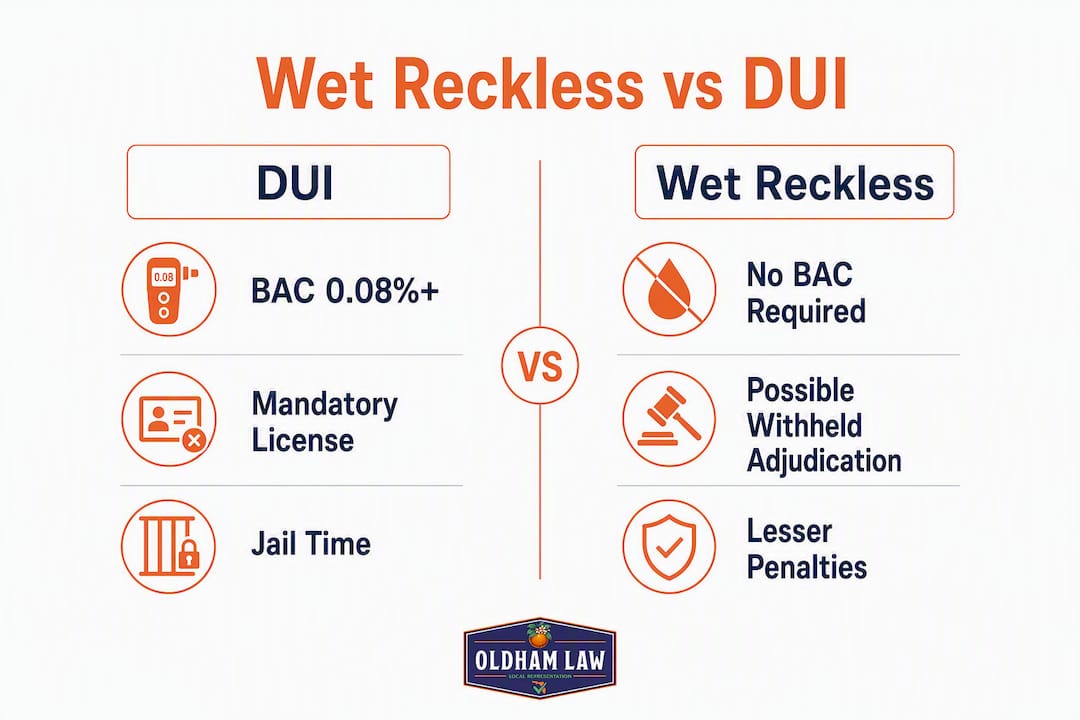
The practical gap between these two outcomes is significant, but it is narrower than most defendants expect. Understanding reckless driving vs DUI Florida comes down to three areas: what the State must prove, what the court must impose, and what follows you afterward.
What the State must prove:
- A DUI requires proof of impairment or a BAC of 0.08% or higher, tied to a lawful traffic stop and valid chemical testing.
- Reckless driving requires only proof of willful or wanton disregard for safety — a lower evidentiary bar with no BAC threshold.
What the court must impose:
- A first-offense DUI conviction triggers mandatory license revocation, potential ignition interlock, and mandatory DUI school.
- A wet reckless carries no mandatory license suspension and no mandatory interlock — though a judge can still order both as conditions of probation.
What follows you:
- A DUI conviction in Florida generally cannot be expunged or sealed.
- A wet reckless may be eligible for sealing if adjudication is withheld and you meet the statutory criteria.
- Both carry an alcohol-related notation that can enhance penalties on a future DUI charge.
Quick comparison:
| Factor | DUI Conviction | Wet Reckless |
|---|---|---|
| BAC threshold required | Yes (0.08%+) | No |
| Mandatory license suspension | Yes | No (discretionary) |
| Mandatory ignition interlock | Possible | No |
| Expungement/sealing eligible | Generally no | Possibly yes |
| Prior offense for future DUI | Yes | Yes |
What penalties should you expect from a wet reckless plea?
The baseline statutory penalties for reckless driving under §316.192 are:
- First conviction: Jail time and fines within the lower ranges specified by Florida law for reckless driving, or both.
- Second or subsequent conviction: Jail time and fines within the higher ranges allowed by statute for repeated reckless driving, or both.
Those numbers look manageable on paper. In practice, judges in Pinellas County and across Tampa Bay routinely layer on alcohol-specific conditions for wet reckless pleas that go well beyond the statutory baseline. Typical add-ons include:
- Substance abuse evaluation and any recommended treatment
- DUI school or equivalent alcohol education program
- Victim impact panel attendance
- Probation with random drug and alcohol testing
- Community service hours
If the reckless driving caused property damage, the charge becomes a first-degree misdemeanor. If it caused serious bodily injury — defined under the statute as a condition creating a substantial risk of death, serious disfigurement, or protracted loss of a bodily function — it becomes a third-degree felony. Those are entirely different sentencing conversations. Understanding probation conditions before you agree to them is as important as understanding the conviction itself.

When do prosecutors offer a wet reckless plea?
Prosecutors do not hand out wet reckless reductions automatically. They offer them when they see evidentiary vulnerabilities that make a DUI conviction uncertain at trial. The weaker the State’s case, the more leverage your attorney has to negotiate a reduction.
Common factors that create that leverage:
- Borderline BAC. A result just above 0.08% is far easier to challenge than a 0.15%.
- Late or unreliable testing. If the breath or blood test was administered well after the stop, rising-BAC arguments become viable.
- Equipment maintenance gaps. Breathalyzer calibration logs and officer training records can reveal procedural failures.
- Weak field sobriety documentation. Poorly recorded or improperly administered field sobriety tests undercut the impairment narrative.
- Questionable probable cause for the stop. If the stop itself is legally vulnerable, everything that follows may be suppressible.
- No crash, no injury, no witnesses. Cases without aggravating facts are easier to reduce.
Your attorney should gather police reports, dash-cam and body-cam video, breathalyzer calibration and maintenance records, and any medical records that explain symptoms that could mimic impairment. That evidence package is what turns a plea offer from a take-it-or-leave-it into a real negotiation.
Pro Tip: Ask the prosecutor whether adjudication will be withheld. That single term determines whether a wet reckless plea might later be eligible for sealing — and it is often negotiable at the plea stage, not after.
What are the collateral consequences of a wet reckless?
The sentence is only part of the picture. The consequences that follow a wet reckless conviction can affect your finances, career, and freedom for years.
- Auto insurance. An alcohol-related conviction almost always triggers a rate increase. Insurers treat a wet reckless as a significant risk flag, even though it is not a DUI.
- Employment and background checks. A reckless driving conviction with an alcohol notation appears on criminal background checks. Many employers, particularly in healthcare, education, and transportation, will see it.
- Professional licenses. Nurses, teachers, CDL holders, and other licensed professionals face licensing board scrutiny after any alcohol-related conviction. Check your industry’s rules before you plead.
- Future DUI enhancement. This is the most underestimated risk. A wet reckless is frequently treated as a prior alcohol-related offense for sentencing purposes if you are later charged with a DUI. That can trigger mandatory minimums and longer lookback periods.
On the positive side, sealing eligibility is a real possibility if adjudication is withheld on your wet reckless and you satisfy the criteria under F.S. 943.059. A sealed record is not visible to most employers or landlords. A DUI conviction, by contrast, is generally ineligible for sealing or expungement under Florida law. That distinction alone is often the strongest argument for pursuing a wet reckless reduction.
What should you do right now after a DUI arrest?
Time matters after a DUI stop in Florida. Administrative license suspension can begin within days, and evidence degrades quickly. Here is what to prioritize:
- Preserve video. Request dash-cam and body-cam footage from the arresting agency before it is overwritten.
- Request calibration records. Breathalyzer maintenance and calibration logs are public records and can reveal gaps that challenge test results.
- Collect witness information. Anyone who observed your driving or your condition before the stop could be relevant.
- Save medical records. Conditions like acid reflux, diabetes, or certain medications can affect breath test results and mimic impairment signs.
- Request a formal review hearing. You typically have ten days from the date of arrest to request a hearing to challenge an administrative license suspension.
Before you accept any plea, ask your attorney these specific questions:
- Will adjudication be withheld?
- Will this plea count as a prior offense if I am charged with a DUI later?
- Can this conviction be sealed, and when?
- What probation conditions will be required, and are any of them negotiable?
- What is the likely impact on my professional license or CDL?
Pro Tip: Local court culture in Pinellas County and Tampa Bay genuinely affects what prosecutors will offer and what judges will accept. An attorney who regularly appears in those courtrooms knows which arguments land and which ones do not — that knowledge is not something you can replicate by reading statutes alone. Oldham Law PLLC handles DUI defense in Pinellas Park and St. Petersburg and can assess your specific facts before you commit to any plea.
Key Takeaways
A wet reckless in Florida is generally better than a DUI conviction, but the alcohol notation, future-DUI enhancement risk, and probation conditions make it a decision that requires careful legal review before you sign anything.

| Point | Details |
|---|---|
| Statutory basis | Reckless driving under Fla. Stat. §316.192 with an alcohol/drug notation — not a separate crime. |
| Baseline penalties | Up to 90 days in jail and a fine of $25–$500 for a first offense, plus common alcohol-specific conditions. |
| Key advantage over DUI | No mandatory license suspension or ignition interlock; possible sealing eligibility if adjudication is withheld. |
| Biggest ongoing risk | A wet reckless can be used as a prior alcohol-related offense to enhance penalties on a future DUI charge. |
| Recommended next step | Oldham Law PLLC offers DUI defense in Pinellas County and Tampa Bay — consult before accepting any plea. |
A local attorney’s perspective on wet reckless pleas in Pinellas County
Most defendants who come to us after a DUI arrest have already heard the phrase “wet reckless” from a friend or a quick internet search. What they often do not realize is how much the outcome depends on factors that have nothing to do with the statute — and everything to do with the specific courthouse, the specific prosecutor, and the specific facts of the stop.
In Pinellas County, prosecutorial discretion on wet reckless reductions is real, but it is not uniform. Some prosecutors will negotiate readily when the BAC is borderline or the stop has procedural issues. Others will hold firm unless defense counsel can present a compelling evidentiary challenge. The difference between those two outcomes often comes down to whether your attorney has the relationships and the courtroom credibility to make the argument stick.
What we also see regularly is defendants who accept a wet reckless without negotiating the probation terms. Judges in this area commonly impose substance evaluations, DUI school, victim impact panels, and random testing as conditions. Those conditions are sometimes negotiable at the plea stage — but only if your attorney raises them before the plea is entered, not after.
The prior-prosecutor experience our attorneys bring to criminal defense matters here. Understanding how the State builds its case, what evidence it values, and where it tends to overreach gives us a clearer picture of where the leverage actually is. That perspective shapes how we approach every plea negotiation, including wet reckless reductions.
Facing a DUI charge in Pinellas County? Here is how Oldham Law PLLC can help
Knowing the law is one thing. Having an attorney who can apply it in the specific courtroom where your case will be heard is another. Oldham Law PLLC provides DUI defense for clients in Pinellas Park, St. Petersburg, and throughout Tampa Bay, with a focus on protecting your record and your future.

The firm’s attorneys bring prior prosecutor experience to every criminal defense case, which means they understand how the State evaluates evidence and where cases are most vulnerable to challenge. For defendants facing a DUI charge, that experience directly informs whether a wet reckless reduction is achievable, what conditions are negotiable, and whether sealing eligibility can be preserved. Oldham Law PLLC handles the full scope of criminal defense in Pinellas County, from the initial arrest through plea negotiations and, when necessary, trial. Contact the firm to schedule a consultation and get a clear-eyed assessment of your case before you make any decisions.
Useful sources and further reading
Bring these to your attorney meeting for faster case review:
- Florida Statute §316.192 — Reckless Driving (Florida Senate)
- Florida Statute §316.192 — Full Text (Online Sunshine)
- What is a wet reckless charge? — TicketShield
- Expunge DUI Florida — Legal Eagles
- What is reckless driving in Florida? — Oldham Law PLLC
- How to fight a DUI charge — Oldham Law PLLC
This article is general legal information, not legal advice for your specific situation. Florida law changes, and your case facts matter. Consult a qualified Florida attorney to understand how the current rules apply to you.
FAQ
Is a wet reckless still considered a DUI in Florida?
No. A wet reckless is a conviction for reckless driving under Fla. Stat. §316.192, not a DUI. However, the alcohol notation means it can be treated as a prior alcohol-related offense for sentencing purposes if you face a DUI charge later.
How serious is a wet reckless in Florida?
It is a misdemeanor with jail time and fines within Florida’s statutory ranges for a first offense, plus likely alcohol-related probation conditions. It is less serious than a DUI conviction, but the collateral consequences — insurance, licensing, and future-DUI enhancement risk — are real.
Can a wet reckless be expunged in Florida?
Possibly. If adjudication is withheld and you meet the eligibility requirements under F.S. 943.059, a wet reckless may be eligible for sealing. A standard DUI conviction is generally ineligible for expungement or sealing under Florida law.
Is a wet reckless better than a DUI?
For most defendants, yes. It avoids mandatory license suspension, mandatory ignition interlock, and the permanent bar on expungement that comes with a DUI conviction. The tradeoff is that the alcohol notation still follows you and can enhance future DUI penalties.
How do I know if I can get a wet reckless offer in Florida?
Prosecutors typically offer reductions when the evidence has vulnerabilities: a borderline BAC, late or unreliable testing, a questionable traffic stop, or weak field sobriety documentation. An experienced Florida DUI attorney can evaluate your specific facts and advise whether a reduction is realistic in your jurisdiction.
