
Vehicular Manslaughter in Florida: What Defendants Need to Know

TL;DR:
- Florida law does not recognize a “vehicular manslaughter” statute; instead, it governs deaths caused by reckless driving under Florida Statute §782.071. The charge requires proof that a driver operated a vehicle with wanton disregard for safety, directly causing death or injury, with severity depending on whether the driver knew about the crash or had prior related convictions. Penalties can reach up to 30 years in prison if the driver leaves the scene or has prior offenses, with specialized defenses focusing on challenging recklessness or causation.
Florida does not have a statute called “vehicular manslaughter.” The offense most people mean when they use that term is vehicular homicide, governed by Florida Statute §782.071. That statute defines the crime as the killing of a human being, or an unborn child by injury to the mother, caused by operating a motor vehicle in a reckless manner likely to cause death or great bodily harm. Three core elements must be present:
- The defendant operated a motor vehicle.
- That operation was reckless, meaning willful or wanton disregard for the safety of others.
- The reckless operation caused the death of a person (or an unborn child).
Understanding the correct statutory label matters immediately, because the charge you face, the evidence the State must gather, and the penalties you could receive all flow from §782.071, not from any generic “manslaughter” framework. If impairment is also alleged, a separate statute, Florida Statute §316.193, governs DUI manslaughter, and the two charges carry different proof requirements and different sentencing consequences.
What Florida Statute §782.071 actually says about fatal crashes
The operative language of §782.071 is precise: the killing must be caused by the operation of a motor vehicle in a reckless manner likely to cause death or great bodily harm. That phrase does a lot of work. It means a driver who makes a momentary mistake, runs a red light out of inattention, or misjudges a gap in traffic has not necessarily committed vehicular homicide. The State must prove something more than ordinary carelessness.
The statute classifies the offense in two degrees:
(a) Second-degree felony — the baseline charge, punishable under Florida Statutes §775.082, §775.083, and §775.084.
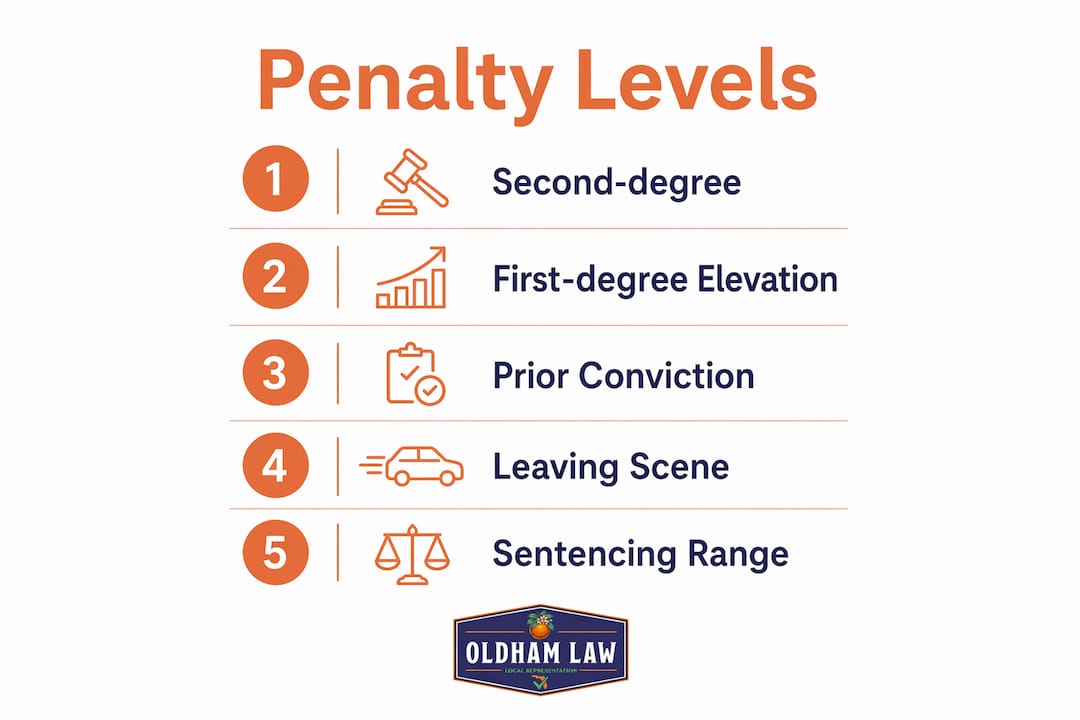
(b) First-degree felony — elevated automatically when, at the time of the accident, the defendant knew or should have known the accident occurred and failed to give information and render aid as required by §316.062. The statute is explicit that the defendant does not need to have known the accident caused injury or death; awareness that a crash happened is enough to trigger the duty.
© First-degree felony — also elevated when the defendant has a prior conviction under §782.071, §316.193(3)©3., §327.35(3)(a)3.c., or §782.072.
The statute also cross-references §768.19, which preserves a civil right of action for wrongful death in every case covered by §782.071. That civil exposure runs parallel to the criminal case and is not extinguished by a criminal acquittal or conviction.
How vehicular homicide differs from DUI manslaughter and culpable negligence manslaughter
These three charges are closely related but legally distinct. Prosecutors evaluate all three when a death follows a crash, and understanding the differences tells you a great deal about what evidence will matter most in your case.
Required mental state and proof
- Vehicular homicide (§782.071): Recklessness, defined as willful or wanton disregard for safety. No proof of impairment required. The Florida Bar’s analysis confirms that this standard is higher than ordinary negligence but does not require intent to harm.
- DUI manslaughter (§316.193): Proof that the driver was under the influence to the extent normal faculties were impaired, or had an unlawful blood or breath alcohol level, and that impairment caused the death. Recklessness is not required; impairment is the key element.
- Manslaughter by culpable negligence: Proof of culpable negligence, a conscious disregard for human life that falls somewhere between ordinary negligence and recklessness. This charge can arise from driving conduct that is grossly careless but not necessarily impaired or classically reckless.
Penalty comparison
| Charge | Classification | Max Prison | Mandatory Minimum |
|---|---|---|---|
| Vehicular homicide | 2nd-degree felony | up to 15 years in prison | None (baseline) |
| Vehicular homicide + leaving scene | 1st-degree felony | up to 30 years in prison | None statutory, but courts treat it seriously |
| DUI manslaughter | 2nd-degree felony | up to 15 years in prison | a mandatory minimum prison term (if BAC ≥ 0.15 or minor in vehicle, higher exposure applies) |
| DUI manslaughter (prior DUI conviction) | 1st-degree felony | up to 30 years in prison | Varies |
Three realistic scenarios
High-speed street racing, no alcohol: Two drivers race on a Tampa Bay highway at double the speed limit. One loses control and kills a pedestrian. No toxicology evidence exists. Prosecutors charge vehicular homicide under §782.071 because the recklessness is clear from speed and conduct alone.
Impaired driver, moderate speed: A driver with a blood alcohol level above the legal limit runs a stop sign and kills another motorist. Prosecutors charge DUI manslaughter under §316.193 because impairment is the central provable fact, and the mandatory minimum sentencing structure makes that charge strategically attractive to the State.
Distracted driver, no impairment: A driver texting at highway speed rear-ends a stopped vehicle and causes a fatality. Whether this rises to recklessness or stays at culpable negligence is a judgment call that defense counsel can contest, and that distinction can be the difference between a felony conviction and a civil case.
What the prosecution must prove in a vehicular death case
The State carries the burden of proof beyond a reasonable doubt on every element. Here is how that breaks down in a §782.071 case:
Operation of a motor vehicle. The defendant was driving. This sounds simple, but it matters when there is a dispute about who was behind the wheel, or when the vehicle was in motion in a parking lot or on private property.
Reckless operation. The driving conduct showed willful or wanton disregard for safety. Courts have consistently held that recklessness requires more than negligence, which is why not every fatal crash becomes a criminal case.
Likelihood of death or great bodily harm. The reckless conduct must have been the kind that a reasonable person would recognize as likely to cause death or serious injury, not just property damage.
Causation. The reckless operation must have directly caused the death. If another driver’s conduct, a road defect, or a sudden mechanical failure was the actual cause, the causal link breaks.
Evidence prosecutors typically use:
- Accident reconstruction reports from law enforcement or private experts
- Event data recorder (EDR) downloads showing speed, braking, and throttle inputs
- Dashcam and traffic camera footage
- 911 call audio and witness statements
- Cellphone records showing distraction or communication at the time of the crash
- Toxicology reports when impairment is alleged
- Police crash reports and scene photographs
Prosecutors sometimes charge both DUI manslaughter and vehicular homicide as alternative theories early in a case. Florida case law has generally applied a “one death/one conviction” rule, meaning a defendant is not punished under both statutes for the same death, but charging alternative counts while investigations are pending is standard practice.
Penalties and sentencing ranges you should expect
The sentencing framework under §782.071 is set by cross-reference to §775.082 (prison terms), §775.083 (fines), and §775.084 (habitual offender enhancements).

| Offense | Classification | Max Prison | Max Fine |
|---|---|---|---|
| Vehicular homicide | 2nd-degree felony | up to 15 years in prison | up to $10,000 |
| Vehicular homicide + failure to stop/render aid | 1st-degree felony | up to 30 years in prison | up to $10,000 |
| Vehicular homicide + prior qualifying conviction | 1st-degree felony | up to 30 years in prison | up to $10,000 |
| DUI manslaughter | 2nd-degree felony | up to 15 years in prison | up to $10,000 |
Common sentence enhancements:
- Leaving the scene is the single most dangerous enhancement. Under §782.071(1)(b), if you knew or should have known a crash occurred and you drove away without stopping to render aid, the charge automatically becomes a first-degree felony. You do not need to have known anyone was injured. This is covered in detail in Oldham Law PLLC’s guide to Florida hit-and-run charges.
- Prior convictions under §782.071, §316.193(3)©3., §327.35(3)(a)3.c., or §782.072 also elevate the charge to a first-degree felony.
- Habitual offender status under §775.084 can extend prison exposure beyond the standard maximums.
Collateral consequences beyond prison:
- Permanent driver’s license revocation
- Court-ordered restitution to the victim’s family
- Up to community service hours in a trauma center or hospital that regularly receives vehicle-accident victims, supervised by a registered nurse, emergency room physician, or emergency medical technician
- Civil judgment exposure under §768.19 (wrongful death)
What defenses actually work in vehicular homicide cases
Defense strategy in a §782.071 case almost always centers on one of two targets: the recklessness standard or the causal chain. Proving only ordinary negligence, rather than willful or wanton disregard, frequently defeats the charge entirely.
Primary defense avenues:
- Challenge recklessness, not just fault. Show that the driving conduct, however tragic in outcome, was careless rather than reckless. A single lane departure at moderate speed, for example, may not meet the willful-or-wanton threshold.
- Attack causation. If another driver’s sudden lane change, a road defect, or a tire blowout was the proximate cause of the crash, the causal link between your client’s driving and the death is broken.
- Dispute who was driving. In some cases, the identity of the operator is genuinely contested. Eyewitness accounts and physical evidence placement matter here.
- Suppress illegally obtained evidence. If the traffic stop, blood draw, or vehicle search violated Fourth Amendment or Florida constitutional protections, a suppression motion can remove key evidence from the State’s case.
- Unavoidable medical emergency. Florida recognizes excusable homicide under §782.03 when a death results from an accident the defendant could not have avoided. A sudden cardiac event or a seizure with no prior warning can support this defense.
- Challenge toxicology chain of custody. In impairment-based cases, errors in blood draw procedures, storage, or lab analysis can undermine the State’s toxicology evidence.
Defense counsel will typically deploy several investigative tools: independent forensic crash reconstruction, cellphone and telematics data analysis, toxicology chain-of-custody review, video analysis, and witness credibility assessments.
Pro Tip: Event data recorders capture speed, throttle position, braking, and steering inputs in the seconds before a crash. Request an independent EDR download immediately — data can be overwritten after repairs or subsequent ignition cycles. An independent reconstruction expert who reviews that data before the State’s expert does can fundamentally change the narrative of what happened.
How a vehicular death case moves through Florida’s courts
Understanding the process helps you prepare and avoid costly mistakes at each stage.

Investigation phase. After a fatal crash, law enforcement begins a criminal investigation that runs parallel to any insurance investigation. Toxicology results, EDR downloads, and reconstruction reports often take weeks or months. You may not be arrested immediately, but you are likely under investigation from the moment the crash is reported.
Charging decision. The State Attorney’s Office reviews the investigative file and decides whether to file charges and under which statute. This is the window where early defense engagement, including retaining your own reconstruction expert, can influence what the State sees and how it evaluates the case.
Initial appearance and arraignment. If arrested, you appear before a judge within 24 hours for a bond determination. Arraignment follows, where formal charges are read and a plea is entered. Most defendants enter a not-guilty plea at arraignment to preserve all options.
Discovery and pretrial motions. Both sides exchange evidence. Defense counsel files motions to suppress, motions in limine, and any constitutional challenges. This phase is where the quality of your attorney’s preparation shows most clearly.
Plea negotiations. The majority of felony cases resolve through plea agreements. In vehicular homicide cases, a negotiated plea to a lesser charge or a reduced sentence recommendation is often possible, particularly when the defense has developed strong evidence challenging recklessness or causation.
Trial. If no agreement is reached, the case goes to a jury. The State must prove every element beyond a reasonable doubt. Defense counsel presents its own reconstruction evidence, challenges the State’s witnesses, and argues the recklessness standard.
Sentencing and post-conviction. If convicted, sentencing follows Florida’s Criminal Punishment Code scoresheet, with the judge having discretion within statutory ranges. Post-conviction remedies include direct appeal, motions for new trial, and, in limited circumstances, post-conviction relief under Florida Rule of Criminal Procedure 3.850.
Preserve these records from day one: medical records, vehicle maintenance logs, phone records, photos of the scene and vehicles, and contact information for any witnesses.
How criminal charges interact with civil liability after a fatal crash
Criminal and civil cases run on separate tracks, and a resolution in one does not automatically determine the other.
Burden of proof distinction:
- Criminal case: The State must prove guilt beyond a reasonable doubt, the highest standard in law.
- Civil wrongful death case: The plaintiff’s family must prove liability by a preponderance of the evidence, meaning more likely than not. That is a significantly lower bar.
A criminal acquittal does not prevent a civil wrongful death suit. Conversely, a criminal conviction can be introduced as evidence in a civil case, though it does not automatically establish civil liability on every element.
Insurance considerations:
- Your liability insurer will conduct its own investigation. Cooperate carefully and only through counsel.
- Many auto policies contain exclusions for intentional acts; a recklessness finding sits in a gray area that insurers sometimes contest.
- Coverage limits may be far below the damages a wrongful death claim could produce, leaving personal assets exposed.
Florida’s wrongful death statute under §768.19 gives the victim’s family a right of action for all deaths described in §782.071, regardless of the criminal outcome. Notify your insurer promptly, preserve all records, and do not give recorded statements without counsel present.
Immediate steps to take if you’re under investigation or charged
Time matters more than most people realize in these cases. Here is what to do, and what to avoid.
Do:
- Contact a criminal defense attorney immediately, before speaking to anyone else.
- Preserve your phone, vehicle data, and any photos or video from the scene.
- Write down everything you remember about the crash while it is fresh, and share it only with your attorney.
- Collect contact information for any witnesses who were present.
- Follow all court orders, subpoenas, and bond conditions without exception.
Don’t:
- Speak to police, investigators, or insurance adjusters without your attorney present.
- Post anything about the crash on social media. Prosecutors routinely review social media accounts.
- Repair your vehicle until your attorney has authorized an independent inspection and EDR download.
- Discuss the case with friends or family in ways that could produce discoverable statements.
When you meet with an attorney for the first time, bring your driver’s license, insurance documents, any paperwork from law enforcement, and a written timeline of events. Ask specifically about the attorney’s experience with vehicular homicide and DUI manslaughter cases, their use of independent reconstruction experts, and their familiarity with the local court where your case will be heard.
How to choose a Florida criminal defense lawyer for a vehicular death charge
Not every criminal defense attorney has handled a vehicular homicide case. These cases require a specific skill set, and the stakes are too high to settle for general experience.
Questions to ask prospective attorneys:
- How many vehicular homicide or DUI manslaughter cases have you handled, and how many went to trial?
- Do you work with independent accident reconstruction experts, and who do you use?
- Are you familiar with the judges and prosecutors in the county where my case will be heard?
- What is your fee structure, and what costs should I expect for expert witnesses and investigators?
- Who will actually handle my case day to day?
On fees: Vehicular homicide defense is expensive because it requires expert witnesses, independent investigators, and significant attorney time. Expect a retainer structure with additional costs for reconstruction experts and toxicology consultants. Ask for a written fee agreement that specifies what is and is not included.
Why local knowledge matters: A Tampa Bay attorney who has appeared regularly in Pinellas County courts knows the local prosecutors, the tendencies of the judges, and the unwritten norms that shape plea negotiations. Prior prosecutor experience adds another layer, because an attorney who has evaluated these cases from the State’s side understands exactly what the prosecution is looking for and where its case is weakest. Oldham Law PLLC’s attorneys bring that background to criminal defense cases in St. Petersburg, Pinellas Park, and across Tampa Bay.
How prior offenses and DUI history affect your sentencing exposure
Florida’s sentencing framework treats prior convictions as a direct escalator for vehicular homicide charges. Under §782.071(1)©, a prior conviction under the vehicular homicide statute itself, under §316.193(3)©3. (DUI causing serious bodily injury), under §327.35(3)(a)3.c. (boating under the influence causing death), or under §782.072 (vessel homicide) automatically elevates a new vehicular homicide charge to a first-degree felony, with a maximum of up to 30 years in prison.
Beyond the automatic elevation, Florida’s Criminal Punishment Code scoresheet assigns points for prior record. More prior points mean a higher recommended sentence, and judges are constrained by the scoresheet’s output in most cases. A prior DUI conviction, even one that did not result in injury, adds points and signals to the court a pattern of impaired or reckless driving conduct.
If you have a prior DUI on your record and are now facing a vehicular homicide charge, the State may also evaluate whether the facts support charging the new offense as DUI manslaughter under §316.193, which carries its own mandatory minimum provisions. The interaction between prior record and current charges is one of the most consequential factors in case strategy, and it is one of the first things experienced defense counsel will assess.
How Florida treats drug impairment in vehicular homicide cases
Florida’s DUI statute, §316.193, covers impairment by any chemical substance, not just alcohol. A driver impaired by prescription medication, marijuana, cocaine, methamphetamine, or any other controlled substance can face DUI manslaughter charges under the same framework as an alcohol-impaired driver, provided the State can prove the substance impaired normal faculties to the extent required by the statute.
The practical challenge for prosecutors in drug cases is that blood alcohol concentration has a clear legal threshold, while drug impairment is more subjective. Toxicology reports showing the presence of a substance do not automatically prove impairment at the time of the crash. Many substances remain detectable in blood or urine long after their impairing effects have worn off. Defense counsel routinely challenges the timing and interpretation of drug toxicology results, and the State must often rely on additional evidence, such as officer observations, field sobriety test performance, and driving behavior, to establish that impairment actually existed at the moment of the crash.
For DUI defense strategies involving drug impairment, the chain of custody for blood samples and the qualifications of the toxicologist who analyzed them are critical review points. A flawed collection procedure or an improperly calibrated analysis can undermine the State’s entire impairment theory.
Key Takeaways
Florida’s vehicular homicide statute, §782.071, is the controlling law for fatal crashes caused by reckless driving, and the distinction between recklessness and ordinary negligence determines whether a crash becomes a criminal case at all.
| Point | Details |
|---|---|
| Correct statutory term | Florida calls this offense vehicular homicide under §782.071, not vehicular manslaughter. |
| Recklessness is the threshold | The State must prove willful or wanton disregard for safety, not mere carelessness or inattention. |
| Leaving the scene escalates charges | Failing to stop and render aid after a crash you knew occurred elevates the charge to a first-degree felony with up to 30 years in prison. |
| Criminal and civil cases run separately | A criminal acquittal does not end civil exposure; families may still pursue wrongful death claims under §768.19. |
| Oldham Law PLLC | Oldham Law PLLC’s criminal defense attorneys in Pinellas Park serve clients across Tampa Bay facing vehicular homicide and DUI manslaughter charges. |
Why early defense engagement changes outcomes in these cases
The most consequential decision in a vehicular homicide case is not made at trial. It is made in the first days after a crash, when evidence is fresh, vehicle data has not been overwritten, and the State’s investigation is still forming its theory. Attorneys who have worked on both sides of these cases understand that the prosecution’s narrative is built from the earliest evidence collected, and that a defense team that arrives late is always playing catch-up.
Prior prosecutor experience is genuinely useful here, not as a credential to display, but as a practical lens. Understanding how a State Attorney’s Office evaluates a case, what evidence it finds most persuasive, and where it is most likely to negotiate, shapes every decision from the initial consultation forward. Local familiarity with Pinellas County courts, the judges who handle serious felonies, and the prosecutors who try them is not a minor advantage. It is the difference between a defense that anticipates the State’s moves and one that reacts to them.
Defendants in these cases also need to understand that the investigation does not stop at the criminal case. Insurance investigators, civil attorneys representing the victim’s family, and sometimes federal authorities may all be gathering information simultaneously. Coordinating a response across all of those fronts, while preserving the defendant’s rights in each proceeding, requires counsel who has seen that complexity before.
Facing a vehicular death charge in Tampa Bay? Here’s how Oldham Law PLLC can help
When the charge is vehicular homicide or DUI manslaughter, the gap between a prepared defense and an unprepared one is measured in years of prison exposure. Oldham Law PLLC’s criminal defense team in Pinellas Park represents clients across St. Petersburg, Pinellas County, and the broader Tampa Bay area in exactly these cases. The firm’s attorneys bring prior prosecutor experience to every case, which means they understand how the State builds its theory and where that theory is most vulnerable.

The firm works with independent accident reconstruction experts, reviews EDR and telematics data, and challenges toxicology evidence where the chain of custody or methodology is flawed. Fee structures are discussed transparently at the outset, and every case receives focused, individualized attention rather than a one-size-fits-all approach. If you or someone you care about is under investigation or has been charged, contact Oldham Law PLLC at oldfllaw.com to schedule a case evaluation. Bring any paperwork from law enforcement, your insurance documents, and a written account of what you remember about the crash.
Useful sources and further reading
The following primary sources were used in preparing this article and are recommended for independent verification:
- Florida Statute §782.071 (2025) — the controlling vehicular homicide statute, Florida Senate
- Florida House of Representatives §782.071 (2025) — parallel House version of the statute
- The Florida Bar Journal: “Tragedy Behind the Wheel” — authoritative analysis of vehicular homicide, DUI manslaughter, and culpable negligence manslaughter under Florida law
- FindLaw: Can You Go to Jail for Accidentally Killing Someone in a Car Accident? — general overview of criminal thresholds for accidental deaths
This article is general legal information, not legal advice for your specific situation. Laws change and individual facts matter enormously in criminal cases. Consult a qualified Florida criminal defense attorney before making any decisions about your case.
FAQ
How long do you go to jail for vehicular homicide in Florida?
A standard vehicular homicide conviction under §782.071 carries up to 15 years in prison as a second-degree felony. If the defendant left the scene or has a prior qualifying conviction, the charge becomes a first-degree felony with up to 30 years in prison.
What’s the difference between vehicular homicide and DUI manslaughter in Florida?
Vehicular homicide requires proof of reckless driving, while DUI manslaughter requires proof that the driver was impaired by alcohol or another substance. Neither charge requires intent to harm, but the evidence the State relies on differs significantly between the two.
Can you go to jail for accidentally killing someone in a car accident in Florida?
Yes, if prosecutors can prove recklessness, gross negligence, or impairment. A purely accidental death caused by ordinary negligence typically results in civil liability rather than criminal charges, because the criminal threshold requires more than carelessness.
Does leaving the scene after a fatal crash make the charge worse in Florida?
Significantly. Under §782.071(1)(b), failing to stop and render aid after a crash you knew occurred automatically elevates vehicular homicide from a second-degree (up to 15 years) to a first-degree felony (up to 30 years), regardless of whether you knew anyone was injured or killed.
How does a prior DUI conviction affect a new vehicular homicide charge?
A prior conviction under §316.193(3)©3. or §782.071 itself triggers automatic elevation of a new vehicular homicide charge to a first-degree felony under §782.071(1)©, and prior record points under Florida’s Criminal Punishment Code increase the recommended sentence range as well.
