
Title Insurance Policy for Homeowners in Florida

TL;DR:
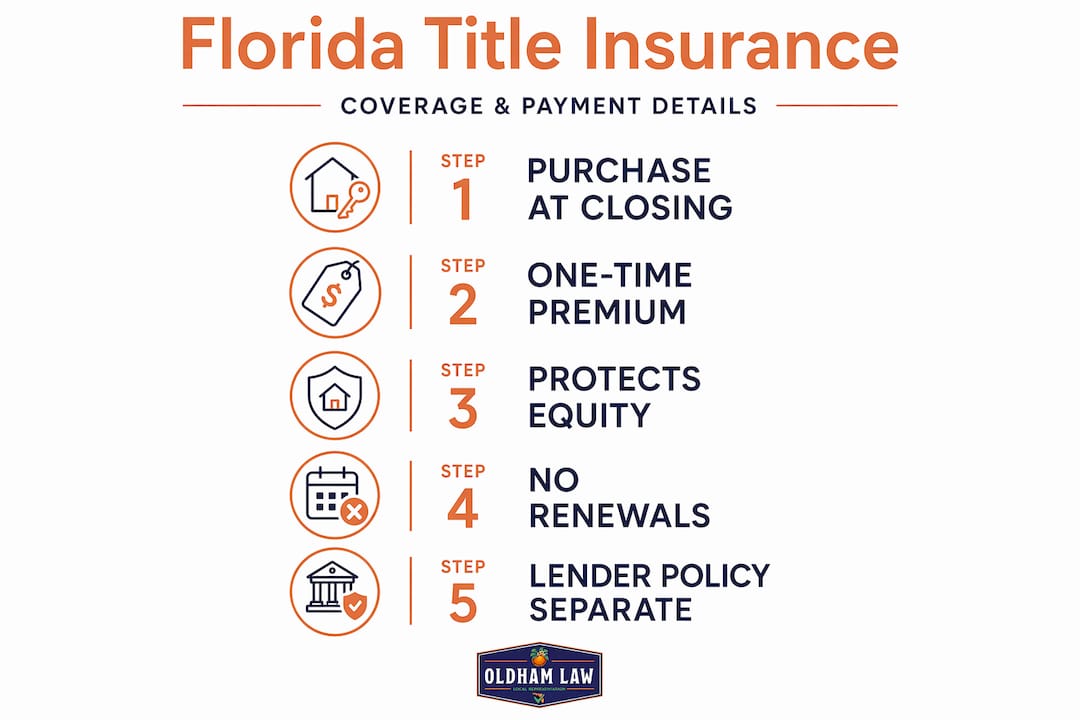
- An owner’s title insurance policy offers permanent protection for your property equity against unseen defects from the past. Florida law makes the owner’s policy optional but essential for safeguarding your ownership, unlike the lender’s policy which only protects the bank. Buying both policies at the same closing minimizes costs and ensures comprehensive coverage.
An owner’s title insurance policy is the only protection that permanently shields your equity from hidden defects in your property’s past. Under Florida law, lenders require a lender’s policy whenever you finance, but the owner’s policy is optional. Optional does not mean unnecessary. The lender’s policy protects the bank, not you.
At closing, confirm these four things:
- Who ordered the title search and whether clouds were cleared before closing
- Whether an owner’s policy will be issued in your name
- Whether both policies are being issued simultaneously to capture the simultaneous-issue discount
- Who pays the owner’s premium in your county (seller in most Florida counties; buyer in Miami-Dade, Broward, Sarasota, and Collier)
Pro Tip: Buy the owner’s policy at the same closing as the lender’s policy. Florida’s simultaneous-issue rule drops the lender’s policy to a $25 flat minimum, making this the most cost-effective moment to secure both.
What your Florida owner’s policy actually covers
A Florida owner’s policy covers pre-closing title defects that a property inspection would never find: forged deeds, recording errors at the county clerk’s office, undisclosed heirs who later claim ownership, and unpaid liens that slipped through the title search. If a covered defect surfaces, the insurer defends your title in court at its own expense and pays for losses up to the policy amount.
Common exclusions matter just as much. The policy does not cover defects that arise after closing, zoning changes, environmental contamination, or matters specifically listed as exceptions on Schedule B-II of your Title Commitment. Reading those exceptions when your policy arrives is worth your time.
How the title search finds and clears clouds on your title
The title search is a review of public records going back through the property’s ownership chain. It surfaces mortgages, liens, judgments, and gaps in the chain. A “cloud on title” is any recorded claim or defect that casts doubt on your clean ownership.

Clearing those clouds before closing is curative work, and legal expertise separates a thorough closing from a rushed one. A title agent can handle routine searches, but an attorney is better positioned to resolve contested liens, missing probate filings, or ambiguous deed language that could block your ownership later.
When you pay and how long coverage lasts
You pay the owner’s premium once, at closing, as a line item on your Closing Disclosure. There is no annual renewal. Coverage lasts for as long as you or your heirs hold an interest in the property, with no expiration date. The Title Commitment is issued at or before closing; the final policy may arrive a few weeks later, after deed recording is complete.
How to choose a title company or Florida real estate attorney
Ask whether the person handling your closing is a licensed Florida attorney or a title agent. Both can issue policies, but an attorney carries professional liability and can represent your interests if a dispute arises. Check Florida Bar membership for attorneys and confirm licensure through the Florida Office of Insurance Regulation for agents.
Red flags include anyone quoting a base premium below the state-promulgated rate. Florida sets rates under Rule 69O-186.003, so every licensed agent charges the same base rate. An unusually large discount on the base rate is a compliance concern, not a bargain. Ask specifically about their curative experience and how they handle clouds discovered during the search.
What to do if a title defect surfaces after closing
Contact your title insurer immediately and in writing. The policy requires prompt notice, and delay can affect your claim. The insurer will assign a defense attorney to protect your ownership at no cost to you. If the defect cannot be cured, the insurer pays up to the policy amount.
For complex defects involving undisclosed issues from the seller or contested ownership claims, having your own real estate attorney alongside the insurer’s counsel protects your interests more fully.
What owner’s title insurance costs in Florida
Florida’s promulgated rate schedule sets the owner’s premium at $5.75 per $1,000 on the first $100,000 of coverage and $5.00 per $1,000 from $100,001 to $1,000,000, with a $100 minimum. A $300,000 home produces roughly $1,575; a $500,000 home produces roughly $2,575. Because the state sets these rates, you cannot find a lower base premium by shopping among Florida agencies.
Buyers who refinance within a few years may qualify for a reissue rate that can reduce the new lender’s policy premium significantly.
When you need an attorney versus a title agent
A licensed title agent handles the majority of straightforward Florida closings competently. You should involve a Florida real estate attorney when the title search reveals unresolved liens or gaps in the ownership chain, when you are buying a for-sale-by-owner property without seller representation, when the property has gone through foreclosure or probate, or when a post-closing defect requires litigation. An attorney can also review your Title Commitment’s Schedule B exceptions and advise whether any exclusion poses a real risk to your ownership.
How refinancing or selling affects your existing owner’s policy
Your owner’s policy survives a refinance. The original lender’s policy ends when the old loan is paid off, and a new lender’s policy is issued on the new loan, often at a reduced reissue rate. Your owner’s coverage continues unchanged. When you sell, your owner’s policy does not transfer to the buyer. The buyer needs their own policy, and the cycle begins again with a new title search.
Oldham Law PLLC guides Pinellas County homeowners through every closing
Buying a home in St. Petersburg, Pinellas Park, or anywhere in Tampa Bay means navigating a closing process where the details matter. Oldham Law PLLC handles title insurance and real estate closings with the kind of focused attention that a volume-driven title shop simply cannot match. The firm’s attorneys review your Title Commitment, explain every Schedule B exception in plain language, confirm your owner’s policy is properly issued, and oversee escrow and deed recording. When a cloud on title needs curative work or a post-closing defect requires litigation, the firm’s background in insurance defense and local court experience becomes a real advantage. Schedule a consultation and bring your Closing Disclosure or Title Commitment to the first call. Contact Oldham Law PLLC to protect your property before and after the closing table.
This article is general information, not legal advice. Confirm current rules and your specific situation with a qualified Florida real estate attorney.
Key Takeaways
A Florida owner’s title insurance policy is a one-time premium that permanently protects your equity from pre-closing title defects, with no renewal required.
| Point | Details |
|---|---|
| Owner’s policy is optional but critical | Florida law does not require it, but it is the only protection for your equity against hidden defects. |
| One-time premium, permanent coverage | You pay once at closing; coverage lasts as long as you or your heirs hold the property. |
| Florida rates are state-set | The promulgated rate is $5.75 per $1,000 on the first $100,000; no agency can legally charge less on the base rate. |
| Buy both policies together | The simultaneous-issue rule reduces the lender’s policy to a $25 flat minimum when issued at the same closing. |
| Oldham Law PLLC | Provides title search, curative work, closing representation, and litigation support for Pinellas County and Tampa Bay homeowners. |
FAQ
Is an owner’s title insurance policy required in Florida?
No. Florida law does not require buyers to purchase an owner’s policy, but lenders require a lender’s policy for any financed purchase. The owner’s policy is optional but strongly recommended.
How much does a Florida owner’s title insurance policy cost?
The state-promulgated rate is $5.75 per $1,000 on the first $100,000 and $5.00 per $1,000 above that, with a $100 minimum. A $300,000 home runs roughly $1,575.
Does my owner’s policy protect me when I refinance?
Yes. Your owner’s policy remains in force through a refinance. A new lender’s policy is issued on the new loan, often at a reduced reissue rate, but your owner’s coverage is unaffected.
What is the difference between an owner’s and a lender’s title policy?
The owner’s policy protects your equity for as long as you or your heirs own the property. The lender’s policy protects only the bank’s mortgage interest and ends when the loan is paid off or refinanced.
When should I hire a Florida real estate attorney instead of a title agent?
Hire an attorney when the title search reveals unresolved liens, the property has a foreclosure or probate history, or a post-closing defect requires litigation. Oldham Law PLLC handles these situations for homeowners throughout Pinellas County and Tampa Bay.
