
Revocable Trust Florida: What Homeowners Need to Know

A revocable living trust is one of the most practical estate-planning tools available to Florida residents. For any asset you actually title in the trust, your family can skip probate entirely, and a named successor trustee can step in immediately if you become incapacitated. The controlling authority is Chapter 736, Florida Statutes — Florida’s Trust Code — supplemented by Florida Bar guidance on revocable trusts. Two limits matter from the start: the trust only protects assets that are funded into it, and it does not shield those assets from your creditors during your lifetime. A pour-over will is still necessary as a safety net. If you’re in Pinellas County or anywhere in the Tampa Bay area, Oldham Law PLLC can help you draft, execute, and fund a trust that actually works.
- A funded revocable trust avoids probate; an unfunded one does not.
- Chapter 736, Florida Statutes governs creation, amendment, and revocation.
- A pour-over will is a required companion document.
- Florida homestead rules add a layer of complexity that generic templates miss.
- Oldham Law PLLC serves Pinellas County and the greater Tampa Bay area.
What is a revocable living trust and how does it differ from a will?
A revocable living trust is a legal arrangement in which you (the grantor) transfer ownership of assets to a trust you control during your lifetime. You typically serve as your own initial trustee, managing the assets just as you did before. You name a successor trustee to take over if you become incapacitated or die, and you name beneficiaries who receive the assets after your death.
The word “revocable” means exactly what it sounds like. You can change the terms, add or remove assets, or dissolve the trust entirely at any point while you’re alive and have legal capacity. Florida Statute § 736.0601 confirms that the capacity required to create or amend a revocable trust is the same as the capacity required to make a will.
How it compares to a will:
- A will transfers assets through the public probate process; a trust transfers funded assets privately, outside of court.
- A will takes effect only at death; a trust is active during your lifetime and handles incapacity automatically.
- A will is a public record once filed with the probate court; a trust document generally stays private.
- Both documents can name guardians for minor children, but only a will can do so.
How it compares to an irrevocable trust:
An irrevocable trust generally cannot be changed once signed. That permanence is the price of real asset-protection benefits: assets in an irrevocable trust are typically outside your taxable estate and beyond the reach of most creditors. A revocable trust offers none of that protection during your lifetime because you still legally own the assets. The tradeoff is flexibility — you keep full control.
Tax treatment while you’re alive: The IRS treats a revocable trust as a “grantor trust,” meaning all income flows to your personal tax return. No separate trust tax return is required during your lifetime. After your death, the trust becomes a separate taxpayer and may need its own EIN and annual filings.
A pour-over will is the standard companion to a revocable trust. It captures any assets you forgot to title in the trust and directs them into the trust through probate, so they ultimately pass under the trust’s terms. Think of it as a backstop, not a substitute.
What is probate in Florida and which assets go through it?
Probate is the court-supervised process by which a deceased person’s assets are collected, debts are paid, and property is distributed to heirs. In Florida, the circuit court in the county where the decedent lived oversees the process. It is public, meaning the will and an inventory of assets become part of the court record.
Assets typically subject to probate in Florida:
- Real estate titled solely in the decedent’s name
- Bank and brokerage accounts with no joint owner, no payable-on-death (POD) designation, and no transfer-on-death (TOD) registration
- Vehicles titled in the decedent’s name alone
- Personal property (furniture, jewelry, collectibles) with no beneficiary designation
- Business interests held in the decedent’s individual name
Assets that generally bypass probate include jointly owned property with right of survivorship, accounts with valid POD or TOD designations, life insurance with a named living beneficiary, retirement accounts (IRAs, 401(k)s) with a named beneficiary, and assets already held in a funded revocable trust. For a full breakdown, see what assets are exempt from probate in Florida.
Probate cost reality check: Florida uses a statutory attorney fee schedule tied to estate value. On a $500,000 estate, statutory attorney fees can reach approximately $15,000. That figure does not include personal representative fees, court filing costs, or accountant fees — all of which add up during a process that can take a year or longer for a formal administration.
One often-overlooked trigger: if you own real estate in another state, your family faces ancillary probate in that state in addition to Florida proceedings. A funded trust eliminates ancillary probate for out-of-state property titled in the trust.
How a revocable trust actually avoids probate
The mechanism is simple. When you die, assets titled in your trust’s name pass directly to your beneficiaries under the trust’s terms. No court petition, no waiting period, no public filing. Your successor trustee has immediate authority to act.

The catch — and it’s a significant one — is that a trust only avoids probate for assets actually held in the trust at death. An executed but unfunded trust is a legal document with no practical effect on probate. Signing the trust agreement is step one. Funding it is the step most people skip.
What “funded” means in practice:
- Real estate: a new deed transferring title from you individually to you as trustee, recorded with the county clerk
- Bank accounts: account registration changed to the trust’s name at your bank
- Brokerage accounts: re-registered in the trust’s name with your broker
- Life insurance: the trust named as beneficiary (not retitled, since you don’t “own” the policy the same way)
- Retirement accounts: generally NOT retitled; name the trust as beneficiary only after coordinating with a tax advisor
Beneficiary designations often trump everything else. If your bank account has a POD designation naming your sibling, that account goes to your sibling regardless of what your trust says. Review every beneficiary designation and POD form alongside your trust funding to make sure they work together, not against each other.
Pro Tip: Create a simple spreadsheet listing every asset, its current title or registration, and the action needed to fund it into the trust. Update it every time you open a new account or acquire property. This single habit prevents the most common trust failure: dying with a beautifully drafted trust and a house still titled in your own name.
How to fund your Florida trust: a step-by-step checklist
Funding is where most DIY trusts fall apart. Here is a practical sequence for the most common asset types.
Real estate. Prepare and record a new deed transferring the property from “[Your Name]” to “[Your Name], Trustee of the [Trust Name] dated [Date].” In Florida, this deed must be recorded with the county clerk’s office where the property sits. For homestead property, the deed must include specific language preserving your homestead tax exemption and Save Our Homes cap (more on this in the homestead section below).
Primary bank accounts. Visit your bank branch with a copy of the trust (or a certification of trust) and ask to re-register the account in the trust’s name. Most banks have a standard form. The new account title reads: “[Your Name], Trustee of the [Trust Name] dated [Date].”
Brokerage and investment accounts. Contact your broker or custodian. Most require a copy of the trust agreement or a certification of trust, a new account application, and an asset transfer form. Allow two to four weeks for processing.
Vehicles. Florida allows but does not require titling vehicles in a trust. For everyday cars, the administrative burden often outweighs the benefit. For valuable collector vehicles or boats, retitling may make sense. Contact the Florida Department of Highway Safety and Motor Vehicles for the current transfer process.
Business interests. If you own an LLC or other business entity, an assignment of membership interest (or stock certificate transfer for a corporation) moves the ownership into the trust. Review your operating agreement first — some require member consent for transfers. Oldham Law PLLC’s business law team can help coordinate this step.
Life insurance. Do not retitle the policy. Instead, name the trust as the primary or contingent beneficiary on the beneficiary designation form with your insurer.
Retirement accounts (IRAs, 401(k)s). Retitling a retirement account into a trust during your lifetime can trigger a taxable distribution. Instead, name the trust as beneficiary only after consulting a tax advisor about the income-tax consequences for your beneficiaries.
Personal property. A general assignment of personal property (a short document listing or describing household items, jewelry, and similar assets) transfers these into the trust without individual retitling.
Digital accounts and intellectual property. Include these in a schedule attached to the trust. Platforms vary in how they handle trust ownership, so document your wishes clearly and give your successor trustee account credentials in a secure location.
Pour-over will as the safety net. Any asset you miss — an account you opened after funding, an inheritance you received — passes through your pour-over will into the trust at death. It still goes through probate, but it ends up under the trust’s terms.
Retitling language that works on Florida deeds and account registrations: “[Grantor Full Name], Trustee of the [Full Trust Name] dated [Month Day, Year], and any amendments thereto.” Using this exact format prevents institutions from rejecting paperwork and avoids ambiguity about which trust document controls.
Florida’s legal formalities for creating, amending, and revoking a trust
Florida does not require a trust to be notarized or witnessed to be valid as a basic trust instrument. But that narrow reading misses a critical point. Under Florida Statute § 736.0403, the testamentary aspects of a revocable trust executed by a Florida domiciliary are invalid unless the trust is executed with the same formalities as a will. That means signed by the settlor in the presence of two witnesses, who also sign, and notarized.
In practice, every Florida estate-planning attorney treats two witnesses and a notary as the standard for all revocable trusts, not just those with testamentary provisions. Post-death challenges almost always target execution formalities, and a trust signed without witnesses is an easy target.
Who can serve as a witness:
- Any competent adult who is not a beneficiary of the trust
- Beneficiaries should not witness the trust; their interest creates a conflict and can invite challenge
- The notary may not also serve as one of the two required witnesses
Formalities checklist:
- Written instrument (no oral trusts for real property)
- Signed by the settlor (grantor) in front of two witnesses
- Both witnesses sign in the presence of the settlor and each other
- Notarized by a Florida notary public
- Original stored securely; copies provided to successor trustee and key institutions
Amending the trust: Florida Statute § 736.0602 allows a settlor to revoke or amend a revocable trust unless the trust terms expressly prohibit it. An amendment is a signed written document that modifies specific provisions. A restatement replaces the entire trust document while keeping the original trust date (preserving existing asset titles). Both should be executed with the same two-witness and notary formalities as the original.
Revoking the trust: Revocation requires a signed written instrument delivered to the trustee. If you are your own trustee, retitling assets back to your individual name and signing a revocation document completes the process.
Pro Tip: Keep a funding ledger alongside the original trust document. List every asset, the date it was transferred, and the recording or account number. Store the original trust and all deeds in a fireproof safe or with your attorney. Give your successor trustee a copy of the trust and the ledger — not just a note saying “there’s a trust somewhere.”
Florida homestead, surviving-spouse rights, and the elective share
Florida’s homestead rules are among the most complex in the country, and they interact with revocable trusts in ways that catch many families off guard.
Homestead tax exemption and Save Our Homes cap:
Transferring your primary residence into a revocable trust does not forfeit the homestead property tax exemption or the Save Our Homes assessment cap, provided the deed and trust are drafted correctly. The deed must include specific language preserving the homestead exemption, and some Florida counties require an affidavit of trust or a separate homestead preservation affidavit filed with the property appraiser’s office. A deed that omits this language can trigger reassessment at current market value, permanently increasing your property taxes.
Constitutional homestead and devise restrictions:
Florida’s Constitution restricts how homestead property can be devised when the owner has a surviving spouse or minor children. If you have a surviving spouse, you generally cannot leave the homestead to anyone other than that spouse (or in a life estate to the spouse with remainder to descendants). A trust that attempts to circumvent these restrictions will not be enforced. Proper planning for married homeowners usually involves coordinating the trust with the constitutional homestead rules, often through a life estate deed or specific trust language.
The elective share:
Florida law gives a surviving spouse the right to claim an elective share of the decedent’s estate, generally 30% of the “elective estate.” Critically, the elective estate includes not just probate assets but also revocable trust assets, certain transfers made within one year of death, and other property. You cannot disinherit a spouse simply by placing assets in a trust.
Planning for married couples:
- A joint revocable trust (one trust for both spouses) is common for couples with straightforward estates and shared goals.
- Separate trusts for each spouse offer more flexibility for blended families or when each spouse has distinct assets or beneficiaries.
- Either approach requires careful coordination with homestead deed language and the elective share rules.
What a revocable trust does not protect: creditors, Medicaid, and taxes
This is where many people are surprised. A revocable trust is a planning tool for probate avoidance and incapacity management, not an asset-protection vehicle.
Creditor claims:
- During your lifetime, trust assets are treated as your own property for creditor purposes. A creditor with a judgment against you can reach assets in your revocable trust.
- After your death, spendthrift provisions in the trust can protect beneficiaries’ shares from their own creditors in many circumstances, but that protection does not apply to your debts.
Medicaid and elder-law planning:
Revocable trusts do not create a Medicaid lookback shield. Because you retain control of the assets, Medicaid counts them as available resources. Transferring assets into a revocable trust does not start or reset the five-year lookback period in a beneficial way. If Medicaid eligibility or long-term care planning is a concern, consult a Florida elder-law attorney about irrevocable Medicaid asset protection trusts or other strategies.
Federal estate tax:
The federal estate tax exemption is currently set at a high threshold, meaning most Florida families are not affected. However, the exemption is subject to change by Congress. A revocable trust does not reduce your taxable estate during your lifetime. For estates that may approach or exceed the federal threshold, separate tax planning (such as irrevocable trusts or annual gifting strategies) is necessary.
Pro Tip: If creditor protection, Medicaid planning, or estate tax reduction is your primary goal, a revocable trust is the wrong tool. An irrevocable trust or specialized elder-law structure is designed for those purposes. A Florida estate-planning attorney can help you identify which approach fits your situation.
What your successor trustee must do after incapacity or death
The successor trustee’s job is real work. The Florida Bar notes that trust administration after death involves many of the same tasks as probate: collecting and valuing assets, identifying and paying creditors, filing tax returns, and distributing property to beneficiaries. The difference is that none of it requires court supervision or public filing.
Core successor trustee duties:
- Locate and secure all trust assets immediately
- Obtain a death certificate (multiple certified copies)
- Notify beneficiaries of the trust’s existence and their rights under Florida law
- Open a trust bank account for estate expenses
- Collect and value all trust assets (real estate appraisals, account statements)
- Pay valid debts, expenses, and any taxes owed
- File the decedent’s final income tax return and, if needed, a trust income tax return
- Distribute remaining assets to beneficiaries per the trust terms
- Keep detailed records of every transaction
Trust administration vs. probate at a glance:
| Feature | Trust administration | Probate |
|---|---|---|
| Court involvement | None required | Mandatory (circuit court) |
| Typical timeline | Weeks to a few months | 9–18 months for formal administration |
| Public record | Private | Public (will and inventory filed) |
| Primary cost drivers | Attorney, accountant, trustee fees | Statutory attorney and PR fees, court costs |
Trustee compensation is allowed under Florida law and is typically a reasonable fee based on the complexity of the estate. For larger or more complex trusts, professional help from an attorney or CPA is common and often cost-effective. For a detailed look at how probate works in Florida by comparison, that resource walks through the court-supervised process step by step.
How to amend or revoke your Florida revocable trust
Life changes. Marriages, divorces, new children, deaths of beneficiaries, and major asset acquisitions all create reasons to update your trust. Florida law makes this straightforward.
Amendment. Draft a written amendment that identifies the trust by name and date, states the specific provisions being changed, and includes the new language. Sign it with the same two-witness and notary formalities as the original trust. Deliver a copy to any co-trustee and update your funding ledger if the amendment affects asset ownership.
Restatement. A full restatement replaces the entire trust document while keeping the original trust name and date. This approach is cleaner than a trust with multiple amendments and avoids confusion about which version controls. Assets already titled in the trust’s name do not need to be retitled because the trust name and date remain the same.
Complete revocation. Sign a written revocation instrument and deliver it to the trustee (yourself, if you are the trustee). Retitle all trust assets back to your individual name. Notify all institutions that previously held trust-titled accounts. Once revoked, the trust no longer exists and its terms have no effect.
After any amendment, check your pour-over will. If the amendment changes beneficiaries or distribution terms, confirm that your pour-over will and any beneficiary designations on life insurance or retirement accounts still align with your updated intent.
Update your funding ledger. Note the amendment date, what changed, and whether any retitling or re-registration is needed as a result.
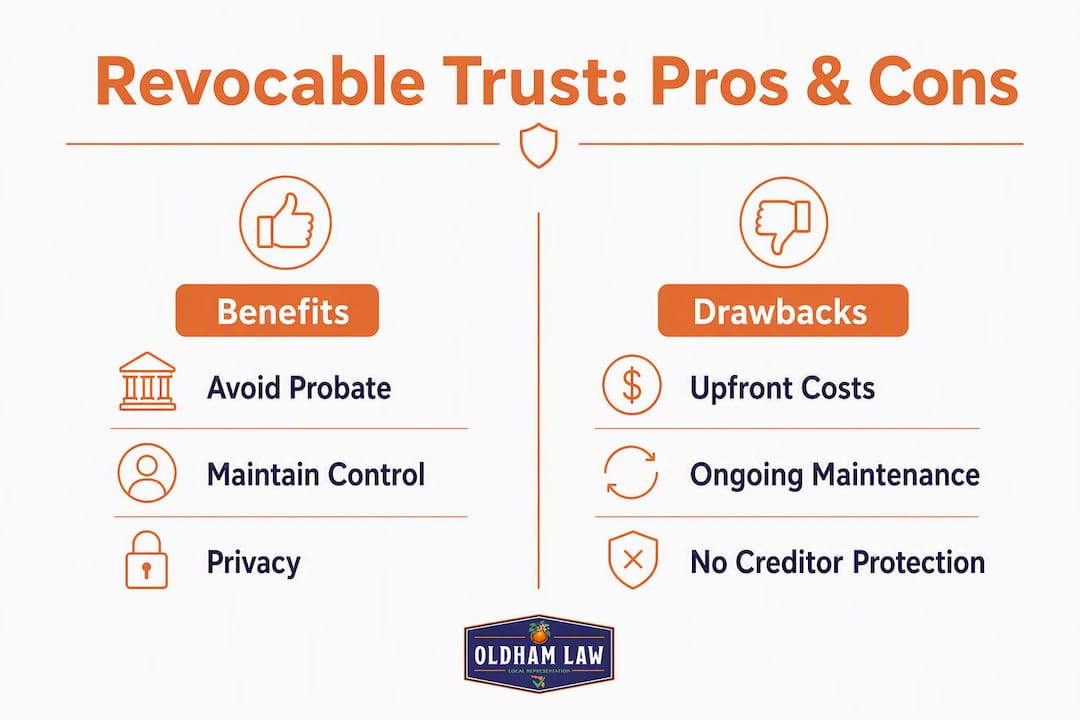
Benefits and drawbacks of a Florida revocable living trust
A revocable trust is not the right tool for every Florida resident. Here is a balanced look at both sides.
Primary benefits:
- Probate avoidance for funded assets, saving time, cost, and public exposure
- Privacy: trust terms and asset values never become part of the public court record
- Incapacity planning: your successor trustee steps in immediately without a court-ordered guardianship
- Multi-state real estate: avoids ancillary probate in other states for property titled in the trust
- Blended families and minor beneficiaries: trust terms can include detailed distribution instructions that a simple will cannot match
- Continuity: no gap in asset management between your death and distribution
Primary drawbacks:
- Upfront cost: attorney-prepared trust packages cost more than a simple will
- Funding requirement: the trust only works if you actually retitle assets, which takes time and effort
- No creditor protection during your lifetime
- No Medicaid shield — assets remain countable for eligibility purposes
- Ongoing maintenance: new assets must be titled in the trust; beneficiary designations must stay current
Who typically benefits most:
- Florida homeowners, especially those with property in more than one state
- Parents of minor children or beneficiaries with special needs
- Blended families with complex distribution goals
- Anyone who values privacy and wants to spare their family the probate process
- Business owners whose interests need seamless management continuity
Who may not need one: A single person with modest assets, a named beneficiary on every account, and no real estate may accomplish the same probate-avoidance goals through POD designations and joint ownership without the cost of a trust. For a direct comparison, see trust vs. will in Florida.
Typical costs and timeline to create and fund a trust in Florida
Attorney fees:
Attorney-prepared Florida living trust packages typically range from about $1,500 to $4,500, depending on complexity. A standard package usually includes the trust document, a pour-over will, durable power of attorney, healthcare surrogate designation, and basic funding guidance. More complex estates with business interests, multiple properties, or tax planning needs fall toward the higher end.
Online template services cost $200–$500 but carry meaningful risks: improper execution, missing homestead language, and unfunded trusts are the most common failures.
The probate comparison: Florida statutory attorney fees on a typical mid-sized estate can be substantial. A trust package costing $2,500 today can save your family many times that amount in probate fees, court costs, and delays.
Timeline:
- Drafting: 1–2 weeks from your initial consultation to a draft ready for review
- Signing and witnessing: same day as the signing appointment
- Funding real estate (deed recording): varies by county; Pinellas County typically processes recordings within a few business days of submission
- Bank and brokerage retitling: 1–4 weeks depending on the institution
- Full funding completion: plan for 30–90 days for a typical estate with multiple asset types
Fee model comparison:
| Service | Typical cost | What’s usually included |
|---|---|---|
| Attorney flat-fee trust package | $1,500–$4,500 | Trust, pour-over will, POA, healthcare docs, funding guidance |
| Online template service | $200–$500 | Trust document only; no legal advice, no funding help |
| Florida probate (statutory fees, $500K estate) | ~$15,000 | Attorney and personal representative statutory fees only |
Flat-fee packages are the most common model for straightforward estates. Hourly billing applies when the estate is complex or when funding requires significant attorney involvement (multiple deeds, business transfers, tax planning).
DIY trust options vs. hiring a Florida estate-planning attorney
Online templates and document services are widely available. For a simple, single-state estate with no homestead property and no blended-family complexity, a carefully completed template may be adequate. In practice, though, Florida’s specific requirements create real risks for DIY trusts.
Common DIY failures in Florida:
- Trust executed without two witnesses or a notary, leaving testamentary provisions vulnerable to challenge
- Homestead deed prepared without the required exemption-preservation language, triggering reassessment
- Retirement accounts retitled into the trust, causing an unintended taxable distribution
- Trust drafted but never funded, providing zero probate-avoidance benefit
- Pour-over will omitted entirely, leaving unfunded assets with no clear direction
When to hire a Florida estate-planning attorney:
- You own real estate in Florida or any other state
- You have a blended family or complex beneficiary arrangements
- You have a minor child or a beneficiary with special needs
- Your estate may approach the federal estate tax threshold
- You own a business interest that needs to be transferred
- You moved to Florida with a trust drafted in another state (Florida’s homestead and witness rules may require re-execution; updating your estate plan when you move to Florida is a critical step)
- You want funding assistance and deed preparation handled correctly the first time
Questions to ask an estate-planning attorney at your first consultation:
- Do you handle Florida homestead deed preparation as part of the trust package?
- Will you assist with funding, or is that left to me?
- Does your flat fee include a pour-over will and powers of attorney?
- How do you handle out-of-state property?
- What is your process for reviewing and updating the trust after major life events?
Common funding mistakes and local practice tips for Pinellas County
Most trust failures come down to execution and funding errors, not drafting problems. Here are the mistakes that Florida practitioners see most often, along with local practice notes for Pinellas and Tampa Bay residents.
Signing the trust but never funding it. The trust sits in a drawer while all assets remain in the grantor’s individual name. At death, the family faces full probate. The fix: fund within 30 days of signing and set a calendar reminder to review the funding ledger annually.
Using a deed that resets the homestead assessment. A deed that transfers homestead property to a trust without the correct exemption-preservation language can trigger a reassessment at current market value. In a county like Pinellas, where property values have risen significantly, this can mean a permanent and substantial increase in property taxes. Small drafting details in deed language are the difference between preserving long-term tax benefits and triggering a permanent reassessment.
Missing witnesses or notarization. A trust signed only by the grantor, without two witnesses and a notary, is vulnerable to post-death challenge on its testamentary provisions under § 736.0403. This is the most avoidable mistake and the one that generates the most litigation.
Failing to change account registrations. Many clients retitle real estate correctly but leave bank and brokerage accounts in their individual names. Those accounts go through probate regardless of what the trust says.
Retitling retirement accounts. Moving an IRA or 401(k) into a trust during your lifetime is treated as a distribution, triggering income tax on the full balance. Name the trust as beneficiary instead, and coordinate with a tax advisor.
Local practice note for Pinellas County: The Pinellas County Clerk of the Circuit Court and Comptroller records deeds at the Clearwater courthouse. Standard recording turnaround for e-recorded deeds is typically a few business days. Bring a certified copy of the trust or a certification of trust when you visit your bank to retitle accounts — most Pinellas-area institutions accept a certification rather than the full trust document, which keeps your terms private.
No pour-over will. Without a pour-over will, assets outside the trust at death pass under Florida’s intestacy laws, not your wishes. Every revocable trust should have a companion pour-over will signed the same day.
Never updating after major life events. A trust drafted before a second marriage, the birth of a grandchild, or the purchase of a vacation property in another state may not reflect your current wishes. Review the trust and all beneficiary designations every three to five years or after any major life change.
Pro Tip: Keep a funding ledger in a shared secure location with your successor trustee. List every asset, its current title, the date it was transferred into the trust, and the recording or account number. Set a calendar reminder every three years to review beneficiary designations on life insurance and retirement accounts. This one habit prevents the most common and most expensive trust failures.
Oldham Law PLLC assists Pinellas County clients with deed preparation, county recording, and bank retitling paperwork as part of the trust drafting process, so funding does not fall through the cracks after the signing appointment.
Key Takeaways
A revocable living trust avoids probate only for assets actually titled in the trust, must be executed with two witnesses and a notary under Florida law, and requires a pour-over will as a companion document to be fully effective.
| Point | Details |
|---|---|
| Funding is everything | A trust avoids probate only for assets retitled into it; an unfunded trust provides no benefit. |
| Execute with will formalities | Sign before two witnesses and a notary to protect testamentary provisions under § 736.0403. |
| Homestead needs special language | Deeds transferring homestead must preserve the exemption and Save Our Homes cap to avoid reassessment. |
| Trusts don’t block creditors or Medicaid | Revocable trust assets remain countable for creditor claims and Medicaid eligibility during your lifetime. |
| Oldham Law PLLC handles the full process | The firm drafts, executes, and funds revocable trusts for Pinellas County and Tampa Bay clients. |
Why most Florida families underestimate the funding step
The conventional wisdom on revocable trusts focuses almost entirely on drafting: get the document right, sign it properly, and you’re protected. That framing is incomplete, and it leads to a predictable failure pattern.
The harder truth is that the document is the easy part. Funding is where the real work happens, and it’s ongoing. Every new bank account, every piece of real estate, every business interest acquired after the trust is signed needs to be evaluated and, in most cases, titled in the trust. Most families don’t do this consistently, which means the trust that was supposed to spare their heirs from probate ends up covering only a fraction of the estate.
There’s also a tendency to treat a revocable trust as a complete solution when it’s really one component of a coordinated plan. The pour-over will, the beneficiary designations on retirement accounts and life insurance, the powers of attorney, the healthcare surrogate designation — all of these need to work together. A trust that contradicts a beneficiary designation, or a pour-over will that names a deceased executor, creates exactly the kind of confusion and delay that the trust was meant to prevent.
For Pinellas County and Tampa Bay families, the homestead layer adds another dimension that generic online guides simply don’t address. Getting the deed language right, filing the correct affidavit with the property appraiser, and coordinating the homestead devise with the constitutional restrictions for married couples — these are not steps a template handles well. They require someone who knows Florida law and local county practice.
The families who get the most value from a revocable trust are the ones who treat it as a living document, not a one-time task. Review it after major life events. Check the funding ledger. Update beneficiary designations. That discipline is what turns a well-drafted trust into a plan that actually works when your family needs it.
Oldham Law PLLC helps Tampa Bay families create and fund revocable trusts
Skipping probate for your family is a concrete, achievable goal — but only if the trust is drafted correctly, executed with Florida’s required formalities, and fully funded before it matters. Oldham Law PLLC offers flat-fee trust packages for Pinellas County and Tampa Bay residents that include the revocable trust, pour-over will, durable power of attorney, and healthcare surrogate designation. Homestead deed preparation and county recording are handled as part of the process, not left as homework for the client.

The firm’s attorneys have experience with Florida homestead law, multi-state property transfers, and business-interest assignments, so complex estates get the same careful attention as straightforward ones. If you’ve moved to Florida with an out-of-state trust, the team can review it for compliance with Florida’s witness and homestead requirements. To get started, visit Oldham Law PLLC or contact the firm directly to schedule a consultation. For clients who already know probate is on the horizon, the probate practice page covers what to expect and how the firm can help.
Useful sources and further reading
Authoritative resources for Florida revocable trust law and practice:
- Chapter 736, Florida Statutes (Florida Trust Code) — the primary governing statute for revocable trusts in Florida, including creation, formalities, amendment, and revocation
- Florida Bar Consumer Pamphlet: The Revocable Trust in Florida — plain-language guidance from the Florida Bar on how revocable trusts work, their benefits, and their limits
- Florida Statute § 736.0601 — Capacity of settlor — confirms that the capacity to create or amend a revocable trust equals the capacity to make a will
- Florida Statute § 736.0602 — Revocation or amendment — governs how a settlor may revoke or amend a revocable trust
- Florida Statute § 736.0402 — Requirements for creation — sets out the basic requirements for a valid trust in Florida
- Oldham Law PLLC: How to avoid probate in Florida — practical strategies for Pinellas County and Tampa Bay residents
- Oldham Law PLLC: Trust vs. will in Florida — direct comparison of the two primary estate-planning documents
- Oldham Law PLLC: Probate cost in Florida — local cost examples and statutory fee explanations for Tampa Bay estates
- Oldham Law PLLC: Avoiding probate in St. Pete and Pinellas Park — local practice page with county-specific guidance
FAQ
Should you put your home in a trust in Florida?
For most Florida homeowners, yes — provided the deed includes language preserving the homestead tax exemption and Save Our Homes cap. Placing your home in a properly drafted revocable trust avoids probate for that property and allows your successor trustee to manage or transfer it immediately at your death or incapacity, without court involvement.
How much does a revocable trust cost in Florida?
Attorney-prepared trust packages typically range from $1,500 to $4,500 and usually include the trust, pour-over will, and powers of attorney. Online templates cost $200–$500 but carry higher risks of improper execution and unfunded trusts.
What are the drawbacks of a revocable trust?
The main drawbacks are upfront cost, the ongoing requirement to title new assets in the trust, and the absence of creditor protection or Medicaid shielding during your lifetime. A trust that is never funded provides no probate-avoidance benefit at all.
Who owns the property in a revocable trust in Florida?
You do, for nearly all legal purposes. As grantor and trustee of your own revocable trust, you retain full control and beneficial ownership of trust assets during your lifetime. Creditors can reach those assets, and Medicaid counts them as available resources, precisely because you have not given up ownership.
Do I need a pour-over will if I already have a revocable trust?
Yes. A pour-over will captures any assets not titled in the trust at your death and directs them into the trust through probate. Without it, those assets pass under Florida’s intestacy laws rather than your stated wishes.
