
Real Estate Attorney Foreclosure: Florida Homeowner Guide

TL;DR:
- A foreclosure attorney in Florida challenges lender actions, enforces homeowner rights, and defends against foreclosure at every stage. Acting early preserves defenses, negotiates better outcomes, and helps protect your home from losing legal leverage.
A real estate attorney specializing in foreclosure is defined as a licensed legal professional who challenges lender actions, enforces homeowner rights, and pursues loss mitigation throughout Florida’s judicial foreclosure process. Florida law requires lenders to file a lawsuit in county circuit court and prove standing to foreclose, which means homeowners have real legal rights to assert at every stage. Missing those rights, or missing a single deadline, can cost you your home. Understanding what a foreclosure defense attorney does is the first step toward protecting yourself.
What is the Florida foreclosure process and how does an attorney intervene?
Florida is a judicial foreclosure state. That means your lender cannot simply take your home. The bank must file a lawsuit, prove it owns the debt, and win a court judgment before any sale can happen. That process gives you time and legal leverage, but only if you use it.
Federal law under 12 C.F.R. § 1024.41 prohibits lenders from starting foreclosure until a homeowner is at least 120 days delinquent. That protected period exists specifically to give you time to apply for loss mitigation, such as a loan modification or repayment plan, before the legal process begins.
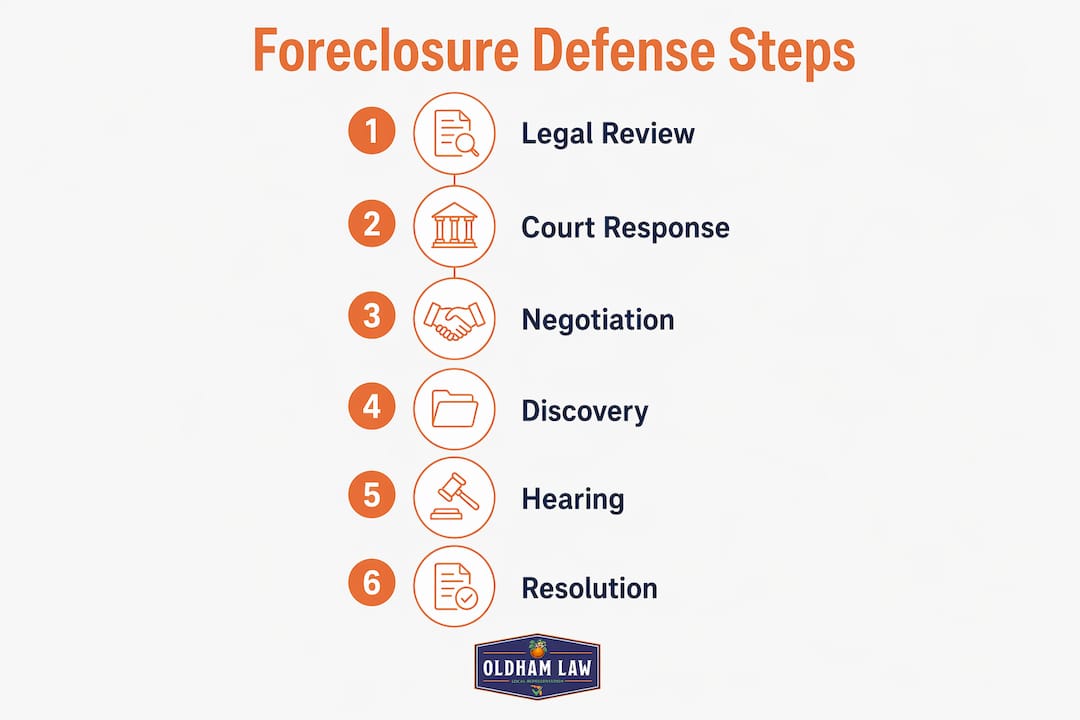
Once the lender files a complaint, the timeline moves in clear stages:
- Notice of Default and acceleration letter. The lender formally declares the loan in default and demands full repayment.
- Complaint filed in circuit court. The bank files its lawsuit and must serve you with legal process.
- Your 20-day response window. Florida law gives you 20 days to file a written answer. Missing this deadline can result in a default judgment, which strips away your right to defend the case.
- Discovery and hearings. Both sides exchange documents, and the court may hold hearings on motions and defenses.
- Final judgment and sale. If the lender wins, the court sets a foreclosure sale date.
Florida foreclosure generally takes 8 to 14 months from lawsuit filing to sale. Contested cases take longer. That timeline is your window for a real estate foreclosure attorney to intervene, negotiate, and protect your position.
Pro Tip: If you receive any court document related to foreclosure, treat the date you received it as day one of your 20-day clock. Do not wait to call an attorney.
Which legal defenses can a Florida foreclosure attorney use?
Florida’s judicial process requires the lender to prove its case. That requirement creates real opportunities for a skilled foreclosure defense attorney to challenge the bank’s claims and protect your home.
The most common and effective defenses include:
- Lack of standing. The lender must prove it owns the loan at the time it files suit. Chain of title errors, missing endorsements, or improper loan transfers can defeat this proof. Lack of standing is one of the most frequently raised and successful defenses in Florida foreclosure cases.
- Defective notice. Failure to properly serve a Notice of Default or other required notices is a valid procedural defense that can delay or derail foreclosure proceedings.
- Servicing errors. Lenders and loan servicers sometimes misapply payments, charge improper fees, or maintain inaccurate payment histories. An attorney can demand a full accounting and challenge errors in the record.
- Failure to evaluate loss mitigation. Federal regulations require servicers to review loss mitigation applications before proceeding. Skipping that step is a regulatory violation your attorney can raise in court.
- Procedural defects. Courts require strict compliance with filing rules, service of process, and notice requirements. Any deviation can be grounds for dismissal or delay.
Beyond courtroom defenses, a property foreclosure attorney also negotiates practical solutions. Loan modification, short sale, and deed in lieu of foreclosure are all alternatives that attorneys negotiate directly with lenders to help homeowners avoid a forced sale. Each option has different consequences for your credit and finances, and an attorney helps you choose the right path for your specific situation.
Filing for bankruptcy triggers an automatic stay that halts foreclosure proceedings immediately. This is not always the right choice, but it is a powerful tool when time is critical and other options have closed. Your attorney at Oldham Law PLLC can help you understand whether bankruptcy fits your goals before you commit to that path. You can also learn more about life after bankruptcy to plan your financial recovery.
Pro Tip: Bring every piece of mail from your lender to your first attorney meeting. Servicer letters, payment statements, and modification denial letters all contain facts your attorney can use.
How does early attorney contact affect your foreclosure outcome?
Consulting a foreclosure attorney as soon as you miss payments, rather than waiting for a lawsuit, gives you the widest range of options. That is not a general observation. It is the consistent finding of foreclosure defense practitioners across Florida. The earlier you act, the more tools your attorney has available.
Here is what early legal intervention preserves:
- Your right to negotiate. During the 120-day pre-foreclosure period, lenders are legally required to consider loss mitigation. An attorney can submit a complete application and hold the lender accountable to that requirement.
- Your ability to raise defenses. Once a default judgment enters, most defenses are waived. Acting before the 20-day answer deadline keeps all options open.
- Your equity. A forced foreclosure sale often produces a lower sale price than a negotiated short sale or private sale. Early action gives you time to exit on better terms and potentially recover foreclosure surplus funds if the sale price exceeds your debt.
- Your credit timeline. A negotiated resolution, such as a deed in lieu, typically causes less credit damage than a completed foreclosure judgment.
- Your housing stability. An attorney can often extend the timeline by months through legitimate legal filings, giving your family time to plan a transition or secure alternative housing.
Florida’s homestead exemption is strong, but it does not protect your primary residence from mortgage foreclosure. The homestead exemption shields your home from most creditors but does not override a lender’s right to foreclose on a mortgage. Many homeowners mistakenly believe the exemption will save them. It will not. Only active legal defense will.
What should you expect when working with a foreclosure attorney?
Working with a real estate foreclosure attorney is a structured, collaborative process. Knowing what to expect reduces anxiety and helps you participate effectively in your own defense.
Your attorney will handle court filings, respond to lender motions, conduct discovery, and appear at hearings on your behalf. Outside of court, the attorney communicates with the loan servicer, submits loss mitigation applications, and negotiates settlement terms. You are not expected to manage those tasks alone.
Fee structures vary. Most foreclosure defense attorneys charge one of three ways: a flat fee for the full representation, an hourly rate billed against a retainer, or a monthly fee for ongoing defense. Ask for a clear written fee agreement before you sign anything. Oldham Law PLLC provides honest case assessments so you understand costs and realistic outcomes from the start.
Gather and organize these documents before your first meeting:
- Your original loan documents and promissory note
- All correspondence from your lender or servicer
- Payment history and bank statements
- Any modification applications or denial letters
- The foreclosure complaint if one has been filed
A good foreclosure lawyer will give you an honest picture of your case, including its weaknesses. Not every case ends with the homeowner keeping the home. But every case benefits from legal representation that pursues the best available outcome, whether that is retention, a negotiated exit, or maximum time to prepare.
Attorneys also coordinate with HUD-approved housing counselors, who provide free guidance on loss mitigation options. If bankruptcy becomes necessary, your foreclosure attorney can refer you to or work alongside a bankruptcy practitioner. You can also review escrow dispute guidance if payment disputes with your servicer are part of your situation.
Key Takeaways
A real estate attorney specializing in foreclosure is your most effective tool for asserting legal rights, challenging lender errors, and negotiating outcomes before Florida’s judicial process closes your options.
| Point | Details |
|---|---|
| Florida is a judicial state | Lenders must sue and prove standing in court, giving homeowners real legal leverage. |
| The 120-day rule matters | Federal law bars foreclosure filings before 120 days of delinquency, creating a negotiation window. |
| The 20-day deadline is critical | Missing the answer deadline after a complaint is filed can result in a default judgment. |
| Early attorney contact expands options | Consulting an attorney before a lawsuit preserves defenses, negotiation rights, and equity. |
| Multiple outcomes are possible | Retention, modification, short sale, deed in lieu, and bankruptcy are all viable strategies with legal help. |
What we have learned from Florida foreclosure cases
At Oldham Law PLLC, the most consistent pattern we see is this: homeowners who wait too long lose options that were available to them weeks or months earlier. The foreclosure process feels overwhelming at first, and that feeling causes delay. Delay is the one thing that genuinely narrows your choices.
The second pattern we see is misinformation. Homeowners sometimes rely on advice from neighbors, online forums, or servicer representatives who have a conflict of interest. Servicers work for the lender. Their job is to collect the debt, not to protect your rights. An attorney’s job is the opposite.
What actually works is a combination of honest case assessment and a clear strategy matched to your goal. If you want to keep your home, the strategy looks different than if you need to exit with minimal credit damage. Both are legitimate goals, and both require different legal approaches. A one-size approach does not serve Florida homeowners well.
We also find that homeowners who stay transparent with their attorney get better results. Share every document, every conversation with the servicer, and every financial change. That information shapes the strategy. Withholding it, even unintentionally, limits what your attorney can do.
Foreclosure is a legal process with defined rules. Those rules exist to protect you as much as the lender. The homeowners who fare best are the ones who treat the process as a legal matter from day one, not a financial embarrassment to manage quietly.
— Oldham Law PLLC
Oldham Law PLLC: local foreclosure defense for Tampa Bay homeowners
Facing foreclosure in Pinellas County or the greater Tampa Bay area is serious, but you do not have to face it without experienced legal support. Oldham Law PLLC provides personalized foreclosure defense representation for homeowners in St. Petersburg, Pinellas Park, and surrounding communities. The firm’s attorneys bring backgrounds in insurance defense and prosecution, which means they understand how lenders build their cases and where those cases are vulnerable.
Oldham Law PLLC offers direct case evaluations so you get an honest assessment of your options, not a generic consultation. Whether you need to contest a foreclosure complaint, negotiate a loan modification, or explore a strategic exit, the firm builds a plan around your specific situation. Contact Oldham Law PLLC to schedule your consultation, or visit the real estate legal services page to learn more about local representation.
FAQ
What does a real estate attorney do in a foreclosure case?
A real estate attorney reviews your loan documents, files a legal response to the foreclosure complaint, raises defenses against the lender, and negotiates alternatives such as loan modifications or short sales. The attorney represents you in all court proceedings and communications with the servicer.
How long does foreclosure take in Florida?
Florida foreclosure typically takes 8 to 14 months from the date the lawsuit is filed to the foreclosure sale. Contested cases with active legal defense can extend that timeline significantly.
Can I contest a foreclosure in Florida?
Yes. Florida’s judicial process requires the lender to prove its case in court, which gives homeowners the right to file an answer, raise affirmative defenses, and challenge the lender’s standing, notice compliance, and payment records.
Does the Florida homestead exemption stop foreclosure?
No. The homestead exemption protects your home from most creditors but does not prevent a mortgage lender from foreclosing. Only active legal defense or a negotiated resolution can stop or delay a mortgage foreclosure.
When should I contact a foreclosure attorney in Florida?
Contact a foreclosure attorney as soon as you miss a mortgage payment or anticipate missing one. Early consultation preserves your full range of defenses and loss mitigation options before the lender files suit and deadlines begin to close.
