
Real Estate Attorney for Eviction: Florida Tenant Guide

TL;DR:
- Receiving an eviction notice in Florida activates strict legal deadlines that tenants often overlook, risking their housing. An eviction attorney can help tenants respond promptly, gather documentation, and build defenses to avoid default judgments and eviction. Early legal support increases the chances of favorable outcomes and helps tenants protect their rights throughout the process.
A real estate attorney for eviction is a licensed legal professional who represents tenants facing removal from their homes under Florida landlord-tenant law. The proper industry term is “tenant eviction defense attorney,” though both phrases describe the same role. Receiving an eviction notice in Florida triggers a series of strict legal deadlines that most tenants do not know exist. Missing even one deadline can cost you your home, your defenses, and your day in court. Consulting a qualified eviction lawyer near me or in your county is the single most effective step you can take after receiving any eviction notice.
What is the eviction process timeline in Florida?
Florida’s eviction process moves faster than most tenants expect. Understanding each step gives you the best chance to respond effectively.
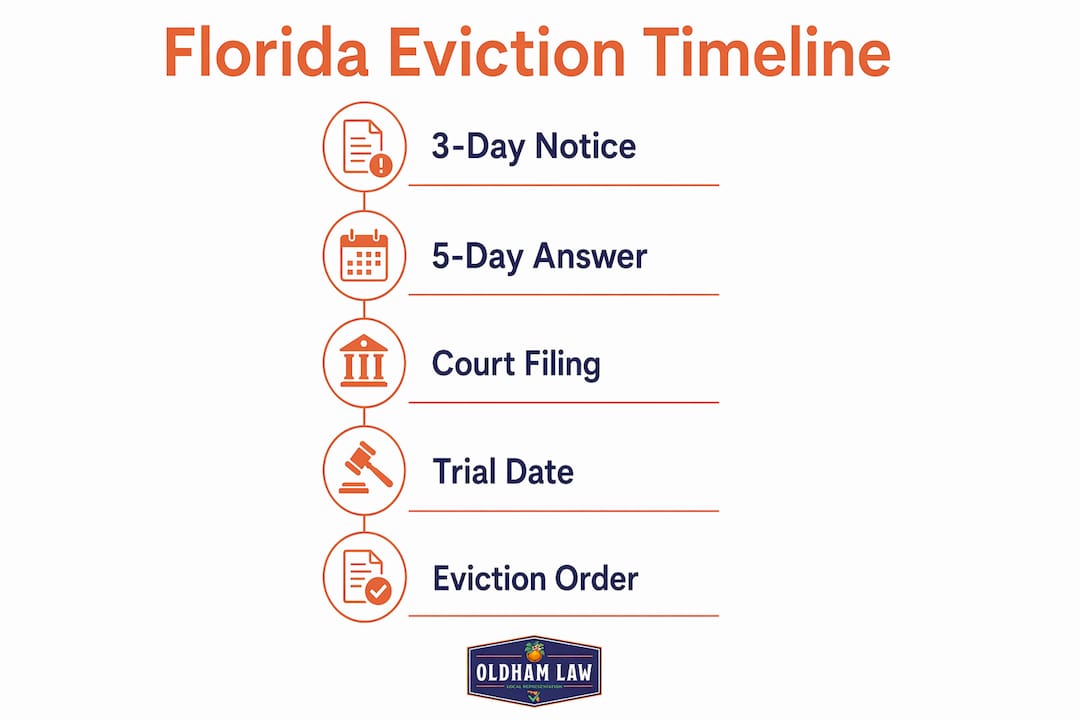
Step-by-step eviction timeline
Notice to pay or vacate. Your landlord must serve a written notice before filing anything in court. For nonpayment of rent, Florida law requires a 3-day notice. For lease violations, the landlord typically serves a 7-day notice. The clock starts the day after you receive it.
Landlord files an eviction complaint. If you do not pay, cure the violation, or vacate, the landlord files a complaint in county court. The court then issues a summons and serves it on you.
Tenant receives the summons. Service of the summons starts the most critical countdown in the entire process.
Tenant must file a written answer. Florida law requires a written answer within 5 business days of receiving the summons. That deadline is firm.
Rent escrow deposit (nonpayment cases). If the eviction is for unpaid rent, you must also deposit the full disputed rent amount into the court registry within those same 5 business days.
Court hearing. After the answer period, the judge schedules a hearing. Both sides present evidence and arguments.
Judgment and writ of possession. If the judge rules for the landlord, a writ of possession is issued. The sheriff then enforces it, which means a physical removal from the property.
| Stage | Deadline | Consequence of missing it |
|---|---|---|
| 3-day or 7-day notice | Starts before court filing | Landlord may file complaint |
| File written answer | 5 business days from summons | Default judgment against tenant |
| Deposit rent in court registry | 5 business days from summons | All defenses waived automatically |
| Court hearing | Set by judge after answer period | Judgment entered without your input |
| Writ of possession | After judgment | Sheriff removes tenant from property |
Pro Tip: Eviction deadlines count business days, not calendar days. Weekends and legal holidays do not count. Tenants who miscalculate this distinction often miss their 5-day window entirely.
What legal defenses can a tenant raise with an eviction attorney’s help?
Florida law recognizes several valid defenses that can delay, reduce, or completely dismiss an eviction case. A tenant eviction attorney helps you identify which defenses apply to your situation and builds the evidence to support them.
Common defenses available to Florida tenants:
- Improper notice. The landlord failed to serve the correct notice type, used the wrong timeframe, or delivered it improperly. A defective notice can void the entire eviction filing.
- Landlord retaliation. Florida Statutes protect tenants who report housing code violations or exercise legal rights. If your landlord filed for eviction shortly after you made a complaint, retaliation may be a valid defense.
- Habitability issues. Florida law requires landlords to maintain rental units in a livable condition. If your landlord failed to make required repairs after proper written notice, you may have grounds to contest the eviction.
- Acceptance of partial rent. If your landlord accepted rent after serving the notice, that acceptance may waive their right to proceed with the eviction.
- Payment already made. If you paid the rent owed and have proof, the eviction has no legal basis.
The strength of any defense depends almost entirely on documentation. Judges prioritize documented evidence such as dated photos, certified rent receipts, and written repair requests over verbal testimony alone. A tenant who walks into court with organized, written exhibits stands in a fundamentally different position than one who relies only on their word.
Preserving your defenses also requires completing the rent escrow step. Failing to deposit the full disputed rent into the court registry within 5 business days of service automatically waives nearly all defenses, regardless of how valid they are. This procedural requirement catches many tenants off guard.

Pro Tip: Send all repair requests to your landlord via certified mail or through a documented landlord portal. Courts treat certified mail as objective proof of notice, which is far more persuasive than a text message or verbal conversation.
How does an eviction attorney assist tenants during court proceedings?
A real estate eviction attorney does far more than show up to a hearing. Their involvement begins the moment you receive a notice and continues through every procedural step.
Ways an eviction attorney supports you:
- Drafting and filing your written answer. Your answer must respond to every allegation in the complaint and raise all defenses you intend to use. An attorney ensures nothing is omitted and that the document meets Florida court formatting requirements.
- Preparing your evidence package. Attorneys organize exhibits into timelines, labeled photos, certified payment records, and documented repair requests. This presentation directly affects how a judge evaluates your case.
- Negotiating with the landlord. Many eviction cases settle before the hearing. An attorney can negotiate a payment plan, a move-out timeline, or a lease modification that avoids a formal judgment on your record.
- Representing you at the hearing. Courtroom procedure is unfamiliar territory for most tenants. An attorney cross-examines witnesses, objects to improper evidence, and presents your case in the format judges expect.
- Advising on settlement proposals. Florida law includes specific rules around formal settlement negotiations that can affect attorney fees and case outcomes. An attorney knows when a settlement offer is favorable and when to push back.
Representation by a specialized attorney leads to better outcomes because of their familiarity with procedural nuances and their ability to present cases strategically. That experience gap between a represented and unrepresented tenant is often the deciding factor in a contested eviction hearing.
What happens if you miss critical eviction deadlines?
Missing a deadline in a Florida eviction case is not a minor setback. The consequences are immediate and often irreversible without significant legal effort.
Risks tenants face when deadlines are missed:
- Default judgment. If you fail to file a written answer within 5 business days of service, the court enters a default judgment in the landlord’s favor. You lose the right to present any defense.
- Automatic waiver of all defenses. In nonpayment cases, failing to deposit the disputed rent into the court registry within the same 5-day window strips you of every legal defense, even valid ones.
- Writ of possession issued quickly. Once a default judgment is entered, the landlord can request a writ of possession almost immediately. The sheriff can then remove you from the property with very little additional notice.
- Eviction record. A judgment for eviction becomes part of your public record and can affect your ability to rent in the future.
Pro Tip: Mark the exact date you received your summons and count forward 5 business days immediately. Do not wait to consult an attorney. Early legal consultation gives you the best chance to respond correctly and avoid a default.
Managing deadlines effectively also means keeping a written log of every interaction with your landlord, every payment made, and every document received. Organized records protect you if the case escalates and give your attorney the raw material to build a strong defense.
Key Takeaways
A tenant who retains a real estate attorney for eviction before the 5-day answer deadline expires preserves the widest range of legal defenses and the best chance of avoiding a default judgment.
| Point | Details |
|---|---|
| 5-day answer deadline | File a written answer within 5 business days of receiving the summons or lose all defenses. |
| Rent escrow requirement | Deposit the full disputed rent in the court registry within 5 business days to preserve your defenses. |
| Documentation wins cases | Dated photos, certified receipts, and written repair requests outperform verbal testimony in court. |
| Early attorney consultation | Consulting an attorney after the notice, not the summons, gives you the most options. |
| Valid defenses exist | Improper notice, retaliation, and habitability failures are recognized grounds to contest eviction in Florida. |
What we have learned from Florida eviction cases
At Oldham Law PLLC, the pattern we see most often is this: a tenant waits until they receive a court summons to call an attorney, and by that point, the window for the best outcomes has already narrowed. Most tenants wait too long before seeking legal help, and that delay costs them options that would have been available days or weeks earlier.
The tenants who fare best are the ones who call us the moment they receive a 3-day or 7-day notice. At that stage, there is still time to negotiate directly with the landlord, cure a lease violation, or identify a procedural defect in the notice itself. Those conversations often prevent a court filing entirely.
We also see tenants who have strong defenses lose their cases because they could not prove them. A landlord who ignored repair requests for months is a legitimate defense. But if those requests were made verbally, with no written record, the defense evaporates in court. The lesson is simple: document everything in writing, from the first day of a dispute.
Free resources like Florida Legal Services exist for tenants who cannot afford private counsel, and coverage varies by county. If you are in the Tampa Bay area, Pinellas County, or St. Petersburg, Oldham Law PLLC offers personalized case evaluations so you understand exactly where you stand before making any decisions.
— Oldham Law PLLC
Facing eviction in Florida? Oldham Law PLLC can help
Oldham Law PLLC serves tenants across the Tampa Bay area, including St. Petersburg, Pinellas Park, and surrounding Pinellas County communities. The firm’s attorneys bring experience in Florida landlord-tenant law, court procedure, and settlement negotiation to every eviction defense case.

Whether you received a 3-day notice this morning or a court summons this week, the time to act is now. Oldham Law PLLC evaluates your case, explains your options in plain language, and represents you through every stage of the process. From filing your written answer to negotiating a resolution that keeps an eviction off your record, the firm provides focused, personal attention to each client. Visit Oldham Law PLLC to schedule a consultation with a Florida eviction defense attorney who knows the local courts and the law.
FAQ
What does a real estate attorney for eviction do for tenants?
A tenant eviction defense attorney files your court answer, organizes your evidence, negotiates with your landlord, and represents you at hearings. Their goal is to protect your housing rights and improve your outcome under Florida landlord-tenant law.
How long do I have to respond to an eviction summons in Florida?
Florida law gives tenants 5 business days to file a written answer after receiving an eviction summons. Missing this deadline results in a default judgment against you.
What happens if I don’t pay rent into the court registry?
In nonpayment eviction cases, failing to deposit the full disputed rent amount into the court registry within 5 business days automatically waives all defenses and triggers an immediate default judgment for the landlord.
Can I fight an eviction if my landlord did not make repairs?
Yes. Unresolved habitability issues are a recognized defense under Florida law, but you must have documented proof of written repair requests and the landlord’s failure to respond. Verbal complaints alone rarely succeed in court.
When should I contact an eviction lawyer near me?
Contact an attorney the moment you receive any eviction notice, not after the summons arrives. Early legal advice maximizes your options for negotiation, defense, and avoiding a formal court judgment.
