Florida Property Ownership Types: Your Legal Rights Guide

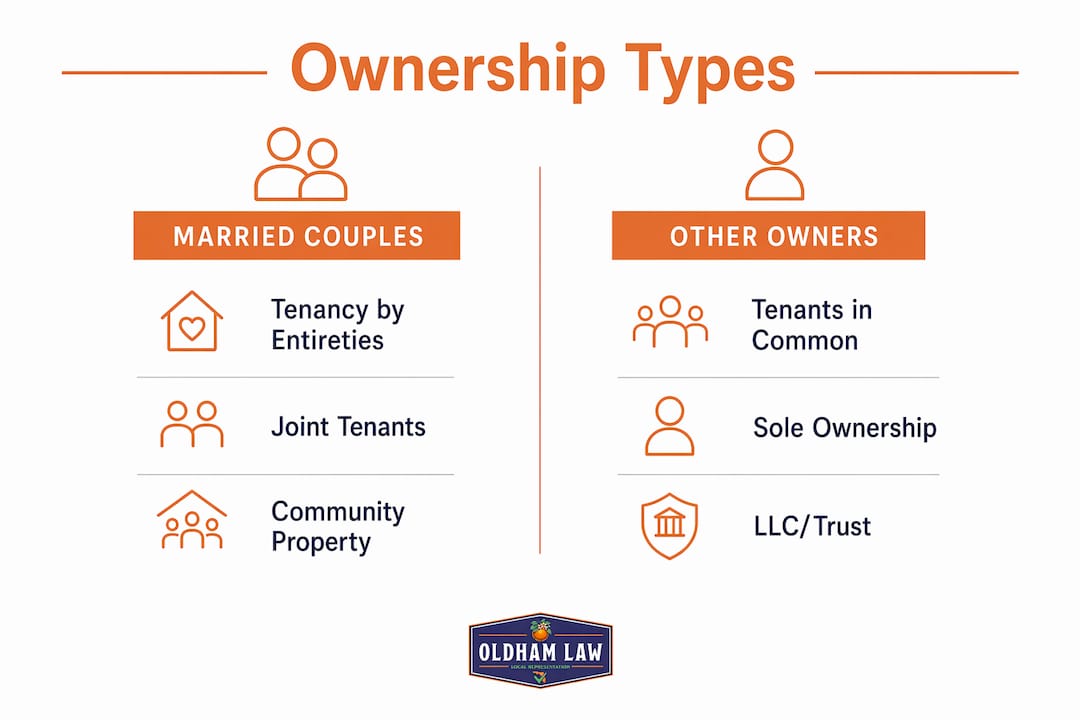
Florida recognizes three primary forms of co-ownership: Tenancy by the Entireties (TBE), Joint Tenants with Right of Survivorship (JTWROS), and Tenants in Common (TIC). The property ownership type you choose shapes everything from who inherits your home to whether a creditor can force a sale. Under Florida Statute § 689.15, if a deed conveys property to two or more people without specifying the ownership form, the law defaults to Tenants in Common. That default can have serious consequences for your estate plan if it is not what you intended.
Here is a quick snapshot of the three core structures:
- Tenancy by the Entireties (TBE): Available only to married couples; provides strong creditor protection and automatic survivorship.
- Joint Tenants with Right of Survivorship (JTWROS): Available to any co-owners; survivorship rights exist but creditor protection does not.
- Tenants in Common (TIC): The statutory default; each owner holds a separate, transferable share with no survivorship rights.
What are the main property ownership types in Florida?
Florida’s three co-ownership forms each serve a different purpose, and choosing the wrong one can cost your family time, money, and peace of mind.
Tenancy by the Entireties treats a married couple as a single legal unit. Neither spouse can sell, mortgage, or transfer the property without the other’s consent. On death, ownership passes automatically to the surviving spouse, bypassing probate entirely.
Joint Tenants with Right of Survivorship works similarly for survivorship but is open to any co-owners, married or not. The four unities of time, title, interest, and possession must exist at acquisition. When one owner dies, the surviving owners absorb the share automatically.

Tenants in Common is the most flexible structure. Owners can hold unequal percentages, sell their share independently, and pass it through a will or trust. The trade-off is that there are no survivorship rights and no protection from individual creditors.
How does Tenancy by the Entireties protect married couples?
TBE is the most protective joint ownership form Florida offers, and it is exclusively for married couples. The Florida Bar describes TBE as treating the couple as one indivisible legal entity, meaning a creditor of only one spouse cannot attach or force a sale of the property.
Key features of TBE in Florida:
- Neither spouse can unilaterally sell, transfer, or encumber the property.
- Ownership passes to the surviving spouse by operation of law, with no probate required.
- TBE status is presumed for real property held in both spouses’ names unless the deed says otherwise.
- For bank accounts, Florida Statute § 655.79 presumes TBE when the account is in both spouses’ names unless a written agreement states otherwise.
- Personal property such as investment accounts, LLC membership interests, and vehicles titled with “and” between spouses can also qualify.
Pro Tip: Practitioners warn that TBE status must be properly documented for non-real-estate assets. A TBE ownership agreement or TBE assignment can protect personal property that lacks formal titling.
What you need to know about Joint Tenants with Right of Survivorship
JTWROS gives co-owners, whether married or unmarried, the right to inherit each other’s shares automatically at death. It shares five of the six unities required for TBE, with the only missing element being the unity of marriage.
- All four unities (time, title, interest, possession) plus survivorship must be present at acquisition.
- Any joint tenant can sever the tenancy unilaterally, which converts ownership to TIC and eliminates survivorship rights.
- JTWROS offers no protection against a creditor of one co-owner; that creditor can pursue the debtor’s interest.
- Unmarried partners, siblings, or business partners who want survivorship rights without the TBE protections often use this form.
Severing a JTWROS changes the inheritance and creditor picture significantly. If you and a co-owner have a falling out and one party transfers their interest, the survivorship right disappears for everyone.
How Tenants in Common works as Florida’s default ownership
TIC is the form Florida law assigns when a deed is silent on ownership structure. Each owner holds a defined percentage interest, and those percentages do not have to be equal. One person can own 70% while another owns 30%.
- Each owner’s interest is independently transferable during life and at death.
- TIC interests pass through a will, trust, or intestate succession, not automatically to co-owners.
- Individual creditors can pursue a TIC owner’s share, potentially forcing a partition sale.
- There are no survivorship rights; the co-owner does not inherit your share simply because you shared title.
TIC works well for investors or family members who want flexibility, but it can create complications when one owner dies without a clear estate plan. The surviving co-owners may suddenly find themselves sharing title with a stranger who inherited the deceased’s share.
Florida Homestead Law and how it affects every ownership type
Florida’s homestead protections apply regardless of how title is held, and they catch many owners off guard. Florida Constitution Article X Section 4© requires both spouses to sign any deed or mortgage on a homestead property, even if only one spouse is on the title.
- A sole owner who is married cannot sell or mortgage the family home without the other spouse’s signature.
- Lenders require the non-borrowing spouse to sign the mortgage, not to obligate payment but to grant lien consent.
- Transactions that skip this requirement can be voided, creating costly litigation to correct the title.
- Homestead protection also limits creditors from forcing a sale of a primary residence in most circumstances.
Pro Tip: If you are refinancing or selling a home where only one spouse holds title, Florida law still requires the other spouse to sign. Skipping this step can render the transaction voidable.
Estate planning and probate implications of ownership structure
How you hold title is one of the most consequential estate planning decisions you will make. TBE and JTWROS both function as built-in probate bypass mechanisms because ownership transfers automatically at death. TIC does not.
- TBE and JTWROS assets transfer outside of probate, saving time and legal fees for surviving owners.
- TIC interests must pass through the probate process or a trust, adding delay and expense.
- Choosing the wrong form can expose property to a deceased owner’s creditors during probate.
- Clear deed language reflecting your actual intent is critical; a vague or outdated deed can default to TIC under § 689.15.
- Life estates and Lady Bird deeds offer additional tools for transferring property outside probate while retaining control during life.
Sole ownership, where one person holds title alone, passes through probate unless a beneficiary deed or trust is in place. For married homeowners in Florida, TBE is almost always the stronger choice for the primary residence.
Does Florida recognize community property?
Florida is not a community property state. In community property states like California, Texas, and Arizona, most assets acquired during marriage are owned equally by both spouses by default. Florida does not follow that rule.
Instead, Florida uses the equitable distribution framework for marital property in legal proceedings, and the ownership type on the deed or account controls how property is treated during life. Married couples who want shared ownership and mutual protection should explicitly choose TBE rather than relying on any community property assumption, which Florida law does not recognize.
Ownership by LLCs and trusts in Florida
Holding property through a legal entity is a common strategy for asset protection and estate planning. An LLC or a revocable living trust can own Florida real estate, and each structure carries distinct advantages.
An LLC separates personal liability from property ownership, which appeals to investors and landlords. A revocable living trust allows property to transfer to beneficiaries at death without probate, while the grantor retains full control during life. Married couples can also hold TBE property inside a properly structured trust, preserving the creditor protections as long as the six TBE unities remain intact. For business law questions related to entity ownership, the structure of the LLC operating agreement matters as much as the deed itself.
How ownership type affects property taxes and creditor protection
Florida’s homestead exemption reduces the assessed value of a primary residence for property tax purposes, and it is available regardless of whether the owner holds title alone or with a spouse. The Save Our Homes cap, which limits annual assessment increases, attaches to the homestead and follows the property under most transfer scenarios.
Creditor protection varies sharply by ownership type. TBE blocks individual creditor claims entirely. JTWROS offers no such shield. TIC interests are fully exposed to each owner’s individual creditors. For homestead property, the Florida Constitution provides a separate layer of creditor protection against forced sale, but that protection does not extend to non-homestead real estate.
How to change or transfer ownership types in Florida
Changing how you hold title requires a new deed. Florida recognizes several deed types, each serving a different purpose: warranty deeds, quit claim deeds, and Lady Bird deeds (also called enhanced life estate deeds) are the most common tools for transferring property title or restructuring ownership.
To convert TIC to JTWROS, both owners must execute a new deed that expressly states the right of survivorship. To establish TBE, a married couple must take title in a deed that reflects their marital status and intent. Severing a joint tenancy is as simple as one owner conveying their interest to a third party or back to themselves, which automatically converts the remaining ownership to TIC. Every change should be recorded in the county where the property sits to be legally effective.
Sole ownership in Florida
Sole ownership means one person holds the entire title with no co-owners. It is straightforward during life but creates planning challenges at death. Without a will, trust, or beneficiary designation, a solely owned property goes through probate, which can take months and cost the estate legal fees.
Married sole owners face an additional layer of complexity under Florida homestead law. Even though only one spouse is on the deed, the other spouse retains constitutional rights in the property as the family home. That means both spouses must still sign any deed or mortgage on a homestead, as noted earlier. Sole ownership works cleanly for unmarried individuals with a solid estate plan, but it rarely serves married couples as well as TBE does.
Key Takeaways
Florida’s choice of ownership type directly controls probate exposure, creditor vulnerability, and survivorship rights, making it one of the most consequential decisions in any real estate transaction.
| Point | Details |
|---|---|
| Default is Tenants in Common | Florida Statute § 689.15 defaults to TIC when a deed is silent, eliminating survivorship rights. |
| TBE is the strongest protection | Only married couples qualify; it blocks individual creditor claims and bypasses probate automatically. |
| JTWROS can be severed unilaterally | Any joint tenant can convert the tenancy to TIC, removing survivorship rights for all owners. |
| Homestead law overlays all ownership types | Florida Constitution Article X Section 4© requires both spouses to sign any deed or mortgage on a primary residence. |
| Deed language controls everything | Vague or outdated deeds default to TIC; clear, recorded language reflecting your intent is the only reliable safeguard. |
FAQ
What are the different types of property ownership in Florida?
Florida recognizes sole ownership, Tenancy by the Entireties, Joint Tenants with Right of Survivorship, Tenants in Common, life estates, and ownership by entities such as LLCs and trusts. Each form carries distinct rights, creditor protections, and probate consequences.
What is the default ownership type when a Florida deed is silent?
Under Florida Statute § 689.15, a conveyance to two or more people with no ownership designation defaults to Tenants in Common, which carries no survivorship rights.
What are the four types of property titles?
Florida property titles are generally categorized as sole ownership, joint tenancy (including JTWROS and TBE), tenancy in common, and entity ownership through trusts or LLCs. The type recorded on the deed determines legal rights and transfer at death.
Can a married couple in Florida own property as community property?
No. Florida does not recognize community property. Married couples who want shared ownership with mutual protections should hold title as Tenancy by the Entireties, which is Florida’s equivalent protective structure for spouses.
How does ownership type affect probate in Florida?
TBE and JTWROS both transfer property to the surviving owner automatically, bypassing the probate process. TIC and sole ownership interests must pass through probate unless a trust or beneficiary deed is in place.
If you are buying, selling, or restructuring property in Pinellas County or the Tampa Bay area, the ownership type on your deed has real legal and financial consequences. Oldham Law PLLC helps clients in St. Petersburg and the surrounding area choose the right structure, prepare accurate deeds, and build estate plans that reflect their actual intentions. Contact Oldham Law PLLC to speak with a Florida real estate attorney who understands the local landscape and can guide you through every step.