
Probation in FL: Rules, Conditions, & Termination

When you leave court with a probation sentence, the first feeling is usually not relief. It's uncertainty. You're trying to figure out what you can still do, what you need permission to do, and how one mistake could affect the rest of the case.
That reaction is normal. Probation in FL is often presented as the better outcome because it can keep you out of jail or reduce time behind bars, but it still comes with rules that affect your daily life. If you treat it casually, problems build fast. If you understand how supervision works, probation becomes much more manageable.
Understanding Your Florida Probation Sentence
Florida uses probation in a large share of criminal cases. A Florida overview notes that the state supervises about 115,000 offenders at a given time, and probation is frequently used to avoid or shorten jail time, with typical terms running from 1 to 5 years, although some periods can last longer depending on the offense and conditions imposed, as explained in this Florida probation overview.
That matters for one reason. You are not dealing with some unusual court order. You are dealing with a system that courts use every day, which means there are patterns, expectations, and practical ways to stay out of trouble.
Probation is a sentence served in the community under court-ordered conditions. It is not informal. It is not something you can “mostly” comply with. The court expects full compliance, and your probation officer will be tracking whether you follow the terms imposed in your case.
If you've just been sentenced, start with the basics:
- Read Every Written Condition: Don't rely on memory from the hearing.
- Know Your Reporting Rules: Missed reporting is one of the fastest ways to create trouble.
- Calendar Deadlines Immediately: Payment dates, classes, treatment, and community service all need a system.
- Ask Before You Act: Travel, address changes, and job changes often require approval.
Practical rule: If a condition affects where you go, who you contact, what you pay, or what programs you complete, assume you need documentation.
People often hurt their own cases by guessing. They assume a short trip won't matter, a late payment will sort itself out, or a missed appointment can be explained later. That approach usually fails. A better approach is to treat probation like a standing court order that follows you into everyday life.
If you need help understanding what your sentence requires, it's smart to get case-specific guidance from a Florida criminal defense attorney.
Probation Versus Community Control In Florida
Probation and community control both fall under court supervision, but they are not the same experience. Confusing them can lead to bad assumptions about how much freedom you have.
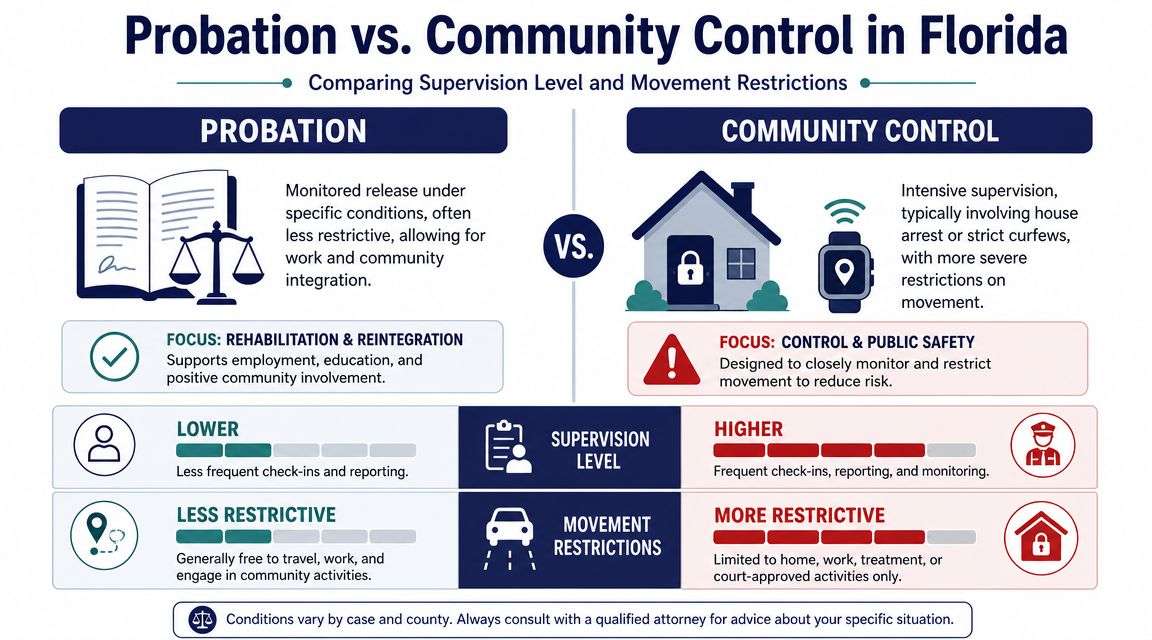
What Standard Probation Usually Looks Like
Standard probation is monitored release under conditions set by the court. You live in the community, report as directed, and comply with whatever requirements apply to your case. For many people, that includes work, family responsibilities, treatment, classes, and regular communication with a probation officer.
A simple way to think about it is this. Probation is like supervised freedom. You are not locked up, but your choices are limited by written rules.
That doesn't mean it's easy. It means the system gives you room to keep living your life if you stay organized and compliant.
How Community Control Is Different
Community control is much tighter. People often think of it as house arrest or near-house-arrest supervision. Movement is far more restricted, and the consequences for unauthorized travel or schedule changes are usually more immediate.
If probation is like routine supervision, community control is intensive supervision at home and in the community. The level of scrutiny is higher. Everyday activities often require closer approval and stricter timing.
Here's the practical difference:
- Probation: More flexibility for work, appointments, and normal life, but only within approved conditions.
- Community Control: Much narrower movement, stricter schedules, and less room for informal changes.
- Both: Violations can still lead to serious consequences.
The label on your sentence matters. A person on probation should not assume the same restrictions as someone on community control, and a person on community control should never assume ordinary probation flexibility.
Why Clients Need To Know Which One They Have
Many problems start when someone hears “supervision” and stops there. That's not enough. You need to know exactly which form of supervision the court ordered, what paperwork controls it, and whether any added special conditions tighten the rules beyond the standard package.
This is especially important if you are trying to manage a work schedule, family caregiving, medical appointments, or travel obligations. The right question is not “Can people on probation do this?” The right question is “Can I do this under my specific order?”
That shift in mindset prevents a lot of avoidable violations.
The Standard And Special Conditions Of Probation
Individuals on probation often focus on the obvious rule. Don't get arrested again. That's important, but it's only part of the picture. Day to day, probation is usually won or lost through the smaller conditions people underestimate.
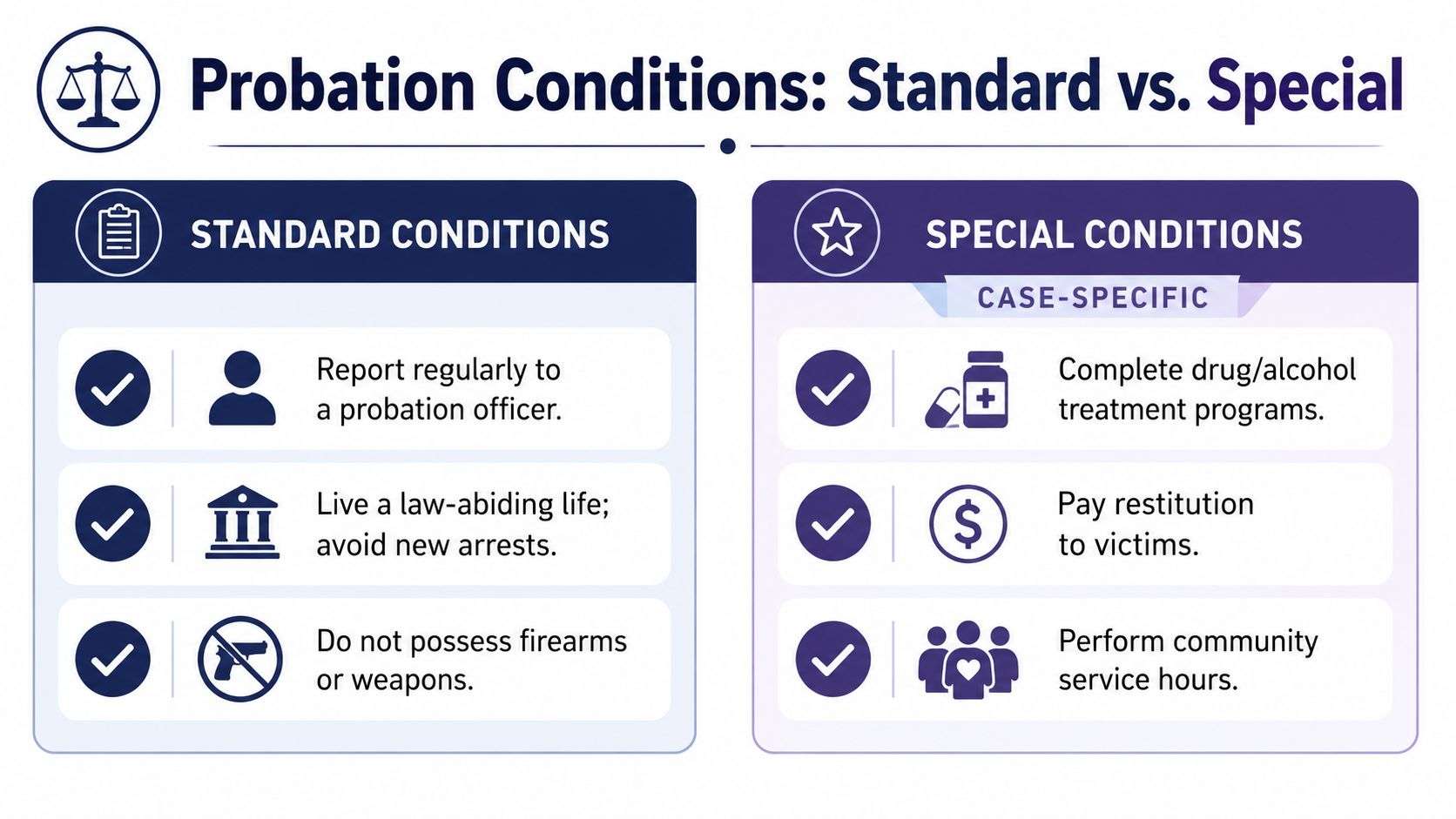
Standard Conditions Most People Must Follow
Florida probation usually comes with a base set of rules. They often include reporting as directed, obeying the law, avoiding prohibited weapons, and following supervision instructions. Those standard conditions apply broadly and give the probation officer a framework to monitor compliance.
What trips people up is consistency. One missed report, one ignored instruction, or one undocumented change can turn an otherwise manageable case into a violation issue.
A good working routine usually includes:
- One Calendar For Everything: Court dates, reporting dates, classes, treatment sessions, and payment reminders should all live in one place.
- One Folder For Documents: Keep receipts, certificates, travel approvals, pay stubs, and proof of residence together.
- One Contact Rule: If something changes, notify the proper person before the change happens when possible.
Special Conditions That Change Daily Life
Courts can also impose special conditions tied to the case. Florida law allows conditions that restrict travel, residence, employment, and similar issues, and probationers often need formal consent from a probation officer to change address or leave the state, as reflected in Florida's probation conditions statute.
Special conditions are where real-life problems often begin. A person gets a better job in another county. A family member needs help out of town. An employer asks for travel. Someone wants to move in with a partner or relocate for childcare. None of those situations sounds criminal, but each can become a probation problem if handled informally.
If your case involves allegations tied to family or household relationships, added restrictions may also overlap with issues discussed in matters involving domestic violence defense.
How To Handle Travel, Moves, And Job Changes
The safest approach is simple. Don't make the change first and explain later.
Use this checklist instead:
Get The Exact Requirement In Writing
Check whether your order limits travel, residence, employment, contact with certain people, or curfew hours.Give Advance Notice
Last-minute requests are harder to approve and harder to defend later.Provide Supporting Documents
Work itinerary, offer letter, lease information, medical paperwork, or family-care records can help show the request is legitimate.Keep Proof Of Approval
Verbal approval is risky. Save emails, signed forms, or written instructions.
If a move, trip, or schedule change matters enough to mention, it matters enough to document.
People often assume probation is about avoiding major misconduct. In practice, it's also about handling ordinary life through the proper channel.
Managing Your Supervision Costs And Reporting
Probation doesn't just limit behavior. It also creates an administrative routine. You have to report, keep records, complete requirements, and stay current on money obligations that can feel never-ending if you don't have a system.
What Reporting Usually Requires
Your probation officer is not the judge, but the officer plays a major role in how your compliance is documented. That means your relationship with supervision should be respectful, organized, and honest.
Reporting usually works best when you treat it like a job requirement. Be on time. Bring what was requested. Answer questions directly. Don't guess, and don't try to smooth over a problem by minimizing it. If you missed something, say so and bring proof of what you've done to correct it.
A few habits make reporting easier:
- Keep A Running Compliance File: Payment receipts, treatment attendance, course completion records, and work documents should be easy to access.
- Confirm Instructions: If you leave a meeting with a new deadline or task, write it down immediately.
- Raise Problems Early: Transportation issues, schedule conflicts, or document delays are easier to address before they become noncompliance.
The Cost Side Of Probation
The financial side surprises many people. One Florida practice summary notes a $50 monthly supervision fee plus surcharges, along with court costs and restitution, in its discussion of Florida probation conditions and fees.
For someone already dealing with rent, transportation, childcare, or treatment costs, those obligations can become the hardest part of probation. The mistake is staying silent after falling behind. That usually creates a paper trail of noncompliance without any context about why it happened.
Bring the problem forward before it becomes a violation issue. Courts and officers can't evaluate a hardship they never hear about.
If your case started with an alcohol-related offense, related obligations may overlap with issues people face after a Florida DUI arrest, especially when treatment, classes, and payment schedules stack on top of supervision requirements.
What Works When Money Is Tight
When finances get strained, the practical move is to act, not disappear.
Try this approach:
- Document Your Income And Expenses: Pay stubs, bills, and job-search records matter.
- Make Partial Compliance Visible: Even if you can't finish everything immediately, showing effort is better than vanishing.
- Ask About Procedure, Not Favors: Find out how payment issues are reported and what documentation should be submitted.
- Talk To Counsel If The Terms Have Become Unrealistic: Some conditions may need court attention if they no longer fit your circumstances.
Ignoring costs rarely solves anything. A documented hardship has a chance to be addressed. An unexplained default usually does not.
What Happens If You Violate Probation In Florida
Upon hearing “probation violation,” the assumption can be that every mistake leads straight to jail. That's not how the system always works. The first question is what kind of violation the state is alleging.
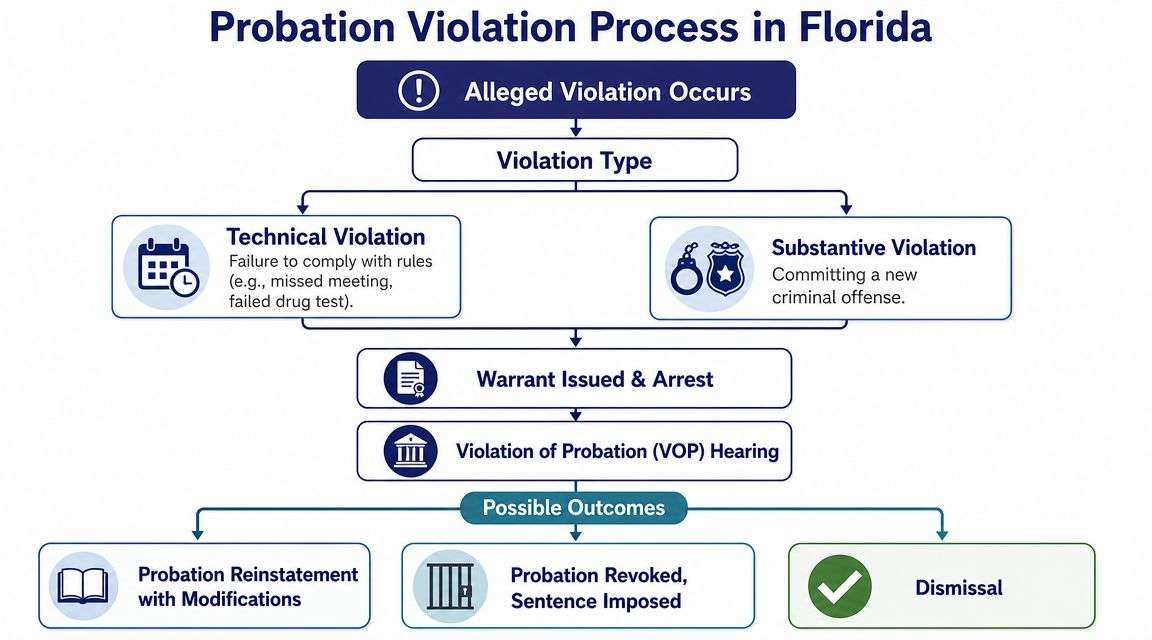
Technical Violations And New Law Violations
Florida distinguishes between a technical violation and conduct that involves a new criminal offense. That distinction matters because the court's response can be very different.
A technical violation is a supervision breach that is not a new felony, misdemeanor, or criminal traffic offense under the statutory framework discussed in Florida Statute 948.06. In practical terms, that can include problems like failing to report, violating curfew, missing required programming, or other noncriminal compliance failures.
A new law violation is more serious because it places a fresh criminal allegation on top of the probation case. Once that happens, the risk level changes fast.
When A Technical Violation May Stay Administrative
For certain low-risk technical violations, Florida uses an alternative sanctioning process instead of immediately pushing every case into full litigation. The law allows sanctions such as short county jail stays, additional community service, counseling or treatment, support-group attendance, drug testing, curfew, house arrest, or loss of privileges. For certain qualifying low-risk probationers with a first-time violation in the current term, the court is directed to modify or continue probation rather than immediately revoke it, under the current Florida statutory framework for probation violations.
That doesn't mean a technical violation is harmless. It means the defense analysis starts with eligibility questions:
- Is it technical, or does the state claim a new offense?
- Does the person qualify as low-risk under the statutory process?
- Has there already been a filed violation in the current supervision term?
- Was the issue something like reporting, travel, curfew, or payment compliance?
Those details often determine whether the case can stay in an administrative lane or escalate to revocation exposure.
What Usually Makes Things Worse
Several choices consistently damage violation cases:
- Ignoring Contact From Supervision
- Admitting Facts Casually Without Legal Advice
- Showing Up To Court Without Records
- Assuming A Minor Violation Will “Blow Over”
If a violation affidavit has been filed or you believe one may be coming, get focused legal advice immediately. The strategy in a violation of probation case depends on the type of allegation, your compliance history, and whether the issue can still be corrected or reframed before the matter hardens into a revocation fight.
Some probation cases are won by disproving the allegation. Others are won by showing the conduct fits a lower-risk category and should be handled as a compliance problem, not a revocation case.
The biggest mistake is treating every violation as the same. They aren't.
Seeking Early Termination Or Modification Of Probation
Probation isn't always fixed in stone. In the right case, a court can shorten it or change a condition that no longer makes sense.

When Early Termination Makes Sense
Early termination is usually strongest when the person has done what the court asked, stayed violation-free, and shown that continued supervision no longer serves much purpose. Judges want to see performance, not promises.
Good facts for this type of request often include:
- completed classes or treatment
- current payment status
- steady employment
- stable residence
- no new arrests or supervision problems
- strong documentation of compliance
Not every case is a fit. Some sentences involve conditions or offense types that make early termination harder. But many people wait too long to even ask the question.
Modification Can Solve Real-World Problems
Sometimes the issue isn't ending probation. It's changing one condition so the person can keep working, caring for family, or handling a move without setting up a violation.
That could involve a curfew conflict, travel restriction, employment limitation, treatment schedule problem, or another term that has become unworkable in practice. Courts are more likely to consider changes when the request is specific, supported, and tied to legitimate needs rather than convenience.
A useful request usually does three things:
- identifies the exact condition causing the problem
- explains why the problem is real and documented
- proposes a reasonable alternative the court can approve
A vague request sounds optional. A documented request tied to work, treatment, or family obligations sounds responsible.
Preparation Matters More Than Hope
People sometimes think the court will reward good intentions automatically. It won't. These motions are strongest when they are built around records, compliance history, and a practical reason the requested change serves both the client and the court's supervision goals.
That's one reason legal counsel can matter here. A lawyer can help decide whether to seek termination, ask for modification, or wait until the facts are stronger.
How An Attorney Can Help With Your Florida Probation Case
Probation in FL is manageable when you stop treating it like a vague warning and start treating it like an enforceable set of instructions. Most problems come from three things. Poor documentation, delayed communication, and assumptions about what the court will excuse.
A lawyer helps by narrowing the issue quickly. Is the condition clear or ambiguous? Does the alleged violation fit the technical category? Is there a way to fix the problem before it expands? Would a motion for modification make more sense than waiting for noncompliance to become formal?
Legal help is especially useful when the stakes rise. That includes pending violation allegations, denied travel requests, payment trouble that may be viewed as noncompliance, or conditions that interfere with work and family responsibilities. In those situations, strategy matters more than general advice.
One option for people in the Tampa Bay area is Oldham Law's DUI lawyer resource, which reflects the firm's criminal defense work alongside related court and supervision issues. More broadly, probation counsel can help review the order, communicate with the right parties, prepare motions, and present the case in a way the court can act on.
The goal is simple. Keep a manageable case manageable. If the case is already in trouble, build a plan before the court makes the next decision for you.
If you're dealing with probation questions, a travel issue, a job change, payment problems, or an alleged violation, Oldham Law PLLC can review your situation and help you build a practical game plan. A clear answer early often prevents a much harder problem later.
