
What Is a Probate Lawyer? Your Florida Guide

A probate lawyer is a licensed Florida attorney who specializes in guiding families and personal representatives through the court-supervised process of settling a deceased person’s estate. When someone passes away, their assets don’t automatically transfer to heirs. A legal process called probate must happen first, and a probate lawyer is the professional who makes sure that process goes smoothly, legally, and without costly mistakes.
Here is what a probate lawyer typically handles in Florida:
- Legal filings with the probate court, including petitions, inventories, and accountings
- Interpreting Florida Probate Code chapters 731–735 and the Florida Probate Rules
- Advising the personal representative on fiduciary duties and legal obligations
- Managing creditor claims and ensuring proper notice is given to interested parties
- Guiding asset distribution to beneficiaries according to the Will or Florida law
- Reducing personal liability risk for the personal representative throughout administration
Not every probate path legally requires an attorney. Florida law allows certain small estate procedures without one. But for most families dealing with a formal estate, having a qualified probate lawyer is the difference between a process that takes months and one that drags on for years, with costly errors along the way.
Why probate is necessary and how it works in Florida
Probate is the legal process by which a deceased person’s estate is administered under court supervision. Its core purpose is to transfer ownership of assets that were held in the decedent’s name alone, with no built-in mechanism to pass them automatically at death. Think of it as the legal handoff: the court validates the Will (or applies Florida law when there isn’t one), confirms who gets what, and makes sure debts are paid before anything goes to heirs.
Florida’s probate system is governed by the Florida Probate Code, chapters 731–735, along with the Florida Probate Rules. The process generally involves three core steps:
- Identifying and inventorying the decedent’s probate assets
- Paying valid debts, taxes, and expenses of the estate
- Distributing the remaining estate to beneficiaries
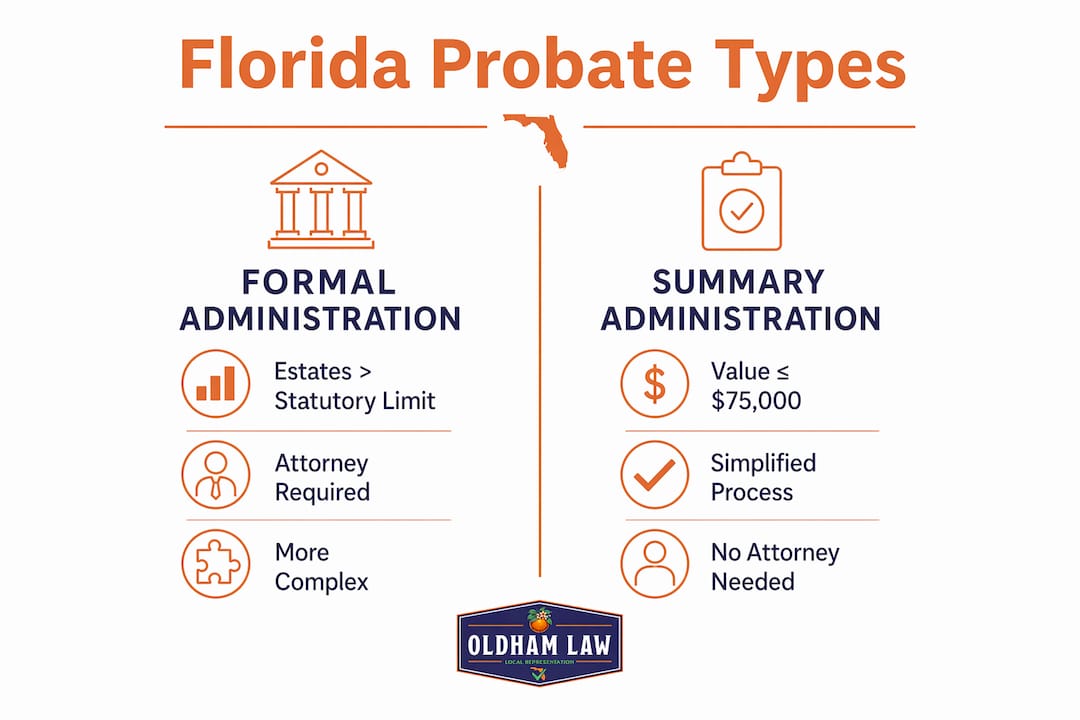
Florida offers three main types of probate administration, each with different requirements:
| Type | When It Applies | Attorney Required? |
|---|---|---|
| Formal Administration | Estates exceeding a statutory threshold or when needed | Yes, in most cases |
| Summary Administration | Estates below the statutory threshold | Not legally required, but recommended |
| Disposition Without Administration | Very small estates, limited assets | Generally not required |
Not all assets go through probate in Florida. Assets with a named beneficiary (like life insurance or retirement accounts), jointly owned property with right of survivorship, and assets held in a living trust all pass outside the probate process entirely. Understanding which assets are “probate assets” and which are not is one of the first things a probate lawyer helps you sort out.
What a Will does and what happens if there isn’t one
A Will is a legal document signed by the decedent in the presence of two witnesses that names beneficiaries and appoints a personal representative to administer the estate. Under Florida law, a valid Will must meet specific execution requirements, and any document that doesn’t meet them may be rejected by the probate court.
When a valid Will exists, the probate process follows the decedent’s expressed wishes. The named personal representative steps in, the court validates the Will, and administration proceeds according to its terms. That clarity makes everything faster and less contentious.
Without a Will, Florida’s intestate succession laws take over. The court appoints a personal representative based on a statutory priority list, and assets are distributed according to Florida’s default rules, not the decedent’s wishes. A surviving spouse, children, and other relatives receive shares determined entirely by statute.
Common problems that arise when there is no Will:
- Family members may disagree about who should serve as personal representative
- Assets may pass to unintended heirs under the statutory formula
- The process often takes longer because the court has more decisions to make
- Blended families face particularly complicated outcomes under intestate rules
- Minor children may require a guardian ad litem, adding cost and delay
A valid Will doesn’t eliminate probate, but it simplifies it considerably. It gives the court clear instructions and reduces the room for disputes.
Who is involved in the Florida probate process?
Probate isn’t a solo endeavor. Several parties play defined roles, and understanding who does what helps you see why the process can get complicated quickly.
- Personal representative (PR): The individual or institution appointed to administer the estate. The PR gathers assets, pays debts, files required documents, and distributes the estate. This role carries significant legal responsibility and personal liability if duties are breached.
- Probate court: Florida’s circuit courts handle probate matters. A circuit court judge oversees the administration, approves key actions, and resolves disputes.
- Probate lawyer: Advises and represents the personal representative throughout administration, handles all legal filings, and ensures compliance with Florida law.
- Creditors: Anyone owed money by the decedent has the right to file a claim against the estate during the creditor claim period.
- Beneficiaries and heirs: The people entitled to receive assets from the estate. They are “interested persons” with legal standing to receive notices and object to actions.
- Letters of Administration: A court-issued document that officially authorizes the personal representative to act on behalf of the estate. Banks, financial institutions, and government agencies require this document before releasing any assets.
Each of these parties has rights and obligations under Florida law. The probate lawyer’s job is to keep all of them properly informed and the process moving forward without missteps.
When you should hire a probate lawyer in Florida
Florida law is direct on this point: under Florida Probate Rule 5.030(a), a personal representative in formal administration must be represented by a Florida-licensed attorney unless the PR is the sole interested person in the estate. In practical terms, if anyone else stands to inherit or has a claim, you need a lawyer.

For summary administration, estates valued at $75,000 or less, attorney representation is not legally required. The same applies to disposition without administration for very small estates. But “not required” doesn’t mean “not wise.” Even in simpler cases, a single procedural error can delay the process or expose the PR to personal liability.
Situations where hiring a probate lawyer is especially important:
- The estate includes real property, business interests, or complex assets
- Creditors have filed claims or disputes are anticipated
- Beneficiaries are in conflict or a Will is being contested
- The decedent had debts that may exceed the estate’s value
- There is no Will and the family structure is complicated
- The estate may owe federal estate taxes
The risks of proceeding without legal guidance in formal administration are real. A personal representative who makes unauthorized distributions, misses a creditor deadline, or fails to file required accountings can be held personally liable for resulting losses.
Pro Tip: Contact a qualified probate lawyer as early as possible, ideally before filing anything with the court. Early guidance is almost always less expensive than fixing mistakes made without it.
What Florida probate lawyers know that most people don’t
One of the most common misconceptions families encounter is believing the probate lawyer represents the personal representative personally. That’s not how it works. The lawyer’s primary duty is to the estate itself, and by extension to the proper fulfillment of the PR’s fiduciary obligations. That distinction matters when conflicts arise between what the PR wants and what the estate’s beneficiaries are entitled to receive.
The personal representative owes fiduciary duties to the estate and its beneficiaries. These include the duty of loyalty, the duty to act prudently, and the duty to keep beneficiaries reasonably informed. A probate lawyer helps the PR understand and fulfill each of these obligations, and protects them from inadvertently breaching duties that could trigger personal liability.
Key legal realities that often surprise families:
- Serving as a personal representative in formal administration is considered practicing law in Florida, which is why attorney representation is legally mandated in most cases
- Creditors have a three-month period to file claims during formal administration, and no court can waive or shorten that deadline
- The 10-day rule requires filing the Will with the probate court within 10 days of learning of the decedent’s death
- Probate lawyers assist with filings, creditor claim management, and interpretation of the Florida Probate Code to avoid court delays
Creditor claim period: Florida law gives creditors three months from the date of first publication of the Notice to Creditors to file claims in formal administration. Missing this window, or failing to publish notice correctly, can create serious legal complications for the estate.
How long does the Florida probate process take?
The timeline varies significantly depending on the type of administration and the complexity of the estate. Summary administration can often be completed in four to eight weeks when the paperwork is in order. Formal administration, by contrast, rarely wraps up in less than six months, and complex estates with disputes or creditor issues can take a year or more.
A general timeline for formal administration looks like this:
- Filing the petition and opening the estate with the court (weeks 1–2)
- Appointment of the personal representative and issuance of Letters of Administration (weeks 2–4)
- Publication of Notice to Creditors and the mandatory three-month creditor claim period
- Inventory and appraisal of estate assets (typically within 60 days of appointment)
- Resolution of creditor claims and payment of valid debts
- Filing of accountings and petition for distribution
- Court approval and final distribution to beneficiaries
A probate lawyer keeps each of these steps on track, files documents on time, and responds to court requirements promptly. Delays usually come from missing deadlines, incomplete filings, or unresolved disputes. Learn more about probate timelines in Florida and what affects them.
Common challenges that complicate Florida probate cases
Even well-organized estates can run into obstacles. Knowing the most common complications helps you prepare and understand why legal guidance matters.
Will contests are among the most disruptive. A beneficiary or heir who believes the Will was signed under undue influence, when the decedent lacked capacity, or that it was improperly executed can file a formal challenge. These disputes can freeze the entire estate for months and require probate litigation to resolve.
Creditor disputes arise when the estate doesn’t have enough assets to pay all valid claims, or when the PR disputes the validity of a creditor’s claim. Determining which debts get paid first, and in what order, requires careful application of Florida’s priority rules.
Other frequent complications include:
- Locating and valuing assets, especially when records are incomplete
- Real property with title defects or co-ownership issues
- Out-of-state assets that may require ancillary probate in another jurisdiction
- Beneficiaries who are minors or have special needs, requiring additional court oversight
- Disputes among co-personal representatives or between the PR and beneficiaries
Each of these situations adds time, cost, and legal complexity. A probate lawyer who knows Florida’s courts and procedures can often resolve complications before they escalate.
Alternatives to probate in Florida
Not every estate has to go through the full probate process. Florida offers several paths that can reduce or eliminate the need for court administration entirely.
Living trusts are the most flexible option. Assets held in a properly funded revocable living trust pass directly to beneficiaries at death, bypassing probate completely. The trustee administers the trust according to its terms without court involvement.
Joint ownership with right of survivorship means the surviving owner automatically inherits the deceased owner’s share. This works for real estate, bank accounts, and other assets titled jointly.
Beneficiary designations on life insurance policies, retirement accounts (IRAs, 401(k)s), and payable-on-death bank accounts transfer assets directly to named beneficiaries outside of probate.
Summary administration is available when the estate’s value is $75,000 or less, or when the decedent has been dead for more than two years. It’s a simplified court process with fewer steps than formal administration.
Disposition without administration applies to very small estates where the only assets are exempt property or amounts needed to reimburse a person who paid the decedent’s final expenses. No personal representative is appointed, and the process requires minimal court involvement.
Understanding which assets are exempt from probate in Florida is a smart first step in any estate plan. The more assets you can position to pass outside probate, the simpler the process becomes for your family.
Oldham Law PLLC guides Tampa Bay families through Florida probate
Probate is one of those legal processes where the right attorney makes a measurable difference, not just in how smoothly things go, but in how much it costs and how long it takes. Oldham Law PLLC works with families across St. Petersburg, Pinellas Park, and the broader Tampa Bay area to handle probate matters with the focused attention each case deserves.

The attorneys at Oldham Law PLLC bring a background in both prosecution and insurance defense, giving them a practical, multi-angle view of how estates are administered and where disputes tend to arise. That experience translates directly into better guidance for personal representatives navigating formal administration, creditor claims, and asset distribution under Florida law. The firm’s approach is value-driven: personalized legal strategy aimed at protecting your family and minimizing unnecessary expense.
Whether you’re dealing with a straightforward estate or a complicated situation involving real property, creditor disputes, or a contested Will, Oldham Law PLLC offers the local expertise and personal attention your family needs. Reach out to the firm’s Florida probate attorneys to discuss your situation and get clear answers about your next steps.
Key Takeaways
A probate lawyer in Florida is a licensed attorney legally required in most formal administrations, whose primary duty runs to the estate, not the personal representative personally.
| Point | Details |
|---|---|
| Attorney requirement | Florida Probate Rule 5.030(a) mandates attorney representation in formal administration unless the PR is the sole interested person. |
| Creditor claim window | Creditors have a three-month period to file claims in formal administration; no court can shorten this deadline. |
| Small estate options | Summary administration applies to estates of $75,000 or less and does not legally require an attorney, though one is often recommended. |
| Probate alternatives | Living trusts, beneficiary designations, and joint ownership can position assets to pass entirely outside the probate process. |
| Oldham Law PLLC | Serves Tampa Bay families in St. Petersburg and Pinellas Park with personalized probate representation focused on protecting personal representatives and beneficiaries. |
FAQ
How much does a Florida probate lawyer cost?
Florida probate attorney fees are typically based on the estate’s value, often calculated as a percentage set by Florida statute, though hourly and flat-fee arrangements are also used. You can find a detailed breakdown of probate costs in Florida to understand what to expect before you hire.
What is the 10-day rule for probate in Florida?
Florida law requires anyone in possession of a Will to file it with the probate court within 10 days of learning of the decedent’s death. Failing to do so can create legal complications and potential liability.
What assets must go through probate in Florida?
Assets titled solely in the decedent’s name with no beneficiary designation or right of survivorship must go through probate. This typically includes individually owned real estate, bank accounts without a payable-on-death designation, and personal property.
Do I need a lawyer to go through probate in Florida?
In formal administration, yes, in almost all cases. Florida Probate Rule 5.030(a) requires the personal representative to be represented by a Florida-licensed attorney unless they are the sole interested person. Summary administration and disposition without administration do not legally require an attorney, but legal guidance is still strongly recommended.
