Florida DUI Dismissal Odds: What Your Case Really Faces

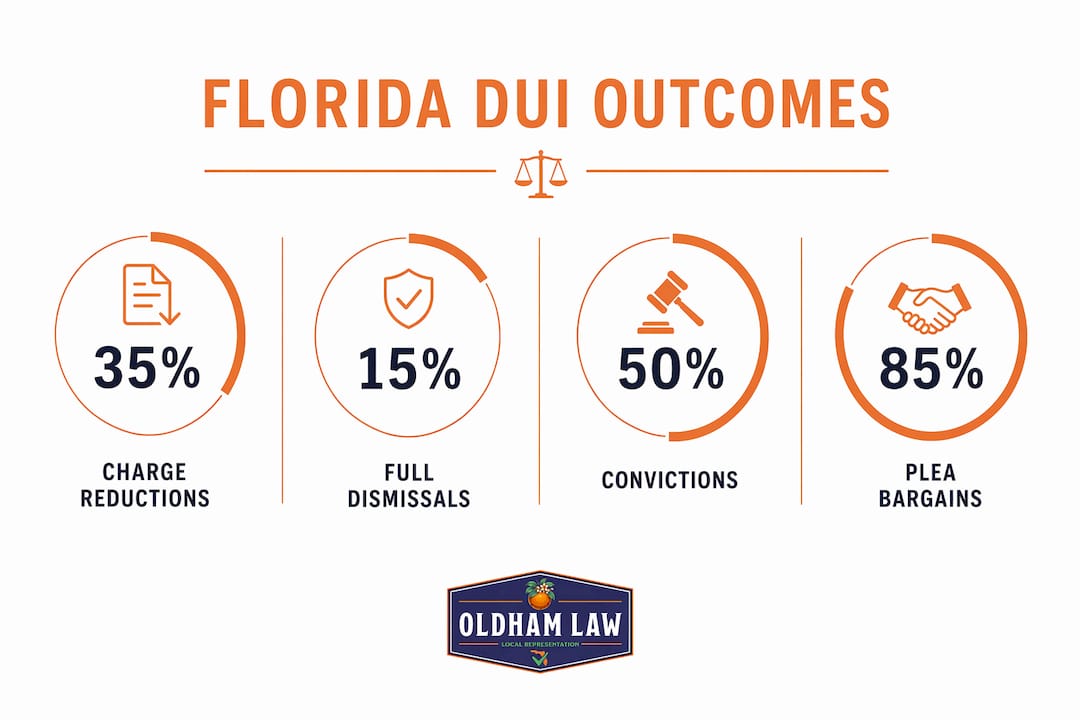
Your odds of getting a DUI dropped in Florida depend heavily on the quality of evidence against you, the procedural conduct of law enforcement, and the skill of your defense attorney. Realistically, a significant portion of DUI cases in Florida see some form of charge reduction or dismissal, though full dismissals are less common than reductions to lesser offenses like reckless driving. Florida Court Clerks and Comptrollers FY 2023–24 data shows that across county criminal cases, 23.1% ended in non-guilty dispositions, which includes acquittals, dismissals, and other non-convictions. Here is what that means for you:
- Full dismissal: Less frequent, but achievable when procedural errors or weak evidence undermine the prosecution’s case
- Charge reduction: The most common favorable outcome, often to reckless driving through plea negotiation
- Conviction: Still the most likely result overall, with 76.9% guilty dispositions across county criminal cases in FY 2023–24
- Key variables: Prior DUI convictions, BAC level, quality of field sobriety testing, and whether the stop was lawful
Under F.S. 316.193, the State must prove you were driving or in actual physical control of a vehicle while impaired. That burden creates real openings for a skilled defense.
What Florida court data says about DUI dismissal rates
Florida’s court statistics give a clearer picture than most people expect. The FY 2023–24 county criminal data from the Florida Court Clerks and Comptrollers shows DUI cases accounted for a meaningful share of county criminal filings, with 26,645 DUI dispositions recorded over the tracked period.
Key figure: Across all county criminal cases in Florida, 23.1% resulted in non-guilty dispositions in FY 2023–24, covering dismissals, acquittals, and other non-convictions.
Most DUI cases that avoid conviction do so through plea bargaining rather than outright dismissal. A charge reduction to reckless driving, sometimes called a “wet reckless,” carries lighter penalties and no DUI record. That outcome is far more common than a judge throwing out the case entirely.
| Disposition type | What it means for you | Relative frequency |
|---|---|---|
| Guilty conviction | Full DUI conviction under F.S. 316.193 | Most common (76.9% across county criminal) |
| Charge reduction via plea | DUI reduced to reckless driving or similar | Common with strong defense |
| Dismissal / acquittal | Charges dropped or not-guilty verdict | Less frequent; requires procedural or evidentiary weakness |
| Other non-guilty | Deferred prosecution, diversion, nolle prosequi | Case-dependent |
The takeaway is straightforward: a full dismissal is possible but not the norm. Your realistic goal in most Florida DUI cases is a charge reduction that keeps a DUI conviction off your record.
Legal and procedural factors that affect your chance of dismissal
Florida law sets a high bar for prosecutors. Under F.S. 316.193, the State must establish that you were driving or in actual physical control of a vehicle and that your normal faculties were impaired, or that your blood-alcohol level (DUI BAC) was 0.08 or higher. Each element is a potential target for your defense.
The most common grounds that increase dismissal chances include:
- Unlawful traffic stop: If the officer lacked reasonable suspicion to pull you over, everything gathered afterward may be suppressible
- Breathalyzer inaccuracies: Calibration records, operator certification, and testing protocol all affect the reliability of BAC readings
- HGN test errors: The horizontal gaze nystagmus (HGN) test must follow strict NHTSA guidelines; deviations can undermine the officer’s impairment testimony
- Improper field sobriety test administration: Uneven surfaces, inadequate lighting, or failure to follow standardized instructions can invalidate results
- Lack of physical control: If you were parked and not driving, the State’s proof of “actual physical control” may be contestable
- Prescription drug defense: If impairment was caused by a legally prescribed medication taken as directed, that context matters to the charge
- Chain of custody issues: Blood samples mishandled between collection and the lab can be challenged for accuracy
Prior DUI convictions generally reduce the likelihood of a full dismissal, since prosecutors are less willing to offer favorable deals and judges apply stricter scrutiny. That said, prior convictions do not eliminate defense options. Charge reductions and alternative sentencing remain available even for repeat offenders in many circumstances.
Timing also shapes your options. The pretrial stage, before any plea is entered, is where most dismissals and reductions happen. Once you enter a guilty plea, those opportunities close.

Pro Tip: Request the officer’s dash cam and body cam footage immediately after your arrest. Video evidence that contradicts the officer’s written report has led Florida courts to reject officer testimony as controlling evidence, as established in Wiggins v. Florida Department of Highway Safety and Motor Vehicles.
How top Florida DUI defense firms compare
Choosing the right attorney is one of the most consequential decisions you will make after a DUI arrest. The firms below represent a range of DUI defense options across Florida, each with distinct strengths.

| Firm | Specialization | Avg. client rating | Notable certifications / recognition | Geographic coverage | Free consultation | Payment options |
|---|---|---|---|---|---|---|
| Oldham Law PLLC | Criminal defense, DUI, real estate, business law | Not publicly listed | Former prosecutors and insurance defense counsel | Pinellas Park, St. Petersburg, Pinellas County, Tampa Bay | Contact for details | Flexible fee structures |
| Aaron Delgado & Associates | Criminal defense, appeals, family law | Top-rated (firm claim) | Florida Board Certified | Daytona Beach area | Yes | Payment plans available |
| Hartpence Law | Criminal defense, DUI, auto accidents, personal injury | Not publicly listed | Tampa Bay area focus | Tampa Bay area | Not publicly listed | Not publicly listed |
| Roelke Law, P.A. | Criminal defense, DUI, drug crimes, domestic violence | Not publicly listed | Super Lawyers, National Trial Lawyers, Best DUI Lawyers Jacksonville | Jacksonville area | Not publicly listed | Not publicly listed |
| Florida DUI Lawyer | DUI defense focus | Not publicly listed | Not publicly listed | Statewide | Not publicly listed | Not publicly listed |
Oldham Law PLLC’s attorneys bring a background as former prosecutors and insurance defense lawyers, which gives them a practical understanding of how the other side builds its case. That perspective directly informs how the firm approaches DUI defense in Florida for clients in Pinellas County and the broader Tampa Bay area.
How a qualified attorney actually improves your DUI outcome
Hiring an experienced criminal defense attorney does more than provide legal representation. It changes the trajectory of your case at every stage.
Here is what a qualified attorney does that genuinely moves the needle:
- Reviews all discovery materials, including police reports, breathalyzer calibration logs, and video footage, to identify procedural errors
- Challenges the stop and arrest if the officer lacked reasonable suspicion or probable cause under Florida law
- Files motions to suppress evidence obtained through unlawful searches or improper testing procedures
- Negotiates plea agreements with the State Attorney’s office to reduce DUI charges to reckless driving or other lesser offenses
- Prepares case-specific trial strategies when the evidence supports fighting the charge in court
Oldham Law PLLC’s attorneys previously worked as prosecutors and insurance defense counsel, which means they understand exactly what the State needs to prove and where those proofs tend to break down. That background is not just a credential. It shapes how they fight a DUI charge from the first evidence review through any plea negotiation.
Pro Tip: Never assume a DUI charge is airtight. Even cases with a BAC above 0.08 have been reduced or dismissed when breathalyzer maintenance records revealed calibration failures or when the arresting officer deviated from required field sobriety test protocols.
Many Florida DUI defense firms, including Oldham Law PLLC, offer flexible fee structures to make qualified representation accessible. Free consultations are also common, giving you a chance to understand your options before committing to a legal strategy.
Key Takeaways
Florida DUI cases are most often resolved through charge reductions rather than full dismissals, and the quality of your legal defense is the single biggest factor in which direction your case goes.
| Point | Details |
|---|---|
| Dismissal and reduction rates | Between 10% and 40% of Florida DUI cases experience charges reduced or dismissed, depending on the evidence and quality of representation. Full dismissals are less common than plea-based reductions. |
| Court data context | FY 2023–24 Florida county criminal data shows 23.1% non-guilty dispositions across all case types. |
| Key dismissal grounds | Unlawful stops, breathalyzer errors, HGN test failures, and lack of physical control are the most effective defense paths. |
| Prior convictions matter | Repeat DUI offenses reduce dismissal odds but do not eliminate options for charge reduction or alternative sentencing. |
| Attorney background counts | Former prosecutors understand the State’s case-building process, which directly improves defense strategy. |
FAQ
Is it possible to get a DUI dropped in Florida?
Yes. Florida DUI charges can be dismissed when procedural errors, unlawful stops, or unreliable evidence undermine the prosecution’s case under F.S. 316.193. Charge reductions to reckless driving through plea negotiation are more common than outright dismissals.
What percentage of DUI cases are dismissed in Florida?
Legal experts estimate that between 10% and 40% of DUI cases in Florida are reduced or dismissed depending on the quality of evidence and defense, with full dismissals less common than charge reductions. According to FY 2023–24 county criminal data, 23.1% non-guilty dispositions were recorded across all county criminal cases, which includes dismissals, acquittals, and other non-convictions.
What are the strongest signs that a DUI case is weak?
A DUI case tends to be weak when the traffic stop lacked reasonable suspicion, the breathalyzer was improperly calibrated, or the officer failed to follow standardized field sobriety test procedures. Video evidence that contradicts the officer’s report is particularly powerful.
Does refusing a DUI test help your case in Florida?
Refusing a breath, blood, or urine test triggers an automatic license suspension, and the refusal itself can be used as evidence against you in court. It removes the BAC number from the prosecution’s case but introduces its own legal consequences.
How do prior DUI convictions affect dismissal chances?
Prior DUI convictions generally make full dismissal less likely, since prosecutors apply stricter scrutiny and Florida law imposes escalating penalties under F.S. 316.193. Defense strategies focused on charge reduction and alternative sentencing remain available in many cases.
If you are facing a DUI charge in Pinellas County, St. Petersburg, or anywhere in the Tampa Bay area, the attorneys at Oldham Law PLLC are ready to review your case. With backgrounds as former prosecutors and insurance defense lawyers, the firm brings a perspective that most defense attorneys simply do not have. Visit Oldham Law PLLC to learn more about your options and take the first step toward protecting your future.