
Lady Bird Deed Florida: Avoid Probate and Keep Control

A Lady Bird deed — the informal name for Florida’s enhanced life estate deed — lets you transfer your property to a named beneficiary at death without going through probate, while keeping every ownership right you have today: the right to sell, mortgage, lease, or simply change your mind. For most Florida homeowners with a single property and a clear beneficiary in mind, it is one of the most practical estate-planning tools available.
Here is what it delivers at a glance:
- Probate avoidance: the property passes directly to your beneficiary by operation of the deed, with no court involvement required.
- Full control during life: you can sell, refinance, lease, or revoke the deed at any time without the beneficiary’s consent.
- Tax and Medicaid advantages: beneficiaries typically receive a full stepped-up basis at death, and Florida’s Medicaid agency (AHCA) generally does not treat a properly drafted enhanced life estate deed as a completed transfer triggering the five-year look-back.
One important caveat: none of these benefits are automatic. The deed must be drafted with an express reservation of enhanced powers, executed with two witnesses and a notary, and recorded in the county where the property sits. Homestead rules add another layer of complexity, federal tax liens can still reach property interests, and certain co-ownership or mortgage situations may make the deed the wrong tool entirely. Read on to find out whether this instrument fits your situation.
Key Takeaways
A Lady Bird deed is Florida’s most practical single-asset probate-avoidance tool when drafted correctly, recorded promptly, and matched to the right property and ownership situation.
| Point | Details |
|---|---|
| Probate avoidance | A properly recorded enhanced life estate deed transfers property at death without any court proceeding. |
| Full owner control | You can sell, refinance, lease, or revoke the deed at any time without the beneficiary’s signature. |
| Tax and Medicaid advantages | Beneficiaries typically receive a full stepped-up basis; AHCA generally does not treat recording as a completed Medicaid transfer. |
| Watch for homestead and liens | Homestead rules and federal tax liens can override the deed’s intended effect — confirm both before recording. |
| Oldham Law PLLC | The firm drafts, reviews, and records Lady Bird deeds for Pinellas County and Tampa Bay homeowners, with a risk-first intake process. |
What is a Lady Bird deed in Florida?
The phrase “Lady Bird deed” is a nickname, not a statutory term. Florida law does not use that label anywhere in the statutes. What the instrument actually is: an enhanced life estate deed, a conveyance that grants a life estate to the grantor (you) while simultaneously vesting a remainder interest in a named beneficiary, but with an express clause reserving the grantor’s full power to sell, mortgage, lease, or revoke the remainder without the beneficiary’s consent.
That reservation of powers is everything. A standard life estate deed also splits ownership between a life tenant and a remainder holder, but once it is recorded, the life tenant cannot sell or mortgage the property without the remainder holder joining the transaction. The enhanced version eliminates that constraint entirely.
A simple example shows how it works in practice:
- Maria owns a home in St. Petersburg. She signs and records an enhanced life estate deed naming her daughter as remainder beneficiary.
- Maria continues to live in the home, pay the taxes, and collect rent from a garage apartment. She refinances the mortgage two years later, signing alone, with no signature required from her daughter.
- When Maria dies, her daughter records a certified copy of the death certificate and an affidavit of successor in Pinellas County. Title transfers to her by operation of the deed. No probate. No court. No waiting.
The Florida Bar Journal’s practitioner guidance on Lady Bird deeds confirms that the enhanced powers clause is what separates this instrument from a traditional life estate and what makes it recognized by title underwriters and AHCA for Medicaid purposes.
How does a Lady Bird deed work step by step?
Understanding the full timeline helps you see both the simplicity and the places where things can go wrong.
Creation through recording
- Confirm property type. Determine whether the property is homestead, non-homestead, or investment property. Homestead status affects what language the deed needs and whether spousal consent is required.
- Draft the deed. Prepare the deed with the grantor’s full legal name, the beneficiary’s full legal name, the complete legal description from the county property records, the parcel identification number, and — critically — the express reservation of enhanced powers.
- Execute with two witnesses and a notary. Florida Statute § 689.01 requires the grantor’s signature in the presence of two subscribing witnesses. A notary acknowledgment is required for recording. The statute also validates certain electronic witnessing methods for remote signings.
- Record in the county where the property is located. File the original deed with the Clerk of Court in the appropriate county (Pinellas County Clerk, Hillsborough County Clerk, etc.). Pay the recording fee and documentary stamp tax.
- Retain the recorded copy. Keep a certified copy with your estate documents and share the recording information with your beneficiary.
During the owner’s lifetime
Once recorded, the deed does not restrict you in any meaningful way. You can:
- Sell the property outright (the remainder interest divests automatically upon sale).
- Refinance or take out a home equity line without the beneficiary’s involvement.
- Lease the property on any terms you choose.
- Record a new deed that revokes or changes the beneficiary entirely.
If you sell during your lifetime, the remainder beneficiary receives nothing from that property. The deed is self-canceling in that scenario.
After the owner’s death
Your beneficiary’s checklist to complete the transfer is short:
- Obtain a certified copy of the death certificate from the Florida Department of Health or the county vital records office.
- Prepare and record an affidavit of successor (sometimes called an affidavit of continuous marriage or affidavit of survivorship, depending on the relationship) in the same county where the deed was recorded.
- Confirm that no probate proceeding is needed for this property — it passes outside the estate by operation of the deed.
- Update homeowner’s insurance and, if applicable, notify the mortgage servicer of the ownership change.
The entire post-death transfer can often be completed in days rather than the months a probate proceeding typically requires.
Florida execution and recording requirements for a valid Lady Bird deed
Getting the formalities right is not optional. A deed that is missing a witness signature, uses an inaccurate legal description, or omits the enhanced-powers clause may be rejected by the county recorder, refused by a title underwriter, or — worse — treated as a traditional life estate deed that strips you of the control you intended to keep.
Here is what every valid Florida enhanced life estate deed must include:
- Written instrument. Under F.S. § 689.01, all conveyances of real estate must be in writing. Oral transfers are void.
- Grantor’s full legal name and grantee/beneficiary’s full legal name, matching public records.
- Complete legal description of the property, taken verbatim from the existing deed or county property records — not just the street address.
- Parcel identification number (PIN) as required by most Florida counties for recording.
- Express enhanced-powers clause reserving the grantor’s right to sell, mortgage, lease, and revoke the remainder without the beneficiary’s consent. This clause is what makes the deed an enhanced life estate rather than a standard life estate.
- Grantor’s signature in the presence of two subscribing witnesses. Both witnesses must be present at the moment of signing.
- Notary acknowledgment for recording purposes.
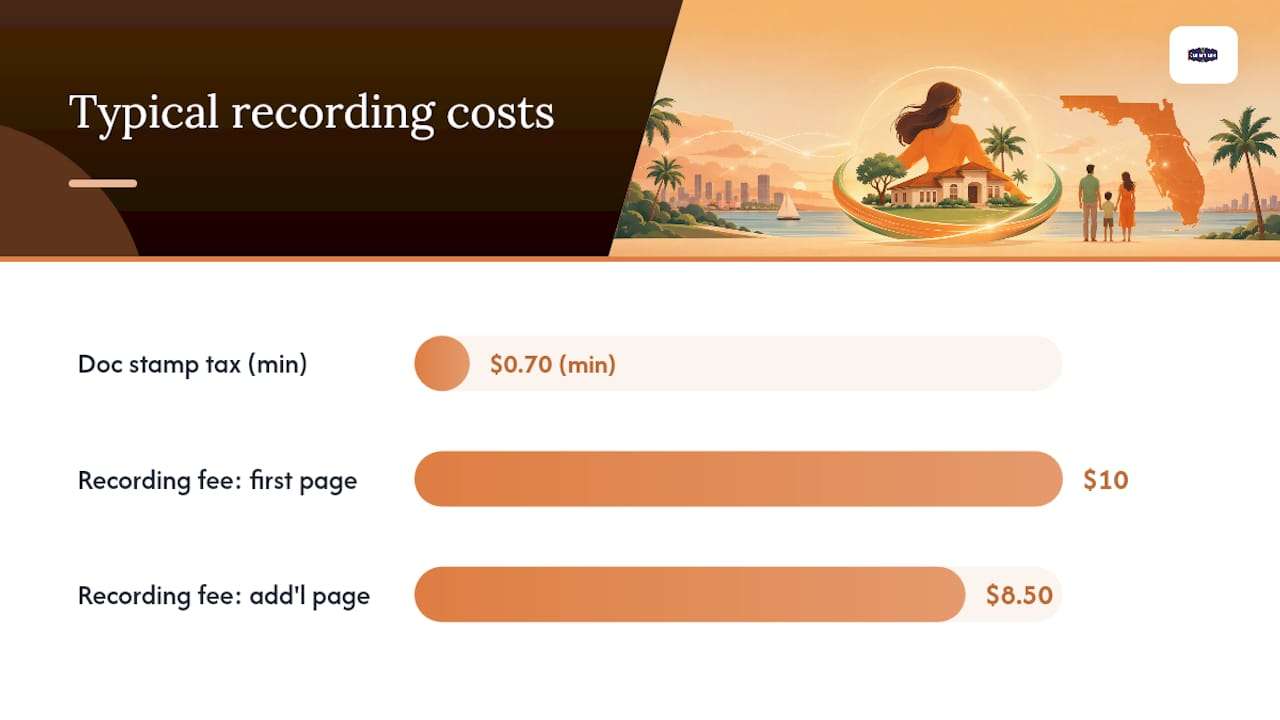
- Documentary stamp tax at the applicable rate (the minimum is $0.70 for nominal-consideration transfers, though the exact amount depends on the county and consideration stated).
- Recording fee paid to the county clerk (typically $10 for the first page and $8.50 per additional page, though fees vary by county).
Pro Tip: Before recording, pull the current deed from county records and copy the legal description character-for-character. A single transposed lot number can cloud title and require a corrective deed — which costs more time and money than getting it right the first time. Also confirm whether the property carries a homestead designation, because homestead property with a living spouse requires the spouse’s joinder on the deed under Florida’s homestead laws.
The Real Property, Probate & Trust Law Section (RPPTL) of The Florida Bar maintains uniform title standards that practitioners and title underwriters rely on when reviewing enhanced life estate deeds. A deed that does not meet those standards may be insurable but will generate title exceptions that complicate a future sale.
What are the main benefits of a Lady Bird deed in Florida?
For the right property and the right owner, the advantages are substantial.
- Probate avoidance. The property transfers by operation of the deed at death, outside the probate estate. Beneficiaries do not need to open a probate proceeding for this asset, which saves court costs, attorney fees, and months of delay. Title underwriters and AHCA recognize properly drafted enhanced life estate deeds as valid non-probate transfer mechanisms.
- Full owner control during life. Unlike a revocable living trust, which requires funding and ongoing administration, a Lady Bird deed leaves day-to-day ownership completely unchanged. You remain the owner of record, pay property taxes, maintain the homestead exemption, and make all decisions about the property without consulting anyone.
- Stepped-up basis for beneficiaries. Because the grantor retains complete revocation and alienation powers, the IRS generally treats the property as part of the grantor’s estate for income-tax purposes. That means beneficiaries typically receive a full stepped-up basis at the date of death, eliminating capital gains on appreciation that occurred during the owner’s lifetime. A standard life estate deed does not always produce the same result.
- No gift-tax event at recording. Because the transfer is revocable, recording the deed does not constitute a completed gift. There is no gift-tax return required simply for creating the deed.
- Medicaid planning advantage. Florida’s Agency for Health Care Administration (AHCA) generally treats a properly drafted enhanced life estate deed as a non-completed transfer, meaning recording the deed alone does not trigger the five-year Medicaid look-back period. This is a meaningful distinction for owners who may need long-term care in the future.
- Low cost relative to alternatives. Compared with establishing and funding a revocable living trust, a Lady Bird deed is a single-document, single-asset solution that typically costs a fraction of a full trust plan.
What are the downsides of a Lady Bird deed in Florida?
No estate-planning tool is right for every situation, and this one has real limitations worth understanding before you record.
- Federal tax liens can reach the property. IRS guidance makes clear that federal tax liens attach to a taxpayer’s rights in property, including remainder interests. If you owe federal taxes, a lien can complicate or defeat the intended transfer regardless of how the deed is drafted.
- Does not protect against all creditors. While the deed avoids probate, it does not create an asset-protection trust. Creditors with valid liens against the property can still enforce those liens.
- Lender and mortgage complications. Some mortgage servicers treat a deed transfer as triggering the due-on-sale clause in the loan agreement. While federal law (the Garn-St. Germain Act) provides some protections for certain transfers, you should review your mortgage documents and consider notifying your lender before recording.
- Co-ownership conflicts. If you own the property with another person, both owners must join the deed. A co-owner who refuses to sign or who has a conflicting estate plan can make the instrument unworkable.
- Challenge risk from incomplete drafting. A deed that omits the enhanced-powers clause or uses ambiguous language may be challenged by heirs, creditors, or title underwriters. The Florida Bar Journal’s guidance specifically cautions practitioners about drafting errors that inadvertently create a traditional life estate.
- Homestead complications. Florida’s homestead laws are layered. If the property is homestead and you have a spouse or minor children, their rights may affect what you can convey and to whom. Naming a non-spouse beneficiary on homestead property when a spouse is living requires careful analysis.
Red-flag situations that should prompt attorney review before recording:
- An active federal or state tax lien against the property or the owner.
- Contested family ownership or a prior deed dispute.
- A recent transfer made for Medicaid eligibility purposes.
- Active probate litigation involving the property.
- A mortgage with a due-on-sale clause and an uncooperative servicer.
Lady Bird deed vs. standard life estate vs. revocable living trust
Each of these three tools avoids probate for real property, but they work differently and fit different situations. Here is how they compare across the dimensions that matter most to Florida homeowners:
| Dimension | Lady Bird deed | Standard life estate deed | Revocable living trust |
|---|---|---|---|
| Probate avoidance | Yes — transfers by operation of deed at death | Yes — transfers at death | Yes — transfers per trust terms |
| Control during life | Full — sell, mortgage, revoke without beneficiary consent | Limited — beneficiary must join any sale or mortgage | Full — trustee (usually you) controls all assets |
| Medicaid / look-back | Generally not a completed transfer; no automatic look-back trigger | Treated as a completed transfer; can trigger look-back | Revocable trust assets counted as available; no look-back advantage |
| Tax / stepped-up basis | Full step-up in basis at death (typical) | Partial step-up only (life estate share) | Full step-up in basis at death |
| Cost and complexity | Low — single deed, one-time recording | Low — but loss of control is a hidden cost | Higher — drafting, funding, ongoing administration |
| Homestead / creditor exposure | Homestead rules apply; federal liens can reach interests | Same homestead rules; remainder can be reached by creditors | Trust structure may offer some additional planning flexibility |
When a Lady Bird deed is the right choice: You own a single Florida property, you want to avoid probate for that asset, you may need Medicaid in the future, and you want to keep full control without the cost and administration of a trust.
When a revocable living trust is better: You own multiple properties (including out-of-state real estate), you want centralized administration of all assets, or your estate involves business interests, investment accounts, and real property that benefit from unified management.
When a traditional life estate is a mistake: Almost always. The loss of control — the inability to sell or refinance without the remainder holder’s signature — creates practical problems that outweigh any benefit. The comparative analysis from practitioners consistently shows that the enhanced version produces better tax and Medicaid outcomes with none of the control sacrifice.
Tax, Medicaid, homestead, and creditor implications in Florida
These four areas are where the details matter most, and where a mistake in planning can cost far more than the deed itself.
Stepped-up basis
When you die holding a Lady Bird deed, the IRS generally treats the property as part of your taxable estate because you retained the right to revoke the transfer. That inclusion is actually a benefit for your beneficiary: the property’s tax basis resets to its fair market value on the date of your death. If your home appreciated from $150,000 to $400,000 during your lifetime, your beneficiary inherits it at a $400,000 basis and owes no capital gains tax on that appreciation if they sell promptly. A standard life estate deed, by contrast, typically produces only a partial step-up, because the remainder interest was treated as a completed gift when the deed was recorded.
Medicaid look-back and estate recovery
Florida’s Medicaid program, administered by AHCA, applies a five-year look-back period to transfers made for less than fair market value. Because a properly drafted enhanced life estate deed preserves the grantor’s right to revoke and sell, AHCA generally does not treat recording the deed as a completed transfer. That means the deed itself does not start the look-back clock.
Estate recovery is a separate issue. Under 42 U.S.C. § 1396p, states may seek recovery from a Medicaid recipient’s estate for benefits paid. Property that passes outside probate through a Lady Bird deed is generally not subject to Florida’s estate recovery program, because Florida limits recovery to the probate estate. That said, Medicaid rules change, and individual circumstances vary. Anyone using a Lady Bird deed as part of a Medicaid plan should confirm current AHCA policy with a Florida elder law attorney.
Federal tax liens and creditors
The IRS is explicit: federal tax liens attach to all property and rights to property belonging to a taxpayer. If you owe federal taxes when you die, the lien can reach the property even if it passes outside probate. The remainder beneficiary may receive title subject to that lien. State creditors generally cannot reach a properly structured homestead property during the owner’s lifetime, but the federal lien exception is real and should not be ignored.
Homestead exemption
Florida’s homestead exemption reduces the assessed value of your primary residence for property tax purposes, and it is preserved when you hold a Lady Bird deed because you remain the owner of record. The constitutional homestead protection against forced sale by creditors also continues during your lifetime. What changes at death: if the property is homestead and you have a surviving spouse or minor children, Florida’s constitutional homestead descent rules may override the deed’s beneficiary designation. This is one of the most common planning errors — assuming the deed controls when the homestead statute actually does.
How to create a Lady Bird deed in Florida: a practical checklist
Creating the deed correctly requires attention to detail at every step. Here is the full process:
- Confirm property type and ownership. Pull the current deed from county records. Confirm whether the property is homestead, whether there is a co-owner, and whether a mortgage is outstanding.
- Prepare the deed with all required elements. Include the grantor’s full legal name, the beneficiary’s full legal name, the complete legal description (verbatim from county records), the parcel identification number, and the enhanced-powers clause.
- Draft the enhanced-powers reservation. The clause should state, in substance, that the grantor reserves the right during their lifetime to sell, convey, mortgage, lease, or otherwise encumber the property, and to revoke or change the remainder beneficiary, all without the consent of the remainder beneficiary. The Florida Bar Journal’s practitioner guidance identifies this clause as the critical element that distinguishes an enhanced life estate from a traditional one.
- Sign in the presence of two witnesses and a notary. All signatures must occur in the same session. Electronic witnessing is permitted under F.S. § 689.01 for remote signings that comply with the statute’s requirements.
- Record the deed in the county where the property is located. Bring the original to the Clerk of Court. Pay the recording fee (typically $10 for the first page, $8.50 per additional page) and the documentary stamp tax (minimum $0.70 for nominal-consideration transfers). Pinellas County, Hillsborough County, and other Tampa Bay area counties each have their own clerk’s office and fee schedules — confirm current amounts before recording. See the firm’s guide to Florida documentary stamp tax for a detailed breakdown.
- Retain the recorded copy and notify your beneficiary. Store the certified recorded copy with your estate documents. Tell your beneficiary where to find it and what steps they will need to take after your death.
Estimated costs: Attorney fees for drafting a Lady Bird deed in Florida typically involve a modest cost for straightforward cases, with potentially higher fees for more complex situations such as homestead property or Medicaid planning. Recording and stamp fees are generally modest. A full revocable living trust, by comparison, costs significantly more and requires ongoing administration.
Pro Tip: Order a title search before recording. A title search reveals existing liens, easements, or prior deed defects that could undermine the transfer. Discovering a cloud on title after recording is far more expensive to fix than catching it beforehand.
When a Lady Bird deed is not the right tool
Sometimes the better answer is a different instrument or a more comprehensive plan. Here are the situations where a Lady Bird deed falls short:
- Mortgaged property with a restrictive lender. If your mortgage contains a due-on-sale clause and your lender does not recognize enhanced life estate deeds as exempt transfers, recording the deed could trigger acceleration of the loan. Review the mortgage documents and consult your lender before proceeding.
- Co-owned property with a non-cooperating co-owner. All owners must sign. If a co-owner refuses or has a conflicting plan, the deed cannot be executed unilaterally.
- Multi-asset estates. If your estate includes multiple properties, investment accounts, business interests, and personal property, a revocable living trust provides centralized administration that a single-asset deed cannot. Explore how to transfer property title to family members as part of a broader plan.
- Active IRS or state tax lien. A federal tax lien follows the property regardless of how title is held. Resolve the lien before recording or the beneficiary may inherit a title problem.
- Complex or contested family dynamics. If multiple potential heirs are likely to dispute the transfer, a Lady Bird deed may invite litigation. A trust with a professional trustee and clear distribution terms is harder to challenge.
- Out-of-state property. A Florida enhanced life estate deed does not govern property located in another state. Each state has its own rules, and some do not recognize the instrument at all.
For any of these situations, the right next step is a conversation with a Florida estate planning attorney before recording anything.
When should you consult a Florida estate attorney about a Lady Bird deed?
Most Florida homeowners benefit from at least one attorney consultation before recording an enhanced life estate deed. The deed is simple in concept but precise in execution, and the consequences of a drafting error can outlast you.
Situations that specifically call for attorney involvement:
- The property is homestead and you have a living spouse or minor children.
- You have an outstanding mortgage and are unsure about the lender’s position.
- You want to use the deed as part of a Medicaid plan and need current AHCA guidance.
- There is any existing lien, judgment, or cloud on title.
- You have multiple beneficiaries and want to specify shares or contingencies.
- A family member has already raised concerns about the estate plan.
- You are new to Florida and need to update an existing estate plan — see the firm’s guide on updating your will when you move to Florida.
What an attorney provides beyond the deed itself:
A Florida estate attorney drafts the enhanced-powers clause with language that title underwriters will accept, confirms homestead status, coordinates the recording process, orders a title search to catch existing problems, and advises on whether a Lady Bird deed or a revocable trust better fits your overall plan. The RPPTL publishes title standards that experienced practitioners use to ensure the deed will be insurable — a standard that DIY documents frequently miss.
For Pinellas County and Tampa Bay homeowners, Oldham Law PLLC handles the full process: intake, title review, deed drafting, witness coordination, and recording. The firm’s probate and estate planning practice is built around helping local families avoid unnecessary court involvement while keeping their plans legally sound.
How we approach Lady Bird deeds for Florida clients
At Oldham Law PLLC, the first thing we do with any Lady Bird deed inquiry is a risk-first review — not a template. We look at the title history, confirm homestead status, check for existing liens, and ask about the mortgage before a single word of the deed is drafted. That sequence matters because the most expensive problems we see are the ones that could have been caught in the first fifteen minutes of a title search.
We are also straightforward about cost. For most single-property homeowners in Pinellas County with a clear beneficiary and no title complications, a Lady Bird deed is a cost-effective solution, and we price it that way. Where a trust or a different instrument would serve the client better, we say so — because the goal is the right outcome, not the most billable one.
Oldham Law PLLC: Lady Bird deed services in Pinellas County and Tampa Bay
Drafting a Lady Bird deed correctly the first time is worth more than fixing a defective one later.

Oldham Law PLLC serves homeowners throughout Pinellas County, St. Petersburg, and the broader Tampa Bay area with flat-fee Lady Bird deed drafting, title search coordination, and full recording assistance. Unlike a generic online document service, the firm reviews your specific property, confirms homestead status, checks for existing liens, and drafts enhanced-powers language that title underwriters accept. If your situation involves a mortgage, a co-owner, or Medicaid planning, the firm advises on the right instrument before you commit to any recording. To get started, visit Oldham Law PLLC’s estate planning and probate page or contact the firm directly to schedule a consultation.
Sources
These are the primary authoritative references used throughout this article. They are official sources for statutes, agency policy, and practitioner guidance — not secondary summaries.
- Chapter 689 CONVEYANCES OF LAND AND DECLARATIONS OF TRUST — F.S. 689.01 (How real estate conveyed.)
- 42 U.S.C. § 1396p (Medicaid and estate recovery)
- The Florida Bar Journal — Lady Bird Deeds
- Lady Bird Deed Florida (2026): How It Works, How to Create One & County Recording Guide
- Understanding a Federal Tax Lien — Internal Revenue Service
This article is general information, not a substitute for advice from a qualified lawyer. Consult a qualified legal professional about your own circumstances before acting on anything here.
FAQ
What are the downsides of a Lady Bird deed in Florida?
The main risks are federal tax liens (which can attach to the property regardless of how it is titled), lender due-on-sale clause issues, homestead complications when a spouse or minor children are involved, and challenge risk if the enhanced-powers clause is missing or ambiguous. Co-owned property and multi-asset estates are also situations where the deed may not be the right tool.
Can I do my own Lady Bird deed in Florida?
Technically, Florida law does not require an attorney to draft a deed, but the enhanced-powers clause must be precisely worded or the deed may be treated as a traditional life estate — stripping you of the control you intended to keep. Title underwriters and AHCA apply specific standards, and a DIY deed that misses those standards can create title problems that cost far more to fix than an attorney’s drafting fee.
How much does a Lady Bird deed cost in Florida?
Attorney fees for a straightforward Lady Bird deed in Florida typically run a few hundred dollars for a single-property deed with no complications. Recording fees are generally $10 for the first page and $8.50 per additional page, plus a documentary stamp tax with a minimum of $0.70 for nominal-consideration transfers. Total out-of-pocket costs are modest compared with the cost of a full revocable living trust or a probate proceeding.
Do you pay taxes on a Lady Bird deed in Florida?
Recording the deed does not trigger income tax or gift tax because the transfer is revocable. At death, beneficiaries typically receive the property with a full stepped-up basis equal to the fair market value on the date of death, which eliminates capital gains tax on appreciation that occurred during the owner’s lifetime. Florida has no state estate or inheritance tax, so the primary tax consideration is the federal stepped-up basis treatment.
Does a Lady Bird deed affect the homestead exemption in Florida?
No — recording a Lady Bird deed does not affect your homestead exemption during your lifetime because you remain the owner of record. The exemption continues as long as you occupy the property as your primary residence. What you do need to confirm is whether Florida’s constitutional homestead descent rules might override the deed’s beneficiary designation if you have a surviving spouse or minor children at the time of your death.
