
How Long Does a Mugshot Stay Online in Florida?

A mugshot can remain online indefinitely unless you take active steps to remove it. Florida law gives you a concrete tool: §901.43 requires qualifying commercial publishers to remove your arrest booking photograph within a short period after receiving a proper written request sent by registered mail, at no charge to you. If they refuse, you can pursue civil penalties per day for noncompliance with a court injunction. Your first move, right now, is to identify every site hosting the photo and send that registered-mail request to each publisher’s registered agent. Keep every receipt.
This article is general legal information, not legal advice for your specific situation. Confirm current rules with a qualified Florida attorney before taking action.
Why mugshots can stay online for years — and who keeps them there
The persistence problem starts with how booking photos move through the internet. When you’re arrested in Florida, the arresting agency typically publishes your booking photo on a publicly accessible law-enforcement site. That’s where the chain begins.

Commercial aggregators use automated scraping tools and, increasingly, AI to pull those images from law-enforcement pages almost immediately after posting. Legislative staff analyses confirm that these aggregators were the primary driver behind §901.43’s passage, because their business model depended on charging people to remove photos the aggregators had no right to monetize in the first place.
Here’s the practical problem that creates for you:
- Law-enforcement agency pages publish the original booking photo as a public record; these are generally not covered by §901.43’s commercial-publisher requirement.
- Commercial aggregator sites scrape and republish the photo, often within hours; these are the primary §901.43 targets.
- News outlets may publish the photo as part of a crime report; their coverage is typically protected by the First Amendment and falls outside the statute’s scope.
- Third-party republishers copy from aggregators, creating additional downstream copies that each require a separate removal request.
- Search engines cache all of the above, meaning the image can appear in results even after a source page is taken down.
Each layer adds time and complexity to the mugshot removal process. Removing one copy doesn’t touch the others, and search engines won’t update until the source page is actually gone.
What Florida law §901.43 actually requires — and what it doesn’t cover
Florida Statute §901.43 is the clearest legal lever available to Florida residents. It targets any person or entity engaged in the business of publishing or disseminating arrest booking photographs who solicits or accepts payment to remove those photos. The statute prohibits that pay-for-removal model outright and creates an enforceable takedown right.
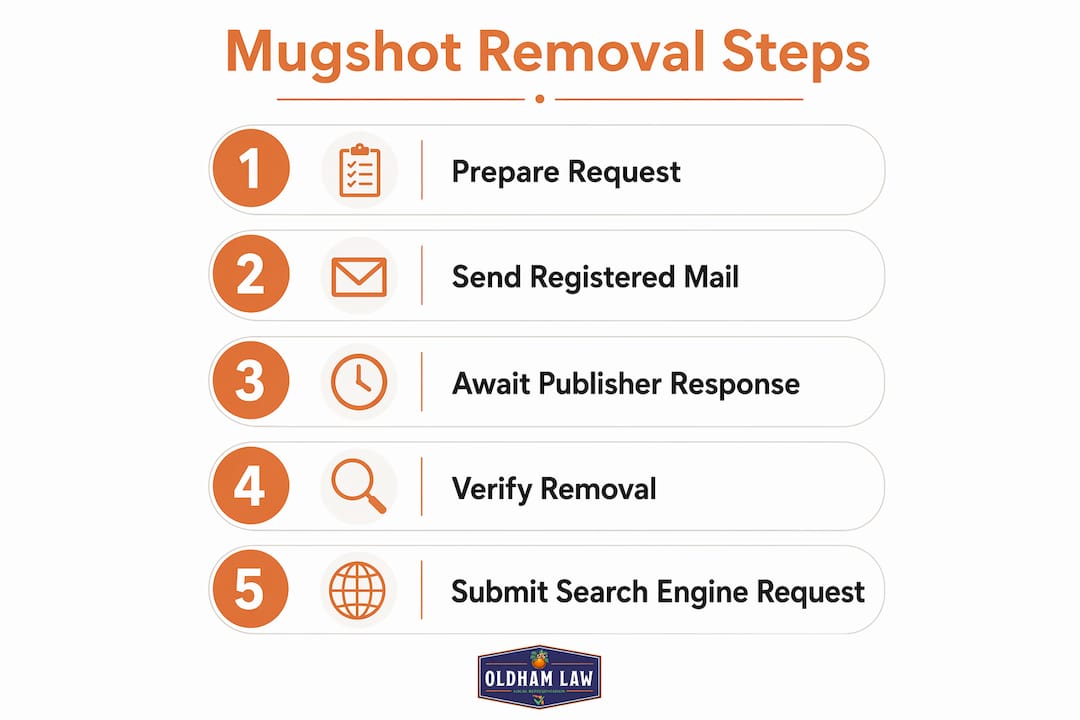
Under subsection (2), you or your legal representative may send a written removal request by registered mail to the publisher’s registered agent. The request must include sufficient proof of your identity and specific information identifying the photograph. Once the publisher receives that letter, the 10-calendar-day clock starts. They must remove the photo without charge and cannot republish it.
What the statute does not do is equally important to understand. It does not reach government agency pages that publish booking photos as part of official records. It does not automatically erase copies already posted by news organizations or small independent sites that don’t fit the commercial-publisher definition. And it does not reach copies that were scraped and saved before your request went out.
Expungement and record sealing work differently. Sealing or expunging your record under Chapter 943 removes official government access to your criminal history, but it does not automatically delete photos already posted by private websites. Practitioners consistently recommend combining a sealing or expunction with statutory takedown requests, because the two tools address different parts of the problem: one fixes the official record, the other targets the third-party copies that live on commercial sites.
Pro Tip: When you send your removal request, include your full legal name, date of arrest, arresting agency, and the exact URL of the photo. Vague requests give publishers an excuse to delay. Precision closes that door.
How to get your mugshot removed in Florida: a step-by-step checklist
This process works best when you treat it like building a legal file from day one. Every step you document becomes evidence if you need to escalate.
Locate every live copy. Search your full name in Google, Bing, and DuckDuckGo. Run a Google Images search. Check common aggregator sites. Note every URL where your photo appears, including law-enforcement pages, news articles, and commercial sites. Screenshot each page with the URL visible in the browser bar and record the date and time.
Identify the registered agent for each commercial publisher. Search the publisher’s entity name in the Florida Division of Corporations database (sunbiz.org) or the state where they’re incorporated. You need the registered agent’s name and mailing address for your letter.
Draft and send the registered-mail request. Your letter must include: your full legal name, date of birth, date of arrest, arresting agency, the specific URL of the photo, and a copy of a government-issued ID. Send it via USPS Certified Mail with Return Receipt Requested to each publisher’s registered agent. Keep the original letter, the mailing receipt, and the green return-receipt card when it comes back signed.
Start the 10-day clock. The 10-calendar-day deadline runs from the date the publisher receives your letter, not the date you mailed it. The signed return receipt establishes that date precisely. Mark day 10 on your calendar.
Verify removal on day 11. Return to each URL. If the photo is gone, screenshot the 404 or blank page. If it’s still live, screenshot the page again with a timestamp. That documentation is your noncompliance evidence.
Escalate if necessary. If a qualifying publisher hasn’t removed the photo by day 11, you have grounds to file a civil action. Consult a Florida attorney at this point if you haven’t already.
Pro Tip: Save your evidence in a dedicated folder: one subfolder per publisher, labeled with the site name and date of your mailing. If you end up in court, an organized file moves faster and costs less in attorney time.
Are paid mugshot removal services worth it?
The short answer is: proceed carefully. The legislative intent behind §901.43 was specifically to dismantle the pay-for-removal business model, where aggregators scraped photos and then charged people to take them down. The statute made that practice illegal for qualifying publishers. If a site is covered by §901.43, you already have a free legal right to removal. Paying a service to do what the law already entitles you to do for free raises an obvious question about value.
That said, some removal services do provide legitimate help: they identify which sites have your photo, draft and send removal letters on your behalf, and monitor for new copies. The realistic outcome varies. A service can contact publishers and track responses, but it cannot force a noncompliant site to comply any faster than the statute allows, and it has no special power over sites outside §901.43’s scope.
Watch for these red flags before engaging any paid service:
- Blanket guarantees that every copy will be removed within a set number of days
- Requests that you waive any legal rights as a condition of service
- Vague descriptions of which publishers they will actually contact
- Upfront fees with no clear breakdown of what actions they’ll take
Pro Tip: Before paying anyone, use the statute yourself first. Send your own registered-mail requests to the commercial sites you’ve identified. If copies remain on sites outside §901.43’s reach, or if a publisher refuses to comply, that’s when professional help, whether from a removal service or an attorney, adds real value.
What to do when a publisher ignores your notice
A publisher that doesn’t remove your photo within 10 calendar days is in violation of §901.43, and Florida law gives you a clear enforcement path.
Confirm noncompliance in writing. On day 11, send a follow-up letter (again by registered mail) notifying the publisher that the deadline has passed and that you intend to pursue civil remedies. This creates an additional paper trail and sometimes prompts compliance without litigation.
Compile your enforcement file. Gather: the original removal letter, the signed return-receipt card with the delivery date, timestamped screenshots of the live photo before and after the deadline, and any correspondence with the publisher.
File a civil action. Under §901.43(3)(a), you may bring a civil action to enjoin continued publication. If the court issues an injunction and the publisher still doesn’t comply, the court may impose a civil penalty of up to $1,000 per day for noncompliance. If the publisher republishes the photo after removal and an injunction, penalties may reach $5,000 per day. The court must also award reasonable attorney fees and court costs related to the injunction.
Pro Tip: Don’t wait to consult an attorney until you’re already in litigation. A Florida attorney can send a demand letter on firm letterhead before you file, which often produces faster compliance than a self-represented request.
When the reputational or economic harm is significant, or when a publisher is operating a repeat-offense model, litigation is a reasonable and often cost-effective step. The attorney-fee provision in the statute means a successful enforcement action can recover your legal costs.
How long after removal will your mugshot disappear from search results?
Removing the source page is step one. Search engines don’t update their indexes the moment a page changes, so the image can still appear in Google or Bing results for days or weeks after the publisher takes it down.

Here’s a realistic timeline and what you can do at each stage:
| Stage | Action | Estimated Timeframe |
|---|---|---|
| Publisher removes the page | Verify with a screenshot; confirm the URL returns a 404 or blank | — |
| Submit to Google Remove Outdated Content | Use Google’s Remove Outdated Content tool; submit the exact URL | Day 1–2 after removal |
| Google index updates | Results typically refresh within days to weeks after submission | days to weeks |
| Bing and other engines | Submit via Bing Webmaster Tools; timelines vary | days to weeks |
| Image search results | Submit the image URL separately in Google’s tool | days to weeks after source removal |
The key constraint is that search-engine removal tools only work after the source page is actually gone. Submitting a removal request while the page is still live accomplishes nothing. Plan for a two-step process: takedown first, then index cleanup.
Pro Tip: After submitting to Google’s Remove Outdated Content tool, set a calendar reminder for day 15 to re-check the search results. If the image still appears, resubmit and check whether the source page is truly gone or has been republished at a slightly different URL.
What to do while removal is still pending
Waiting out the 10-day window, or longer if litigation is involved, doesn’t mean you’re without options. There are practical steps you can take right now to reduce the photo’s visibility and its real-world impact.
- Build positive search results. Create or update a LinkedIn profile, a professional bio page, and any other authoritative profiles that rank for your name. Search engines surface what’s there; give them better material to index.
- Consider a personal website. A simple site at your name’s domain (yourname.com) can rank above aggregator pages over time, especially with consistent, original content.
- Prepare a factual context statement. If a landlord or employer asks about an arrest, a brief, factual written statement explaining the case status, especially if charges were dropped or you were not convicted, is more effective than silence. Keep it short and stick to facts.
- Set up monitoring. Create a Google Alert for your full name and variations of it. Check the alert results weekly. If a new copy of the photo appears on a different site, start the removal process for that publisher immediately.
- Document everything as you go. New copies that appear after you’ve already sent removal requests strengthen your legal position if you later need to show a pattern of republishing.
Pro Tip: Arrest and conviction records affect online visibility differently. An arrest without a conviction is still a public record in Florida, but it carries less legal weight in many employment and housing contexts. If your case was dismissed or you were acquitted, say so clearly in any context statement you provide.
Key Takeaways
Florida’s §901.43 gives you a free, enforceable right to remove your booking photo from qualifying commercial publishers within 10 calendar days. If the publisher fails to comply with a court injunction, civil penalties may reach up to $1,000 per day, and republishing after removal can trigger penalties up to $5,000 per day.
| Point | Details |
|---|---|
| Mugshots stay online indefinitely | Without action, commercial sites keep photos live; Florida law creates a removal right. |
| 10-calendar-day deadline | The clock starts when the publisher receives your registered-mail request, not when you send it. |
| Civil penalties for noncompliance | Courts may impose daily penalties for injunction violations (up to $1,000 per day); republishing after removal can trigger penalties up to $5,000 per day. |
| Search engines need a second step | After the source page is removed, use Google’s Remove Outdated Content tool; expect days to weeks to update. |
| Oldham Law PLLC can help | The firm handles statutory takedown letters, civil enforcement, and record-sealing support in Pinellas County and Tampa Bay. |
A Florida attorney’s honest take on mugshot removal
Most people who contact an attorney about a mugshot online are surprised by two things: how straightforward the statutory process is, and how often it still requires legal pressure to actually work.
The statute is well-designed. A properly documented registered-mail request, sent to the right registered agent with the right identifying details, puts a qualifying publisher on a hard deadline. Many comply. The problem is the publishers who don’t, the ones who ignore the letter, claim they never received it, or quietly republish the photo at a slightly different URL a few weeks later. That’s where the DIY approach tends to break down, not because the law is weak, but because enforcement requires follow-through that most people understandably don’t have time or experience to manage.
What people also underestimate is the gap between removing the source page and actually clearing search results. Clients sometimes assume that once the site takes the photo down, it’s gone. The cached version in Google Images can persist for weeks. That second step, submitting to removal tools and monitoring for recrawl, is easy to miss if you’re not watching for it.
The realistic picture: if you’re dealing with one or two commercial aggregator sites and the arrest was minor, a well-drafted registered-mail request often resolves the issue without an attorney. If you’re facing multiple republishers, a site that has already ignored one request, or a situation where the photo is affecting employment or housing, retaining counsel is the faster and usually cheaper path when you factor in the attorney-fee recovery provision. A court that awards fees on a successful enforcement action can make the legal cost largely self-funding.
The defamation and reputational harm framework in Florida also matters here. If a publisher is making false statements alongside the photo, or if the publication crosses into harassment, additional civil remedies may apply beyond §901.43.
Oldham Law PLLC: local Florida legal help for mugshot removal
Facing a mugshot online is stressful, and the legal process has real deadlines. Oldham Law PLLC provides hands-on legal assistance for Pinellas County and Tampa Bay residents who need to act quickly and correctly.

The firm handles the full removal process: drafting and sending statutory takedown letters under §901.43, preparing civil enforcement actions when publishers don’t comply, and coordinating record-sealing or expunction work to address the underlying criminal record. When you come in for a consultation, bring copies of your screenshots (with timestamps and URLs), your registered-mail receipts if you’ve already sent a request, your case number, and a government-issued ID.
Oldham Law PLLC’s attorneys have backgrounds as former prosecutors and insurance defense lawyers, which means they understand how these cases look from multiple sides. Fee structures are discussed at intake, and the attorney-fee recovery provision in §901.43 is always part of the conversation for enforcement cases.
If your mugshot is online and you’re in the St. Petersburg, Pinellas Park, or greater Tampa Bay area, contact Oldham Law PLLC or visit the firm’s criminal defense practice page to schedule a consultation and get a clear plan in place.
Useful sources and where to learn more
These are the primary legal sources you should save and reference when preparing your removal request or working with an attorney.
- Florida Statute §901.43 (2024) — The full text of the statute, including the 10-day removal requirement, the no-charge mandate, and the civil penalty provisions. This is the document your removal letter is based on; read subsections (1) through (3) before you draft anything.
- Florida House of Representatives — 2024 Statutes §901.43 — The House’s annotated version of the statute, useful for confirming the penalty amounts and the injunction framework.
- House Staff Analysis, CS/CS/HB 755 — The legislative staff analysis that explains why the statute was passed and which publisher types it targets. Useful for understanding the statute’s intent if a publisher disputes coverage.
- Chapter 943, §943.0585 — Florida Statutes — Governs expunction eligibility and the 12-month validity window for certificates of eligibility. Relevant if you’re combining a takedown request with a record-sealing effort.
- Google’s Remove Outdated Content tool (search “Google Remove Outdated Content”) — The practical tool for requesting index updates after a source page is removed. Free to use; submit the exact URL of the removed page.
Save this article and the statute links together in a single folder when you’re preparing an enforcement packet for counsel. Having the statute text, your screenshots, and your mailing receipts organized in one place saves time and legal fees.
FAQ
How long will my mugshot stay online in Florida?
Without action, a mugshot can remain online indefinitely. Florida Statute §901.43 gives you a legal right to demand removal from qualifying commercial publishers within 10 calendar days of your registered-mail request.
Can I get my mugshot removed from the internet for free?
Yes, for qualifying commercial publishers. Under §901.43, those publishers must remove your photo at no charge after receiving a proper written request. You do not need to pay a removal service to exercise this right.
Are all mugshots public records in Florida?
Arrest booking photographs are generally public records in Florida, but §901.43 restricts how commercial publishers can monetize them. Government agency pages that publish booking photos operate under different rules than commercial aggregator sites.
How do I get rid of my mugshot in Florida?
Send a written removal request by registered mail to the publisher’s registered agent, including your ID and the photo’s URL. The publisher has 10 calendar days to remove it. If they don’t, you can file a civil action under §901.43 and seek penalties that may reach up to $1,000 per day for noncompliance, and up to $5,000 per day if the photo is republished after removal and injunction.
Does expungement remove my mugshot from websites?
Expungement seals your official criminal record but does not automatically delete photos already posted by private websites. Practitioners recommend pairing expunction with statutory takedown requests under §901.43 to address both the official record and third-party copies.
