
Florida Real Estate Contract Law: Your 2026 Guide

Florida real estate contract law governs every agreement to buy or sell property in the state, and getting it wrong can cost you far more than a deal. At its core, this body of law requires that property sale agreements be in writing, contain specific enforceable terms, and comply with Florida statutes to protect both buyers and sellers. Here is what you need to know before you sign anything:
- Florida’s Statute of Frauds (Fla. Stat. § 725.01) requires real estate contracts to be in writing to be legally enforceable.
- A valid contract must include offer, acceptance, consideration, and a clear property description.
- Contingencies for inspection, financing, and title give buyers built-in exit ramps, but only when exercised correctly.
- Missing a deadline, even by a day, can forfeit your deposit or your right to cancel.
- The Florida Bar and Florida Realtors both provide guidance on standard contract forms, though complex transactions often require custom legal drafting.
Understanding these fundamentals is the first step toward protecting your interests in any Florida property transaction.
Do Florida real estate contracts have to be in writing?

Yes, and this is not a technicality you can work around. Florida law requires contracts for the sale of real property to be in writing under the Statute of Frauds (Fla. Stat. § 725.01). An oral agreement to buy or sell a home is generally not enforceable in Florida, regardless of what was said or promised.
The narrow exception involves partial performance, where one party has already taken significant steps in reliance on an oral agreement. But this exception rarely applies in practice and is difficult to prove in court.
- Oral promises about repairs, timelines, or included appliances are not binding unless written into the contract.
- Witnesses are not legally required for a Florida real estate contract to be valid.
- Leases longer than one year and real estate commission agreements must also be in writing.
- Verbal assurances from agents or sellers carry no legal weight outside the written document.
The practical takeaway: if it is not in the contract, it does not exist legally.
What terms and clauses should you expect in a Florida real estate contract?
Florida’s standard residential contracts, including the Florida Realtors/Florida Bar (FR/Bar) forms and the Florida Realtors Contract for Residential Sale and Purchase (CRSP), cover a predictable set of terms. Knowing what each one means protects you from signing away rights you did not intend to waive.
- Parties and property description: Full legal names and a precise legal description of the property.
- Purchase price and deposit: The agreed price, earnest money amount, and how the balance will be paid.
- Contingencies: Clauses for financing, inspection, title, and sometimes appraisal that allow cancellation under defined conditions.
- Closing date: The target date for transferring ownership, which carries legal consequences if missed.
- Inspection period: Typically 15 days by default in the AS IS contract, though this is negotiable.
- Seller disclosures: Florida law requires sellers to disclose all known facts that materially affect the property’s value, including those not visible during a standard inspection.
- Time calculation method: FR/Bar contracts use calendar days; the CRSP uses business days, and all deadlines end at 5 p.m. local time.
Pro Tip: Read every pre-printed clause carefully. Standardized forms are starting points, not complete protections. If your transaction involves non-standard financing, unusual property conditions, or custom arrangements, those forms may not adequately reflect your intent.
What makes a Florida real estate contract legally enforceable?
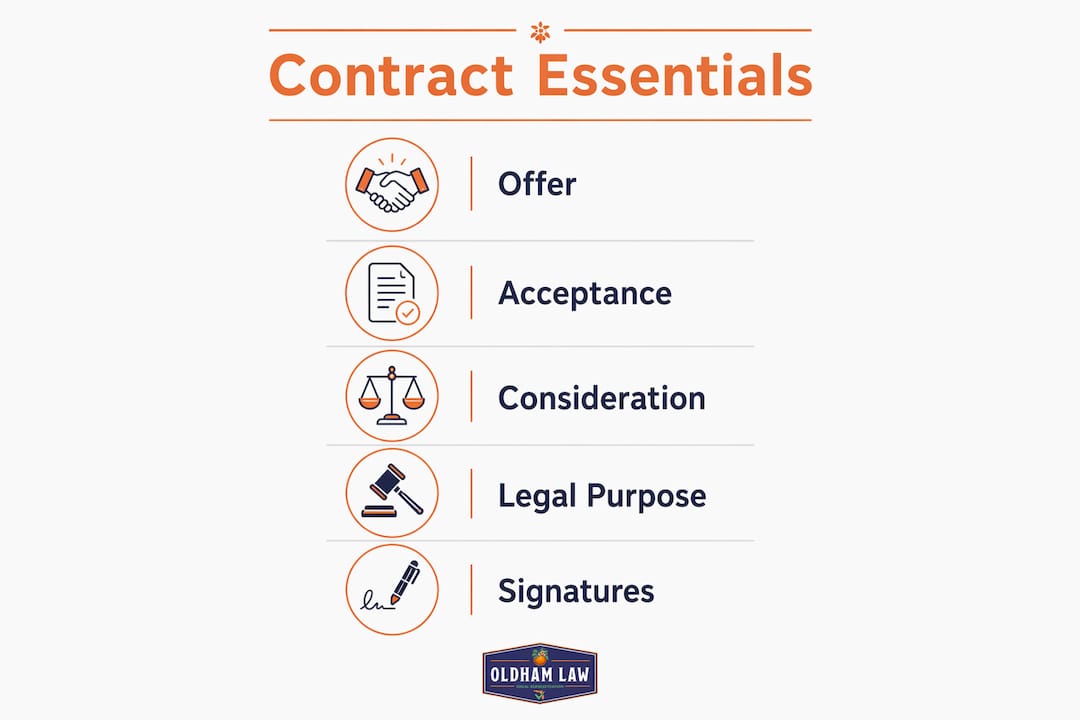
A contract that looks official can still be unenforceable if it is missing a required element. Florida law sets clear criteria, and courts will not save a defective agreement just because both parties signed it.
For a real estate contract to be legally binding in Florida, it must satisfy all of the following:
- Written form: Required by the Statute of Frauds for property sales.
- Offer and acceptance: Both parties must agree to all material terms without ambiguity.
- Consideration: Something of value exchanged by each party, typically the purchase price and the promise to convey the property.
- Legal capacity: Both parties must be of legal age and sound mind.
- Lawful subject matter: The contract cannot require anything illegal.
- Mutual assent: There must be a genuine meeting of the minds, free from fraud, duress, or material mistake.
Common reasons contracts fail enforceability review include misrepresentation of property condition, one party signing under duress, or a material term left vague enough to be disputed. A thorough attorney review before signing catches these problems before they become expensive.
Can you back out of a Florida real estate contract?

You can, but only under specific conditions and within strict deadlines. Florida does not give buyers an automatic three-day right to cancel after signing. That right must be written into the contract, and none of the standard Florida Realtors forms include it by default.
Your real cancellation rights come from contingencies:
- Inspection contingency: Under the AS IS contract, you may cancel for any reason during the inspection period by delivering written notice before it expires. No justification is required.
- Financing contingency: If you cannot secure loan approval within the specified period, you may cancel and recover your earnest money deposit, provided you made a good-faith effort to obtain financing.
- Title contingency: If the title search reveals a defect the seller cannot cure within the contract’s allotted time, you may cancel and receive your deposit back.
- Appraisal contingency: This protection is not automatic. It must be specifically added or a corresponding box checked in the contract.
Missing a contingency deadline by even a single day can result in forfeiture of your deposit. The “time is of the essence” clause in Florida contracts means deadlines are absolute, not approximate.
How are Florida real estate contract disputes resolved?
When a deal goes sideways, Florida law offers several paths forward. The right one depends on the nature of the dispute, the contract’s terms, and how much is at stake.
- Negotiation: The fastest and least expensive option. Parties work directly, often through their attorneys, to reach a resolution.
- Mediation: A neutral third party facilitates discussion. Many Florida contracts require mediation before litigation.
- Arbitration: A binding decision from a private arbitrator, faster than court but with limited appeal rights.
- Litigation: Court proceedings that can result in damages or specific performance, where a judge orders the sale to proceed as agreed.
Common remedies for breach of contract include compensatory damages, return of the earnest money deposit, and specific performance. Most Florida residential contracts also include a prevailing party clause, meaning the losing side pays the winner’s attorney fees and court costs. That provision raises the stakes considerably for both parties.
When should you consult a Florida real estate attorney?
Florida real estate agents are not permitted to provide legal advice or alter core contract language. Only a licensed attorney can ensure the terms of your agreement actually reflect your goals and protect your interests.
Situations that call for legal counsel include:
- Any transaction involving non-standard financing, seller financing, or lease-to-own arrangements.
- Title issues such as liens, boundary disputes, or unresolved permits discovered before closing.
- Custom contract clauses or significant modifications to standard forms.
- Disputes over earnest money deposits or contract cancellation.
- Commercial property transactions, which require different contract forms entirely.
- For-sale-by-owner transactions where no agent is involved on either side.
Hiring an attorney early, before you sign, is almost always less expensive than resolving a dispute after the fact. A contract review at the outset can identify ambiguous language, missing contingencies, or unrealistic deadlines before they become problems.
Practical insights from Oldham Law PLLC on Florida property contracts
Oldham Law PLLC serves buyers, sellers, and property owners throughout Pinellas Park, St. Petersburg, and the broader Tampa Bay area. The firm’s attorneys bring prior experience as prosecutors and insurance defense lawyers, which gives them a perspective on contract disputes that goes beyond standard transactional work. They understand how the other side thinks, and that shapes how they draft and negotiate agreements.
A few patterns the firm sees repeatedly in Florida real estate disputes:
- Buyers who assume a verbal agreement with a seller about repairs is binding, only to discover at closing that nothing was written into the contract.
- Sellers who miss the window to respond to a buyer’s cancellation notice, creating confusion about whether the contract is still active.
- Parties who rely on pre-printed forms for complex transactions without realizing those forms were not designed to handle their specific circumstances.
Pro Tip: Pay close attention to how contingency deadlines are calculated in your specific contract. FR/Bar forms use calendar days; CRSP uses business days. A deadline that appears to give you two weeks may actually give you fewer days than you expect, depending on weekends and holidays.
The firm’s approach prioritizes personalized attention over volume, meaning your transaction gets focused legal strategy rather than a one-size-fits-all response.
Oldham Law PLLC: real estate legal help in Pinellas County
Real estate transactions in Tampa Bay move fast, and the legal details move with them. Oldham Law PLLC gives buyers and sellers in Pinellas County a concrete advantage: attorneys who know Florida property law from multiple sides of the table and who focus on your specific situation rather than a generic checklist.
Whether you need a contract reviewed before you sign, help navigating a title issue, or representation in a real estate dispute, the firm handles it with the kind of focused attention that prevents small problems from becoming expensive ones. Flat-fee, hourly, and contingency structures are available depending on your needs. Contact Oldham Law PLLC to schedule a consultation and get clear answers about your rights before the deadline passes.
Key Takeaways
Florida real estate contracts must be in writing, contain all required legal elements, and have contingencies exercised strictly on time to be enforceable and protective.
| Point | Details |
|---|---|
| Written contracts required | Florida’s Statute of Frauds (Fla. Stat. § 725.01) mandates written agreements for all real estate sales. |
| Deadlines are absolute | The “time is of the essence” clause means missing a contingency deadline, even by a day, can forfeit your deposit. |
| No automatic cancellation right | Florida buyers do not have a three-day right to cancel unless it is specifically written into the contract. |
| Attorney review prevents disputes | Consulting a real estate attorney before signing catches missing contingencies and ambiguous language early. |
| Oldham Law PLLC | Serves buyers and sellers in Pinellas County and Tampa Bay with personalized contract review, drafting, and litigation support. |
FAQ
What voids a real estate contract in Florida?
A Florida real estate contract can be voided by fraud, misrepresentation, duress, lack of legal capacity, mutual mistake, or failure to meet the Statute of Frauds requirement of a written agreement. Contracts with illegal subject matter are also unenforceable from the start.
Can you back out of a real estate contract in Florida?
Yes, but only through a valid contingency exercised before its deadline, such as the inspection, financing, or title contingency. Florida does not provide an automatic right to cancel after signing unless that right is written into the contract.
What is the new contractor law in Florida?
Florida has updated several construction and contractor licensing statutes in recent years, primarily affecting licensing requirements and consumer protections for home improvement contracts. For specifics affecting your transaction or property, consulting a Florida real estate attorney is the most reliable way to get current, applicable guidance.
What is the new real estate law in Florida in 2026?
Florida continues to refine its real estate disclosure and transaction statutes. Buyers and sellers should confirm current requirements with a licensed Florida attorney, as statutory updates can affect disclosure obligations, contract timelines, and closing procedures in ways that standard form contracts may not yet reflect.
