
Florida Closing Costs: What Buyers and Sellers Should Expect

TL;DR:
- Florida buyers pay for loan fees, appraisals, and title insurance, while sellers mainly cover commissions and deed taxes. The responsibility for owner’s title insurance varies by county, with sellers paying in most but buyers in some, like Miami-Dade. Reviewing costs early and consulting a Florida attorney can help prevent surprises during closing.
Florida closing costs typically represent a moderate portion of the purchase price for buyers, and sellers often pay more when you factor in real estate commissions. Buyers and sellers should expect varying amounts depending on the home price and local customs, with higher prices generally leading to higher closing costs.
Here is the short version of what drives those numbers:
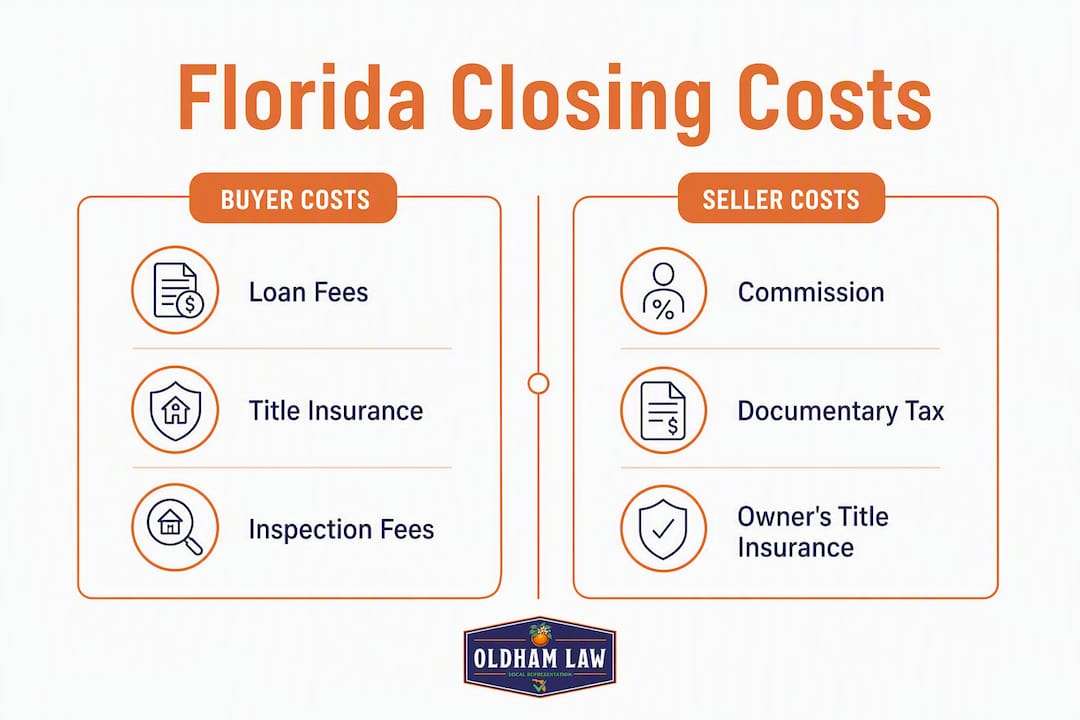
- Buyers pay loan fees, appraisal, title insurance (lender’s policy, and sometimes owner’s), prepaids, and recording fees.
- Sellers pay real estate commissions, documentary stamp tax on the deed, prorations, and often the owner’s title policy.
- The single biggest county variable: in 63 of Florida’s 67 counties, the seller customarily pays the owner’s title insurance premium. In Miami-Dade, Broward, Sarasota, and Collier, the buyer customarily pays it instead.
This article breaks down every line item, shows you how to estimate your own costs, and explains when a real estate attorney can protect your proceeds.
What do Florida closing costs typically look like by price point?
Statewide closing costs for buyers vary widely depending on factors such as financing, county, commission structure, and title insurance payer, leading to a broad range of possible closing cost percentages relative to the purchase price.
The table below illustrates approximate buyer and seller costs at common price points, noting that seller figures include an estimated commission rate and documentary stamp tax at the mandated rate. Buyer estimates vary due to financing and who pays the owner’s title policy, resulting in a range of possible closing costs.
A few things worth noting about the spread. Cash buyers sit near the bottom of the buyer range because they skip loan origination fees, appraisal, and lender’s title insurance. Financed buyers in counties with local surtaxes, or in transactions where the buyer pays the owner’s policy, can push toward the top. Reported market averages vary widely depending on whether commissions are included, which is why you will see different totals across different sources.
What does a buyer actually pay at closing in Florida?
Buyer closing costs in Florida fall into four broad categories: loan-related fees, title and settlement costs, prepaids and escrows, and third-party inspection fees. Understanding each one helps you spot overcharges before you sign.
Loan-related fees
- Origination fee: Typically 0.5%–1% of the loan amount. This covers the lender’s cost to process and underwrite your loan.
- Discount points: Optional, paid upfront to buy down your interest rate. One point equals 1% of the loan amount.
- Appraisal: Usually $400–$600 for a standard residential property; higher for luxury or complex homes.
- Credit report and underwriting fees: Often $50–$500 combined, depending on the lender.
Title and settlement costs
Florida title insurance premiums are fixed by state statute and Office of Insurance Regulation rules, making the premium rate non-negotiable. However, other fees related to title search, settlement, and closing agent services may vary and can often be negotiated.

On a financed purchase, you will pay for a lender’s title policy. When the owner’s and lender’s policies are issued simultaneously on a residential purchase, the lender’s simultaneous-issue rate is commonly just $25, which makes the lender’s policy essentially a line-item rounding error. On a $400,000 purchase, the combined title premium for both owner’s and lender’s policies issued together can be calculated using the promulgated rate schedule. Buyers should confirm with their closing agents that any applicable simultaneous-issue discount is applied.
Pro Tip: If you are refinancing rather than purchasing, the simultaneous-issue discount does not apply. A lender’s policy on a refinance is rated on the full loan amount, which can add several hundred dollars to your costs. This is a common source of sticker shock for homeowners who refinanced recently and expected the same low lender-policy cost they saw at purchase.
For a deeper look at what each policy actually covers, the lender’s title insurance guide for Florida buyers at Oldham Law PLLC walks through the practical differences.
Prepaids and escrows
These are not fees in the traditional sense. They are money you pay upfront to fund your escrow account and cover the first stretch of homeownership:
- Homeowners insurance: — First year’s premium paid at or before closing, plus 2–3 months into escrow.
Third-party inspection fees
- Home inspection: $300–$500 for most single-family homes.
- Pest/WDO inspection: $75–$150.
- Wind mitigation inspection: $75–$150; often pays for itself through insurance premium discounts.
The buyer typically orders and pays for inspections before closing, so these costs appear before you ever see the Closing Disclosure.
What does a seller pay at closing in Florida?
Sellers in Florida often underestimate their total closing exposure because they focus on the sale price and forget the line items that come off the top. The biggest cost is almost always commission, followed by the documentary stamp tax on the deed.
Common seller-side costs
- Real estate commissions: Typically 5%–6% of the sale price, split between listing and buyer’s agents. On a $500,000 home at 5.5%, that is $27,500.
- Documentary stamp tax on deed: Calculated at $0.70 per $100 of consideration in most Florida counties. Multiply the sale price by 0.007 to get the amount. On a $500,000 sale: $500,000 × 0.007 = $3,500.
- Owner’s title insurance premium: In 63 of 67 counties, the seller pays this. On a $500,000 purchase, the owner’s policy premium runs roughly $2,750–$3,000 under the promulgated schedule.
- Prorations: Property taxes (if not yet paid for the year), HOA dues, and any prepaid utilities are prorated to the closing date.
- Mortgage payoff: Your existing loan balance plus any prepayment penalty or per-diem interest through the payoff date.
- Settlement/closing fee: Often $500–$800 when the seller selects the closing agent.
Example net-proceeds calculation for a $500,000 sale
| Line Item | Amount |
|---|---|
| Sale price | $500,000 |
| Less: Commission (5.5%) | ($27,500) |
| Less: Documentary stamp tax | ($3,500) |
| Less: Owner’s title premium (est.) | ($2,750–$3,000) |
| Less: Prorations and misc. fees | ($1,500–$1,800) |
Many of these costs are negotiable. Sellers can offer buyer credits in lieu of price reductions, negotiate who pays the owner’s policy in counties where custom is not locked in by contract, and sometimes negotiate commission rates. The Florida Department of Revenue publishes the DR-228 form and filing instructions for documentary stamp tax, including penalty and interest rules for late payment.
Who pays owner’s title insurance in Florida, and does your county matter?
This is the question that catches more buyers and sellers off guard than almost any other closing-cost item. The answer depends on where in Florida you are closing.
In most Florida counties, the seller customarily pays the owner’s title insurance premium and often selects the closing agent. However, in some counties such as Miami-Dade, Broward, Sarasota, and Collier, local custom typically has the buyer paying for the owner’s policy.
What “customary” actually means
Custom is not law. No Florida statute requires either party to pay the owner’s title policy. The convention comes from regional practice and the standard FR/Bar contract language, which defaults to local custom unless the parties negotiate otherwise. That means you can contract around it in any county, and you should confirm the allocation in writing before you sign.
Pinellas and Hillsborough vs. Miami-Dade: a cost comparison
In Pinellas County (Tampa Bay area), the seller pays the owner’s title policy. On a $400,000 purchase, that premium is approximately $2,100 combined (owner’s + lender’s simultaneous issue), with the seller absorbing the bulk and the buyer paying roughly $25 for the lender’s policy.
In Miami-Dade, the buyer pays the owner’s policy. That same $400,000 purchase would shift roughly $2,075 of title cost from the seller’s column to the buyer’s column.
Pro Tip: When you receive your Loan Estimate or Closing Disclosure, look at Section B (Services You Cannot Shop For) and Section C (Services You Can Shop For). The owner’s title insurance premium will appear in one of those sections. Confirm it matches what your contract says about who pays. If it does not, flag it with your closing agent immediately.
For a full breakdown of how title insurance works in Florida, including what each policy covers long-term, Oldham Law PLLC has a dedicated resource that explains both owner’s and lender’s coverage in plain language.
How can you estimate your closing costs before you get to the table?
Getting a reliable estimate early prevents the shock of seeing a large number for the first time three days before closing. A three-step approach works well for most buyers and sellers.

Step 1: Request a Loan Estimate within three business days of application. Federal law requires lenders to provide this form within three business days of receiving your loan application. It itemizes every projected cost, including lender fees, title charges, prepaids, and escrow amounts. Use it as your first benchmark.
Step 2: Run a title insurance calculator. Because Florida title premiums are promulgated (set by the state), you can calculate the exact owner’s and lender’s policy premiums yourself using the OIR rate schedule. Online calculators built on the promulgated schedule give you a precise figure, not an estimate.
Step 3: Audit the Closing Disclosure during the three-business-day review window. The Closing Disclosure must be provided at least three business days before closing, and that window is your last real opportunity to catch errors. Compare every line to your Loan Estimate. Any fee that increased beyond allowable tolerances may be subject to a lender cure.
Pro Tip: Bring these four items to your Closing Disclosure review: your signed purchase contract (to verify allocation lines), your payoff statement (to confirm the exact balance), your HOA statement (to verify prorations), and your insurance binder (to confirm the prepaid premium matches). Having these in hand means you can resolve discrepancies in minutes rather than delaying the closing.
The CFPB’s Closing Disclosure explainer is a reliable resource for understanding what each section of the form controls and what your rights are during the review window.
When will you see each document, and what does each one control?
The timeline for a financed purchase in Florida follows a predictable sequence. Knowing what to expect at each stage keeps you from being caught off guard.
- Within 3 business days of loan application: Lender delivers the Loan Estimate. This is your first official cost projection and sets the baseline for fee tolerances.
- At least 3 business days before closing: Lender delivers the Closing Disclosure. This is the final authority on costs. Review it line by line against your Loan Estimate.
- Day before or morning of closing: Final walkthrough. Confirm the property’s condition matches what was agreed in the contract.
- Closing day: You sign documents, funds are disbursed, and the deed and mortgage are sent for recording.
- After recording: The county clerk records the deed and mortgage. In Pinellas County and most Florida counties, recording typically happens the same day or the next business day.
The settlement statement (often a HUD-1 or ALTA statement in Florida cash transactions) shows every dollar paid and owed by each party. For a step-by-step walkthrough of the full Florida real estate closing process, Oldham Law PLLC’s guide covers each stage from contract to recording.
How can buyers and sellers reduce closing costs in Florida?
Most closing costs are not fixed. Several of the largest line items are negotiable, and a few smart moves can shift thousands of dollars from one column to another.
| Strategy | Who Benefits | Trade-Off |
|---|---|---|
| Ask for a seller credit | Buyer | Seller may counter with a higher price; net savings depend on loan terms |
| Shop lenders for origination fees | Buyer | Lower origination often means a higher rate; compare APR, not just fees |
| Confirm simultaneous-issue title discount | Buyer | Only applies on purchases; refinances pay full schedule |
| Negotiate non-promulgated closing fees | Buyer/Seller | Settlement fee, search fee, and courier charges are competitive |
| Seller credit instead of price reduction | Seller | Buyer gets cash at closing; seller nets the same; works better in financed deals |
| Negotiate who pays owner’s policy | Seller | Only effective in counties where custom is not already locked in by contract |
| Roll costs into loan | Buyer | Increases loan balance and total interest paid over time |
| Waive optional inspections | Buyer | Saves money upfront; significant risk if defects are discovered post-closing |
A few of these deserve a closer look. Rolling closing costs into the loan sounds appealing, but you pay interest on those costs for the life of the loan. On a 30-year mortgage, a $5,000 cost rolled in at 7% costs you roughly $12,000 over the full term. Waiving inspections is the highest-risk option on this list; the short-term savings rarely justify the exposure.
Seller credits are often the cleanest solution for buyers who are short on cash at closing. The seller agrees to credit a fixed dollar amount toward buyer closing costs, which reduces what the buyer must bring to the table without changing the loan amount in most cases. Understanding the negotiation mechanics in Florida purchase contracts helps both parties structure these credits correctly.
When should you call a Florida real estate attorney?
Florida does not require an attorney at closing, but there are situations where going without one is a real financial risk. The three-day Closing Disclosure window is short, and title exceptions discovered late can derail a closing entirely if no one with legal authority is at the table to resolve them.
Consider calling an attorney when:
- The contract allocation is disputed. If your agent and the seller’s agent disagree about who pays the owner’s title policy or a repair credit, an attorney can read the contract language and give you a definitive answer before closing.
- A title exception appears late. Liens, easements, or encumbrances that surface during the title search can cloud ownership. An attorney can negotiate a resolution, demand a payoff, or advise you whether to proceed.
- The payoff figures do not match. If the seller’s mortgage payoff is higher than expected, or if a second lien appears, the closing can stall. An attorney can communicate directly with lenders and lienholders to clear the path.
- HOA or CC&R obligations are ambiguous. Undisclosed special assessments or transfer fees can add thousands to closing costs at the last minute.
- The transaction involves an estate, trust, or unusual ownership structure. These closings require additional documentation and often legal sign-off that a title agent alone cannot provide.
During the three-day Closing Disclosure window, an attorney will review every line item, compare it to the contract, and flag discrepancies that exceed allowable tolerances. At the table, they can negotiate corrections, hold up disbursement if something is wrong, and clear title objections on the spot.
Pro Tip: Calling an attorney before you sign the purchase contract is almost always cheaper than calling one after a problem surfaces. Contract language about who pays what, how credits are structured, and what happens if title issues arise is far easier to fix before both parties have signed.
For FSBO sellers in particular, the guide to for-sale-by-owner closings in Florida at Oldham Law PLLC covers the specific risks of closing without professional representation.
Key Takeaways
Florida closing costs typically range from about 2% to 5% of the purchase price for buyers, with sellers generally paying more when commissions and documentary stamp tax are included. A major variable across counties is the customary party responsible for the owner’s title insurance premium.
| Point | Details |
|---|---|
| Statewide buyer range | Buyers typically pay closing costs that range from about 2% to 5% of the purchase price, depending on financing and other variables. |
| Documentary stamp tax | Sellers pay the documentary stamp tax at the statutory rate of $0.70 per $100 of sale price. |
| Owner’s title insurance custom | Sellers pay in most counties, but buyers pay in specific counties such as Miami-Dade, Broward, Sarasota, and Collier. |
| Three-day audit window | Review your Closing Disclosure within the mandatory three-business-day window before signing. |
| Oldham Law PLLC | Pinellas County and Tampa Bay buyers and sellers can consult Oldham Law PLLC for contract review, title-issue resolution, and Closing Disclosure audits before closing. |
What local attorneys see most often at Florida closings
The closing-cost surprises that cause the most friction are rarely the big, obvious ones. Buyers and sellers usually know to expect commissions and title insurance. What catches people off guard is the gap between what they assumed and what the contract actually says.
In Pinellas County and across Tampa Bay, the most common last-minute friction point is the owner’s title policy allocation. A buyer who moved from South Florida assumes they are paying the owner’s policy, because that is the Miami-Dade custom. Their agent, working under the Pinellas convention, has already written the contract with the seller paying it. Nobody catches the discrepancy until the Closing Disclosure arrives, and then everyone is scrambling three days before closing.
The second most common issue is undisclosed HOA transfer fees and special assessments. These can appear as late as the day before closing and, if not addressed in the contract, can become a point of real dispute about who absorbs the cost.
The practical advice: read your contract’s allocation lines before you sign, not after. Confirm the county custom applies to your transaction. And if anything on your Closing Disclosure does not match what you agreed to in writing, get legal eyes on it before you show up at the table.
Oldham Law PLLC handles Florida closings from contract to recording
Closing on a Florida property without a legal review is a calculated risk that often costs more than the review itself. Oldham Law PLLC works with buyers and sellers throughout Pinellas County, St. Petersburg, and the greater Tampa Bay area to catch the problems that title agents and real estate agents are not positioned to resolve: contract disputes, title exceptions, payoff discrepancies, and Closing Disclosure errors that exceed federal tolerance limits.

The firm offers flat-fee and hourly arrangements for real estate closings and contract reviews, so you know the cost before you commit. If you are buying or selling in Pinellas County or the surrounding area and want a legal review of your purchase contract or Closing Disclosure, contact Oldham Law PLLC to schedule a consultation. For contested closings or title disputes that have already surfaced, the firm’s real estate litigation practice handles those matters as well.
Authoritative sources and tools for verifying your closing costs
Use these official resources to verify specific line items before and after you receive your Closing Disclosure.
| Resource | What It Covers | Link |
|---|---|---|
| Florida House — F.S. §201.02 | Documentary stamp tax rate and calculation rules | F.S. §201.02 |
| Florida Dept. of Revenue — DR-228 | Doc stamp filing instructions, penalties, and payment | DR-228 Form |
| CFPB — Closing Disclosure explainer | What each section of the Closing Disclosure controls | CFPB Guide |
| Florida Senate — F.S. §695 | Recording requirements for deeds and instruments | F.S. §695 |
| OIR/Cornell Law — Title rate rule | Promulgated title insurance rate schedule (Fla. Admin. Code) | Rate Schedule |
| The Fennec Lab — Title Calculator | Florida promulgated title premium calculator for owner’s and lender’s policies | Title Calculator |
To verify the documentary stamp tax on your transaction, use the F.S. §201.02 page and the DR-228 instructions. To confirm your title premium, use the OIR rate schedule or the promulgated calculator. To understand your rights during the Closing Disclosure review window, start with the CFPB guide.
This article is general information about Florida closing costs and is not legal advice. Closing-cost rules, tax rates, and county customs can change. Confirm current figures with the Florida Department of Revenue, the OIR, your county clerk, or a qualified Florida real estate attorney before relying on any figure for your transaction.
FAQ
How much are closing costs on a $400,000 house in Florida?
Buyer closing costs in Florida typically range between about 2% and 5% of the purchase price, depending on loan fees, title insurance payer, financing, and county. Sellers typically pay commission plus documentary stamp tax and often the owner’s title premium in most counties.
What are typical closing costs on a $300,000 house in Florida?
Buyer closing costs typically range from about 2% to 5% of the purchase price statewide, depending on financing and title policy payer. Seller costs similarly vary with commission rates and documentary stamp tax, which is calculated at $0.70 per $100 of consideration.
Why are closing costs so high in Florida?
Florida closing costs are influenced by the documentary stamp tax on deeds, promulgated title insurance premiums, and real estate commissions as significant seller-side costs. The owner’s title policy premium varies by price and who pays.
Who usually pays closing costs in Florida?
Both parties pay closing costs, but for different items. Buyers typically cover loan fees, appraisal, lender’s title insurance, prepaids, and recording fees. Sellers typically pay real estate commissions, documentary stamp tax on the deed, and the owner’s title insurance premium in 63 of Florida’s 67 counties. The allocation is negotiable and should be confirmed in the purchase contract.
Do I need an attorney to close on a home in Florida?
Florida does not legally require an attorney at closing, but having one is strongly advisable when title exceptions surface late, contract allocation is disputed, or the Closing Disclosure contains errors. An attorney can resolve these issues during the mandatory three-business-day review window, which is the last practical opportunity to correct problems before funds are disbursed.
