
Florida Real Estate Closing Process: Step-by-Step Guide

TL;DR:
- The Florida real estate closing process is a structured legal procedure involving detailed escrow, title, and disclosure requirements. Buyers and sellers must review documents carefully, resolve title issues early, and confirm all funds and obligations before signing. Consulting a qualified attorney can help prevent delays and ensure a smooth transfer of ownership.
The closing process in real estate is the final legal and financial step that transfers ownership from seller to buyer once required documents are signed, funds are disbursed, and the deed is recorded with the county. In Florida, that moment is more structured than most buyers and sellers expect. You will deal with escrow rules governed by Florida Statutes § 475.25, a federal Closing Disclosure that must reach you at least three business days before signing under TRID rules, and a title insurer who is legally required to preserve evidence of your title search for at least seven years under Fla. Stat. § 627.7845. Florida is also a title state, meaning title companies typically lead the closing rather than attorneys, though having a real estate attorney review your documents is always an option and often a smart one.
Before you get to the closing table, here are the non-negotiables:
- Review your Closing Disclosure at least three business days before closing and compare every line to your original Loan Estimate.
- Confirm wire instructions by phone using a number you independently verified, never from an email. Wire fraud targeting real estate closings is a real and growing threat.
- Clear all title commitment exceptions before closing day. Unresolved liens or unreleased mortgages are the most common reason closings fall behind.
- Have earnest money ready. In Florida, earnest money is commonly a small percentage of the purchase price and must be deposited promptly after contract execution.
- Know who holds your escrow. Whether a broker or a title company holds your funds affects the dispute rules that apply if something goes wrong.
Oldham Law PLLC serves buyers and sellers throughout Pinellas County, St. Petersburg, and Tampa Bay and can walk you through every one of these checkpoints before you sign.
What happens before closing: contract, earnest money, and due diligence
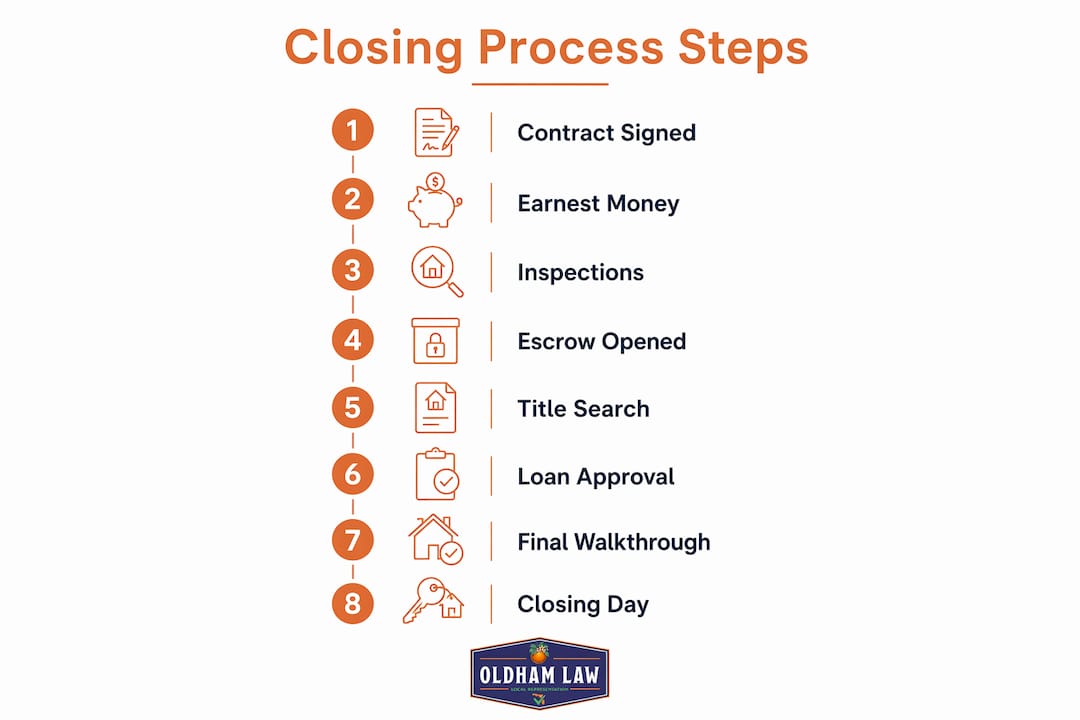
The closing process actually begins the moment both parties sign the purchase contract. That effective date starts the clock on every deadline that follows, including your inspection period, financing contingency, and escrow deposit.
Contract execution and who is involved
The buyer and seller both sign the contract, typically with their respective real estate agents facilitating the transaction. Once the contract is fully executed, the buyer generally has three days from the effective date to deliver the earnest money deposit to the escrow agent.
Earnest money and deposit timing
Earnest money in Florida is commonly 1%–3% of the purchase price. If a licensed broker is holding the funds, Florida administrative rules require the broker to deposit those funds within three business days of receiving them. Missing that window is a license violation, so reputable brokers move quickly. Title companies follow their own trust accounting rules under Fla. Stat. § 626.8473, which require immediate deposit into a separate, FDIC-insured escrow account.
The inspection and due-diligence period
Florida Realtors/Bar contract forms typically include a 10-day inspection period, though that window is negotiable. During this time, you should order:
- General home inspection
- Pest and termite inspection
- Wind mitigation inspection (affects insurance premiums)
- Roof inspection
- Pool and HVAC inspections if applicable
If the inspections reveal problems, you submit a Request for Repair (RFR) to the seller. The seller can agree, counter, or decline. If you cannot reach an agreement, you generally have the right to cancel and recover your deposit before the inspection period expires.
Practical timeline: Financed deals in Florida generally take about a month or more from contract to closing. Cash deals can close more quickly depending on title and funding speed.

Pro Tip: Schedule your inspections and start gathering homeowner’s insurance quotes within 24 hours of contract execution. Waiting even two or three days can compress your timeline and leave you scrambling near the deadline.
How escrow works in Florida and who holds your funds
Escrow is the neutral holding arrangement that keeps your earnest money safe while the transaction is being processed. In Florida, two parties commonly hold escrow: licensed real estate brokers and title companies. Attorneys acting as settlement agents may also hold funds, and they are subject to both The Florida Bar’s trust accounting rules and the requirements of Fla. Stat. § 626.8473.
Broker-held escrow
When a broker holds escrow, the three-business-day deposit rule applies. If conflicting demands arise on those funds, the broker must notify the Florida Real Estate Commission (FREC) within 15 business days. That notification requirement is specific to brokers and does not apply to title companies or attorneys.
Title company-held escrow
Title companies are the more common escrow holders in Florida residential transactions. Under Fla. Stat. § 626.8473, all funds must be placed immediately in a Florida-based, FDIC-insured account and kept separate from the title company’s operating funds. If the parties disagree on how to release the funds, the title company may interplead those funds with the county clerk rather than make a unilateral decision.
Once the title company receives the signed contract and the earnest money deposit, it opens a title file and orders the title commitment. That commitment is the underwriter’s formal promise to issue an owner’s title insurance policy at closing, provided the listed requirements are satisfied.
Action item: Get written escrow instructions from whoever holds your funds. Confirm the account details, the conditions for release, and the dispute procedures before you wire anything.
What a title search covers and why title insurance matters
A title search is a review of public records going back far enough to establish a clean chain of ownership. The examiner looks at recorded deeds, mortgages, judgments, tax liens, contractor liens, easements, and UCC filings. For residential properties, that search typically takes one to three business days; commercial searches can run five to ten business days.
What the title commitment contains
The title commitment has two key schedules. Schedule A confirms the current ownership status and the proposed insured amount. Schedule B lists the requirements that must be satisfied before the policy is issued (such as paying off an existing mortgage) and the exceptions that will remain in the policy (such as recorded easements). Read Schedule B carefully. If you object to an item that is legitimately objectionable, the title company is required to remove it from your policy, giving you the broadest possible coverage.
Common title defects that delay closings include:
- Unreleased mortgages from prior owners
- Contractor or mechanic’s liens
- Judgment liens against the seller
- Errors in prior deeds (wrong legal description, missing signatures)
- Unpermitted improvements that create code-violation liens
Most of these can be resolved with payoffs, releases, or short affidavits if caught early. Late discovery is the problem. An unreleased mortgage found two days before closing is a genuine crisis; the same lien found three weeks out is a paperwork task.
Under Fla. Stat. § 627.7845, title insurers and their agents must preserve evidence of the title search and determination of insurability for at least seven years after issuing a commitment or policy. This retention requirement is a meaningful accountability mechanism: if a defect surfaces after closing, the insurer’s records can be audited to determine what was known and when.
Pro Tip: Request a copy of the title commitment as soon as it is issued, not the day before closing. Have your attorney or title agent walk you through each Schedule B exception in plain language so you know exactly what you are and are not insured against. You can learn more about how title insurance works in Florida before your closing.
Inspections, repairs, and protecting your right to cancel
Inspections are your primary tool for understanding what you are buying. Schedule them as early as possible in the due-diligence period so you have time to negotiate if problems arise.
Types of inspections to consider
- General home inspection: Covers structure, roof, electrical, plumbing, HVAC, and more.
- Pest and termite inspection: Required by most lenders; Florida’s climate makes this one non-negotiable.
- Wind mitigation inspection: Documents construction features that may reduce your homeowner’s insurance premium.
- Roof inspection: Often ordered separately from the general inspection for older roofs.
- Pool and HVAC: Worth separate inspections if the property has a pool or aging mechanical systems.
Negotiating repairs
After reviewing inspection reports, you submit a Request for Repair to the seller. The seller has three options: agree to all repairs, counter with a partial credit or selected repairs, or decline entirely. If the seller declines and the inspection period has not expired, you can cancel the contract and receive your earnest money back.
Here is a practical checklist to work through before your inspection period ends:
- Confirm all inspection reports are in hand and reviewed.
- Submit the RFR in writing with specific repair requests.
- Obtain the seller’s written response.
- If repairs are agreed upon, confirm they will be completed before closing with receipts and contractor warranties.
- If repairs cannot be completed before closing, negotiate a repair escrow holdback documented in the closing paperwork.
- Verify your cancellation rights have not lapsed if you choose to walk away.
If a seller promises repairs but does not complete them, you will want written proof at the closing table. A verbal agreement is not enough. Get receipts, contractor invoices, and any applicable warranties, and confirm those items are referenced in the final closing documents.
Financing milestones, the Closing Disclosure, and the 3-day rule
For buyers using a mortgage, the lender controls much of the closing timeline. Understanding the lender’s sequence helps you anticipate delays before they become crises.
The lender’s sequence
- Appraisal: Ordered by the lender shortly after contract execution. The property must appraise at or above the purchase price for the loan to proceed as structured.
- Underwriting: The underwriter reviews your financial documentation, the appraisal, and the title commitment. Conditions are issued, and you must respond to each one promptly.
- Clear to Close (CTC): Once all conditions are satisfied, the lender issues a CTC. This is the gating milestone. Even minor open conditions can prevent funding, so stay responsive to every underwriter request.
- Closing Disclosure delivery: The lender must deliver the Closing Disclosure to you at least three business days before closing under federal TRID rules. Certain material changes, such as an APR increase above a specified threshold or a change in loan product, restart that three-day clock.
What the Closing Disclosure contains
The Closing Disclosure (CD) is a five-page federal form that itemizes your loan terms, projected monthly payment, and every closing cost. Compare it line by line to your original Loan Estimate. The loan amount, interest rate, and cash-to-close figures should match what you agreed to. If they do not, ask for an explanation before you sign anything.
Timeline callout: Financed purchases in Florida generally take around a month or more to close; cash purchases often close more quickly depending on the circumstances.
Pro Tip: Verify your final loan terms against the Loan Estimate the day you receive the Closing Disclosure, not the morning of closing. If the APR has changed by more than the allowable threshold, the three-day clock restarts and your closing date shifts. Catching that early gives everyone time to adjust.
Understanding your closing documents before you sign
Closing day is typically a 30–45 minute signing session in Florida. The real work happens in the weeks before. By the time you sit down at the table, you should already understand every document in front of you.
Documents the buyer signs
- Promissory note: Your personal promise to repay the loan.
- Mortgage: The security instrument that gives the lender a lien on the property.
- Loan disclosures: Federal and state-required forms confirming loan terms, servicing, and escrow arrangements.
- Closing affidavits: Statements confirming your identity, occupancy intent, and other representations.
Documents the seller signs
- Deed: Transfers legal title to the buyer. In Florida, the deed must be signed in the presence of two witnesses and a notary.
- Payoff authorizations: Authorizes the title company to pay off any existing mortgages from the sale proceeds.
- Seller’s affidavit: Confirms no undisclosed liens, judgments, or pending work orders.
The ALTA settlement statement
The ALTA settlement statement is the master accounting document for the transaction. It maps to the Closing Disclosure and shows every debit and credit for both buyer and seller. Key fields to verify:
- Legal names spelled correctly on the deed and all documents.
- Legal description of the property matches the contract.
- Loan amount and interest rate match the Closing Disclosure.
- Prepaid items (homeowner’s insurance, prepaid interest) are accurate.
- Prorations for property taxes and HOA dues are calculated correctly.
- Seller’s payoff figure matches the lender’s payoff statement.
What to bring to closing: Government-issued photo ID for every person signing, a cashier’s check or proof of completed wire for funds due, your homeowner’s insurance binder, and any documents your lender or title company requested in advance. If you are married and the property is your homestead, your spouse may need to sign the mortgage even if they are not on the title, per Florida homestead law.
What happens on closing day: walkthrough, signing, and funding
Closing day has a clear sequence, and knowing it in advance removes most of the anxiety.

The final walkthrough
Schedule the final walkthrough within 24 hours of closing. Its purpose is narrow but important: confirm the property is in the agreed condition, that negotiated repairs were completed, and that no new damage occurred after the inspection. Bring your inspection report and the list of agreed repairs so you can check each item.
Who attends closing
- Buyer and seller (or their authorized representatives with a power of attorney).
- Real estate agents for both sides.
- Closing agent from the title company, who walks everyone through the documents.
- Attorney, if either party has retained one.
- Lender representative, sometimes present for financed transactions.
Remote online notarization (RON) is permitted in Florida under Fla. Stat. § 117.201, so remote signings are a legitimate option if you cannot attend in person.
Signing order and funding
Here is how the sequence typically works:
- Buyer signs loan documents and closing affidavits.
- Seller signs the deed and payoff authorizations.
- The closing agent confirms all funds are received and in the escrow account.
- The lender reviews the executed loan documents and authorizes disbursement.
- The closing agent records the deed with the county clerk.
- Proceeds are disbursed to the seller, payoff lenders, and other parties per the settlement statement.
Wire fraud warning: Before you wire any funds, call your title company at a phone number you independently looked up and verbally confirm the wiring instructions. Criminals send fraudulent wire instructions by email, and best closing practice is to send funds at least 24 hours before closing to allow them to clear.
When does ownership officially transfer in Florida?
Legal ownership transfers when the deed is properly executed by the seller, delivered to the buyer, and accepted. As a practical matter, most title companies wait for funding to clear before submitting the deed for recording, so the functional transfer of ownership and possession typically happens after the lender authorizes disbursement.
The recording process
The closing agent submits the executed deed to the county clerk of court for recording. Recording creates public notice of the ownership transfer and protects the buyer against subsequent claims. Once the deed is recorded, the title insurance policies are issued and mailed to the parties.
Key points about recording:
- Recording fees in Florida are set by statute and vary by the number of pages.
- The deed is typically recorded the same day as closing or the following business day.
- You will receive a copy of the recorded deed by mail after it is returned from the county.
Action item: After closing, sign up for your county’s free property fraud alert program. Several Florida counties offer this service, and it notifies you if any document is recorded against your property, which is an early warning system for deed fraud.
Closing costs in Florida: who pays what
Closing costs in Florida are negotiable to a degree, but local custom creates a fairly predictable starting point. The table below reflects typical payer conventions; your contract may vary.
| Closing Cost Item | Typical Payer | Estimated Range |
|---|---|---|
| Lender origination fees | Buyer | Varies by lender |
| Appraisal fee | Buyer | — |
| Owner’s title insurance premium | Seller (by custom) | Varies by purchase price |
| Lender’s title insurance premium | Buyer | Varies by loan amount |
| Title search and closing fee | Split or buyer | — |
| Documentary stamp tax on deed | Seller | $0.70 per $100 of purchase price |
| Documentary stamp tax on note | Buyer | — |
| Recording fees | Buyer | $10–$30 per document |
| Survey | Buyer | — |
| HOA transfer/estoppel fee | Seller (by custom) | — |
| Real estate commissions | Seller | Negotiated |
| Attorney fees (if retained) | Each party pays their own | Varies |
For a detailed breakdown of who pays closing costs in Florida, including how contract negotiations can shift these defaults, review the full guide. The documentary stamp tax on the deed is one of the larger seller costs and is not negotiable; it is set by Florida statute.
Review the ALTA settlement statement and the Closing Disclosure line by line before signing. If a fee appears that was not on your Loan Estimate and no one can explain it, ask for a written explanation before you proceed.
Common problems that delay closings and how to fix them
Most closing delays are preventable. The ones that are not can usually be resolved faster when they are caught early.
Title defects
Unreleased mortgages and contractor liens are the most common title problems. A prior owner refinanced and the old mortgage was never formally released. A contractor completed work and filed a lien that was never paid off. Both are fixable with payoffs and recorded releases, but they take time. If your title commitment comes back with a Schedule B requirement to clear a lien, start that process immediately.
Appraisal gaps
When a property appraises below the purchase price, the lender will only loan against the appraised value. The gap between the appraised value and the contract price must be covered somehow. Options include the buyer bringing additional cash, the seller reducing the price, or a combination of both. If the contract has an appraisal contingency and no agreement is reached, the buyer can typically cancel and recover the deposit.
Underwriting conditions
A Clear to Close is not guaranteed until every underwriting condition is satisfied. Common conditions include updated bank statements, letters of explanation for large deposits, or additional documentation of employment. Respond to every underwriter request the same day you receive it.
Documentation errors
Name mismatches between the contract and the deed, incorrect legal descriptions, and missing signatures are all fixable but can cause re-recording delays and added fees. Review every document for accuracy before the signing appointment, not during it.
Escrow disputes
If a broker holds your funds and receives conflicting demands, FREC must be notified within 15 business days. Title companies and attorneys follow different rules and may interplead funds with the clerk if the parties cannot agree. For a deeper look at how these disputes play out, the escrow dispute guide from Oldham Law PLLC covers the process in detail.
Pro Tip: In the weeks before closing, avoid making large, unexplained deposits into your personal bank accounts. Underwriters flag unusual activity and will ask for documentation. Use traceable wire transfers for all closing-related funds and confirm every set of instructions independently by phone.
Florida-specific legal rules every buyer and seller should know
Florida’s closing rules are not identical to those in other states. If you have bought property elsewhere, a few of these may surprise you.
Escrow deposit timing: Brokers must deposit escrow funds within three business days of receipt. Associates must deliver funds to the broker by the end of the next business day. These are administrative code requirements with real license consequences for violations.
FREC notice for escrow disputes: When a broker holds funds and receives conflicting demands, the 15-business-day FREC notification requirement kicks in. Title companies and attorneys are not subject to this rule; they follow their own trust accounting frameworks under the Department of Financial Services and The Florida Bar, respectively.
Title insurer record retention: Under Fla. Stat. § 627.7845, title insurers must retain evidence of the title search and determination of insurability for at least seven years after issuing a commitment or policy. This is not just a filing requirement; it is an audit mechanism. If a defect surfaces years after closing, regulators can demand those records.
TRID and Florida practice: The federal TRID rule requires the Closing Disclosure to be delivered at least three business days before closing. Florida title companies build this into their scheduling. Material changes to the loan terms restart the clock, which is why lenders and title companies coordinate closely in the final week before closing.
Florida is a title-state, meaning title companies typically lead the closing process rather than attorneys. Buyers accustomed to attorney-conducted closings in other states should expect a title-company-led process here, though retaining a real estate attorney for document review remains a sound practice regardless of who runs the closing.
Remote online notarization: Florida authorizes RON under Fla. Stat. § 117.201, making remote closings legally valid. This is particularly useful for out-of-state buyers purchasing Florida property.
When should you hire a Florida real estate attorney?
Florida does not legally require a buyer or seller to have an attorney at closing. That said, there are situations where going without one creates real risk.
Scenarios where an attorney is strongly recommended
- Complex title defects: Unreleased mortgages, contractor liens, or judgment liens that require negotiation and legal releases.
- Escrow disputes: When parties disagree on the release of funds and the matter may escalate to interpleader or litigation.
- Probate or estate sales: Properties with ownership tied to a deceased person’s estate require probate proceedings before title can transfer cleanly.
- Commercial terms in a residential contract: Lease-back arrangements, seller financing, or complex contingencies that go beyond standard form contracts.
- For-sale-by-owner transactions: Without an agent, the buyer or seller often lacks someone to catch contract errors or missing disclosures.
- Any time you are uncertain about what you are signing.
What a real estate attorney does at closing
- Reviews the purchase contract for unfavorable terms before you are bound.
- Examines the title commitment and explains each Schedule B exception.
- Negotiates settlements for title defects, drafts payoff letters, and coordinates releases.
- Represents you in escrow disputes, including FREC proceedings or interpleader actions.
- Attends closing to review documents in real time and flag errors before you sign.
- Follows up on post-closing recording and confirms the deed is properly recorded.
The attorney fee structures for real estate matters in Florida vary by complexity. Straightforward document reviews are often available at a flat fee, while complex title disputes or escrow litigation are typically handled hourly. Either way, the cost of legal review is almost always less than the cost of a delayed or failed closing.
If you are buying or selling in Pinellas County, St. Petersburg, or anywhere in Tampa Bay, Oldham Law PLLC can provide a pre-closing document review or step in to handle an escrow dispute before it escalates.
Key Takeaways
The closing process in Florida follows a defined legal sequence, and buyers and sellers who prepare early, review documents carefully, and understand their escrow rights are far less likely to face delays or disputes at the closing table.
| Point | Details |
|---|---|
| Earnest money timing | Deposit 1%–3% of the purchase price; brokers must deposit within three business days of receipt. |
| Closing Disclosure rule | Review the CD at least three business days before closing and compare it line by line to your Loan Estimate. |
| Title commitment review | Request it early, read Schedule B carefully, and clear all requirements before closing day. |
| Closing timeline | Financed deals typically take 30–45 days; cash closings often complete in 10–21 days. |
| Oldham Law PLLC | Serves buyers and sellers in Pinellas County and Tampa Bay with contract review, title oversight, and escrow dispute resolution. |
What attorneys actually see at the closing table
The most consistent pattern in troubled closings is not the dramatic title defect or the collapsed financing. It is the small thing that nobody caught because nobody looked early enough. A name spelled differently on the deed than on the mortgage. A lien from a contractor who worked on the property two owners ago and never filed a release. A Closing Disclosure that arrived three days before closing with a fee the buyer had never seen, and no time left to question it.
The wire fraud issue deserves more attention than it typically gets. Criminals specifically target real estate transactions because the dollar amounts are large and the wiring instructions change legitimately throughout a transaction. A buyer who receives an email with “updated” wiring instructions two days before closing has no reliable way to know whether that email is real unless they pick up the phone and call a number they found independently. That one step, a two-minute phone call, has prevented significant losses for clients who took it seriously.
Early legal review is not about finding problems. Most transactions are clean. It is about having someone in your corner who knows what to look for, can explain what the title commitment actually says, and can move quickly if something does need to be resolved. In Pinellas County and across Tampa Bay, Oldham Law PLLC handles exactly that kind of work, and the clients who come in before closing day consistently have smoother experiences than those who call after something has already gone wrong.
Oldham Law PLLC guides you through every stage of closing
Closing on a Florida property involves more moving parts than most buyers and sellers anticipate, and the consequences of a missed deadline or overlooked lien can follow you long after the keys change hands. Oldham Law PLLC offers real estate legal services for buyers, sellers, and investors throughout Pinellas County, St. Petersburg, and the greater Tampa Bay area, with the focused attention that complex transactions require.
The firm handles contract review, title commitment analysis, escrow oversight, closing attendance, and post-closing recording follow-up. For straightforward document reviews, flat-fee arrangements are available. For escrow disputes, title defect resolution, or matters that may require litigation, hourly representation is offered. Whether you are a first-time buyer trying to understand what you are signing or a seller dealing with a lien that surfaced at the last minute, the attorneys at Oldham Law PLLC bring local knowledge and practical experience to every transaction. Schedule a consultation at oldfllaw.com before your closing date, not after a problem appears.
This article is general legal information, not legal advice for your specific situation. Consult a qualified Florida real estate attorney to confirm how current rules apply to your transaction.
Authoritative Florida sources and further reading
- Florida Statutes § 475.25: Governs real estate broker conduct, escrow handling, and license requirements; the statutory basis for earnest money rules.
- Florida Statutes § 627.7845: Title insurer duty to determine insurability and the seven-year record retention requirement.
- Florida Statutes § 626.8473: Escrow trust account requirements for title insurance agencies.
- FREC Rules 61J2-10.032: FREC notice requirements for brokers holding disputed escrow funds.
- Florida Realtors: Escrow Laws and Rules: Practical guidance on broker deposit timing, dispute procedures, and interpleader.
- CFPB TRID Resources: Federal source for the Closing Disclosure three-business-day rule and TRID compliance.
- Oldham Law PLLC: Title Insurance in Florida: Explains title insurance coverage, underwriting duties, and what buyers should know before closing.
- Oldham Law PLLC: Closing Costs in Florida: Who pays which closing costs in Florida and how local custom compares to contract negotiation.
- Oldham Law PLLC: Escrow Disputes: What happens when escrow funds are disputed and when to involve an attorney.
FAQ
How long does it take to close on a property in Florida?
Financed purchases in Florida typically take 30–45 days from contract execution to closing; cash purchases can close in as few as 10–21 days, depending on title clearance and funding speed.
What is the 3-day rule for closing?
Under federal TRID rules, the lender must deliver the Closing Disclosure to the buyer at least three business days before closing. Certain material changes to the loan terms, such as an APR increase above the allowable threshold, restart that three-day clock.
What fees do sellers pay at closing in Florida?
Sellers in Florida typically pay the documentary stamp tax on the deed ($0.70 per $100 of the purchase price), the owner’s title insurance premium (by local custom), real estate commissions, and any outstanding liens or mortgage payoffs. HOA transfer and estoppel fees are also commonly a seller cost.
What should you not do during the closing process?
Avoid making large, unexplained deposits into your bank accounts, taking on new credit, making major purchases, or changing jobs during the closing period, as any of these can trigger underwriting conditions that delay or derail your loan. Never wire funds based solely on emailed instructions; always confirm wiring details by phone using an independently verified number.
When should you hire a real estate attorney in Florida?
An attorney is particularly recommended when the title commitment shows unresolved defects, when an escrow dispute arises, when the transaction involves a probate or estate sale, or when the contract contains terms beyond standard Florida Realtors forms. Oldham Law PLLC handles pre-closing document reviews and escrow dispute resolution for buyers and sellers throughout Pinellas County and Tampa Bay.
