
Can’t Pay Your Balloon Payment? Florida Guide

TL;DR:
- Missing a balloon payment in Florida immediately triggers default and potential foreclosure. Early contact and complete financial documentation improve your chances of negotiating options like loan modification or refinancing. Foreclosure can take 6 to 24 months, with significant credit and financial consequences.
A balloon payment is a large lump-sum amount due at the end of a loan term that, if unpaid, immediately triggers default under your loan contract. Florida homebuyers face this situation more often than many realize, particularly with owner-financed homes and certain commercial-style residential loans. Missing this payment sets off a chain of consequences: late fees, default interest, damaged credit, and potential foreclosure. The good news is that you have real options, and acting early makes all the difference. This guide explains what happens if you can’t pay your balloon payment and what Florida law means for your situation.
What happens if you can’t pay your balloon payment in Florida?
Missing a balloon payment triggers default almost immediately. Your lender can assess late fees around 5% of the overdue amount, and those fees can begin accruing daily. That means even a one-day delay costs you real money and activates the default provisions written into your loan contract.

The financial consequences escalate quickly from there. Your lender may apply a higher default interest rate, which is often several percentage points above your original rate. Florida statutory interest rates set certain limits, but your loan contract governs the specific default terms, so read that document carefully.
Beyond fees and interest, the legal consequences are serious. Once you are in default, your lender has the right to begin foreclosure proceedings. Florida is a judicial foreclosure state, meaning the lender must file a lawsuit and obtain a court order before selling your property. That process takes time, but it begins the moment you default.
Here is a clear picture of the consequences you face:
- Late fees: Typically about 5% of the overdue amount, calculated daily after the due date
- Default interest: A higher rate may apply per your loan contract terms
- Formal default notice: Your lender sends written notice, starting the clock on legal action
- Foreclosure filing: In Florida, lenders can file suit after the default is established
- Credit score damage: A missed balloon payment and foreclosure can drop your score 80–100 points and stay on your credit report for seven years
- Deficiency judgment: If the foreclosure sale does not cover your full loan balance, the lender may pursue you for the difference
Seven years of credit damage is not a small consequence. It affects your ability to buy another home, qualify for car loans, and sometimes even rent an apartment.
What options do Florida homebuyers have when they can’t make the payment?
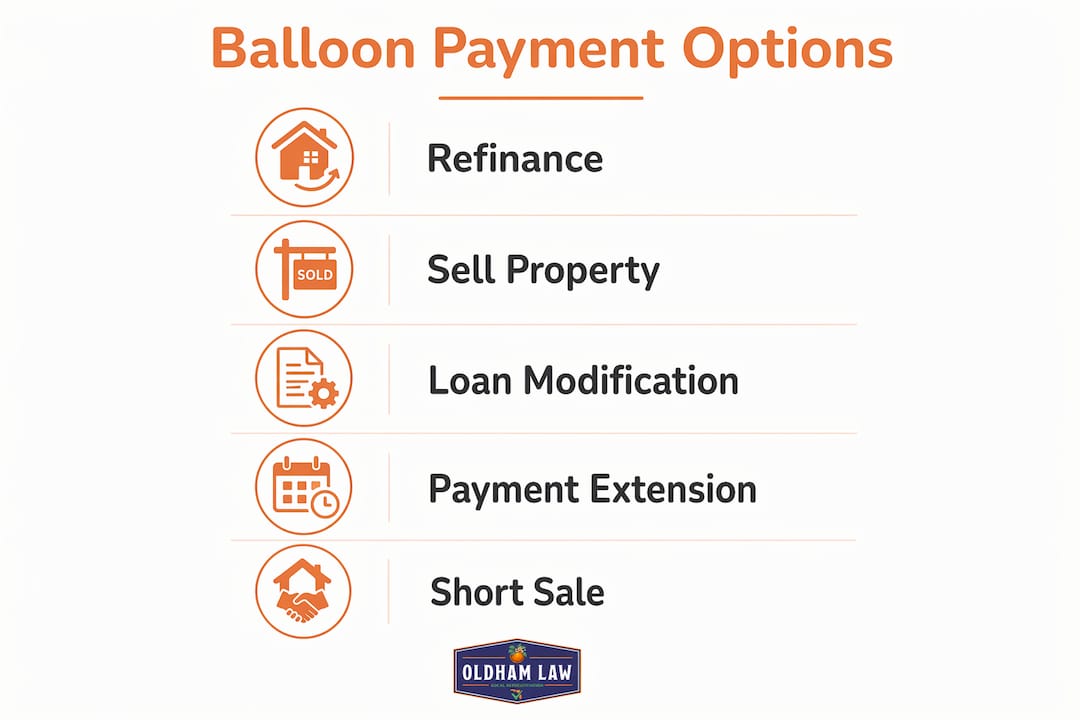
You have more options than you might think, but timing is everything. The best outcomes go to homebuyers who start planning 6–12 months before the balloon payment comes due. Waiting until the month it is due severely limits what you can do.
1. Refinance the loan
Refinancing replaces your balloon loan with a new, fully amortizing mortgage. This is the most common solution. The catch is that underwriting typically takes 30–45 days, and lenders require full income verification, a solid credit score, and sufficient home equity. Start this process at least six months early to allow for delays, appraisal issues, or documentation problems.
2. Sell the property
If you have equity in your home, selling before the balloon due date pays off the loan and puts any remaining proceeds in your pocket. Selling with equity is the cleanest exit. Factor in Florida closing costs when calculating whether a sale covers your full balance.
3. Request a loan modification
A loan modification changes the terms of your existing loan rather than replacing it. Your lender might extend the maturity date, reduce the interest rate, or convert the balloon loan to a fully amortizing note. Some balloon loans even include conditional reset clauses that automatically convert the loan if you have made all payments on time and still occupy the home as your primary residence. Check your loan documents for this provision.
4. Negotiate a payment extension or forbearance
Forbearance lets you pause or reduce payments temporarily. Lenders rarely forgive principal, but they do defer it, pushing the balloon balance to a later date or spreading it across future payments. This buys time without eliminating the debt.
5. Short sale
If your home is worth less than your loan balance, a short sale lets you sell for less than you owe with lender approval. The lender accepts the sale proceeds as full or partial settlement. Short sales do damage your credit and may leave you with a remaining debt obligation, but they are generally less damaging than foreclosure.
Pro Tip: Contact your lender’s loss mitigation department directly, not just the general customer service line. Loss mitigation teams have the authority to offer modifications and extensions that standard representatives cannot.
How to negotiate with your lender to avoid foreclosure
Lenders genuinely prefer to avoid foreclosure. The process is expensive, slow, and uncertain for them too. Lenders favor proactive borrowers who reach out early and come prepared with documentation. That gives you real negotiating leverage if you use it correctly.
What documents to prepare
Gather these before you make your first call:
- Hardship letter: A clear, factual explanation of why you cannot make the balloon payment
- Recent pay stubs: Typically the last two to three months
- Federal tax returns: Usually the last two years
- Bank statements: Last two to three months for all accounts
- Monthly budget breakdown: Income versus expenses, showing your current financial position
Full financial documentation speeds up the lender’s review and signals that you are serious. Lenders are far more receptive to borrowers who show up organized and honest about their situation.
What lenders may offer
When you negotiate proactively, lenders may agree to one or more of the following:
- An interest rate reduction for the remaining loan term
- A maturity date extension, giving you more time to refinance or sell
- Conversion of the balloon loan to a fully amortizing note with regular monthly payments
- A forbearance agreement that defers the balloon balance temporarily
The worst mistake Florida homebuyers make is waiting until they are already in default to call their lender. At that point, your options narrow and the lender’s legal process has already started. Call before you miss the payment, not after.
Pro Tip: Put every lender conversation in writing. Follow up each phone call with an email summarizing what was discussed and what was agreed. This protects you if the lender later claims no agreement was made.
What are the Florida-specific consequences of foreclosure?
Florida’s foreclosure process has specific rules that every homebuyer in the state should understand. Federal law prevents lenders from starting foreclosure until you are at least 120 days delinquent. After that threshold, the Florida judicial foreclosure process begins, and it can take anywhere from 6 to 24 months to complete depending on court backlogs and whether you contest the action.
That timeline sounds long, but it does not mean you are safe during that period. Your credit is already damaged, fees are accumulating, and the legal costs are growing.
Deficiency judgments in Florida
A deficiency judgment is a court order requiring you to pay the difference between your loan balance and what the foreclosure sale generates. Florida law allows lenders to pursue deficiency judgments in many residential loan situations. If granted, the lender can garnish wages or place liens on other property you own. Not all loans allow this, and Florida does have restrictions, but many balloon loans on residential property do not automatically prohibit deficiency actions.
Tax consequences
Forgiven debt after a foreclosure or short sale may be treated as taxable income by the IRS. Florida has no state income tax, so the federal tax consequence is the primary concern. Consult a tax professional alongside your real estate attorney to understand your full exposure before agreeing to any settlement.
| Consequence | Florida Detail |
|---|---|
| Foreclosure timeline | 6–24 months after 120-day delinquency threshold |
| Deficiency judgment | Allowed in many residential cases; subject to court approval |
| Credit score impact | 80–100 point drop; stays on report for seven years |
| Tax on forgiven debt | Federal taxable income; no Florida state income tax |
| Post-foreclosure surplus | Florida law may entitle you to surplus funds after the sale |
One detail many Florida homeowners miss: if the foreclosure sale generates more than your loan balance, you may be entitled to those surplus funds. Florida law protects that right, but you must act to claim it.
Key Takeaways
Missing a balloon payment in Florida triggers immediate default, and the most effective response is proactive lender contact backed by complete financial documentation, ideally starting 6–12 months before the due date.
| Point | Details |
|---|---|
| Default starts immediately | Late fees of about 5% begin accruing daily the moment you miss the payment. |
| Credit damage is long-lasting | Foreclosure drops your score 80–100 points and stays on your report for seven years. |
| Start options early | Refinancing and loan modifications require 30–45 days of underwriting; begin 6–12 months out. |
| Lenders prefer negotiation | Proactive borrowers with full documentation get better terms than those who wait until default. |
| Florida has specific rules | Judicial foreclosure, deficiency judgments, and surplus fund rights all apply under Florida law. |
What I have seen working with Florida homebuyers facing balloon payments
The clients who come to Oldham Law PLLC in the best position are almost never the ones with the most money. They are the ones who called us early. The homebuyers who wait until the balloon payment has already come and gone, or until they have received a foreclosure notice, have far fewer options and far more stress.
The biggest misconception I see is that lenders want to foreclose. They do not. Foreclosure is expensive, slow, and unpredictable for lenders too. What they want is resolution. When a borrower shows up with a hardship letter, organized bank statements, and a clear proposal, lenders listen. When a borrower goes silent and stops returning calls, lenders file paperwork.
Florida’s judicial foreclosure process does give you time, but that time is not a gift. Every month in default costs you money in fees and interest, and the credit damage starts on day one. The 6 to 24 month foreclosure timeline is not a runway. It is a window to fix the problem before it becomes permanent.
If you are sitting on a balloon loan that matures in the next year, treat that date like a hard deadline. Start exploring refinancing now. Pull your credit report. Talk to a real estate attorney who knows Florida law. The escrow disputes and foreclosure complications we handle most often could have been avoided with a single early phone call.
— Oldham Law PLLC
Oldham Law PLLC is ready to help Florida homebuyers
Facing a balloon payment you cannot cover is stressful, but you do not have to figure it out alone. Oldham Law PLLC serves homebuyers across the Tampa Bay area, including St. Petersburg, Pinellas Park, and all of Pinellas County, with focused real estate legal guidance.
Our attorneys help clients negotiate with lenders, review loan modification terms, assess foreclosure risk, and protect their rights under Florida law. We bring experience from both sides of the table, which means we know how lenders think and what arguments actually move the needle. If your balloon payment is approaching or already past due, contact our Florida real estate lawyers for a consultation. You can also visit Oldham Law PLLC to learn more about how we help homebuyers protect their property and their financial future.
FAQ
What happens immediately when I miss a balloon payment?
Missing a balloon payment triggers default under your loan contract, with late fees of about 5% of the overdue amount accruing daily. Your lender can also apply a higher default interest rate and begin the foreclosure process.
How long does foreclosure take in Florida?
Florida foreclosure is a judicial process that cannot begin until you are at least 120 days delinquent. Once filed, the process typically takes 6–24 months depending on court schedules and whether you contest the action.
Can I negotiate with my lender after missing a balloon payment?
Yes, and lenders prefer it. Contacting your lender’s loss mitigation department with a full financial package, including a hardship letter, pay stubs, and bank statements, gives you the best chance of securing a modification or extension.
Will a missed balloon payment hurt my credit score?
A missed balloon payment and resulting foreclosure can drop your credit score by 80–100 points and remain on your credit report for seven years, significantly limiting your borrowing ability.
Can a lender sue me for the remaining balance after foreclosure in Florida?
Florida law allows lenders to pursue deficiency judgments in many residential loan cases. If the foreclosure sale does not cover your full loan balance, the lender may seek a court order to collect the difference through wage garnishment or property liens.
