

Yes, a probation violation can be dismissed in Florida. Under Fla. Stat. § 948.06, a judge has explicit authority to dismiss a violation charge when the state fails to prove it by a preponderance of the evidence, or when procedural errors undermine the case. Dismissal is a real outcome, not just a legal technicality.
Here is what makes dismissal possible:
- The prosecution must prove the violation by a preponderance of the evidence, meaning it was more likely than not that you broke a condition. If the evidence falls short, dismissal is appropriate.
- Procedural failures, such as improper notification or due process violations during the arrest or hearing, can independently support dismissal.
- For low-risk offenders facing minor technical violations, Florida law limits a judge’s authority to revoke probation outright, opening the door to alternatives or dismissal.
- When a judge dismisses the violation affidavit, your probation continues as originally imposed, and you receive credit for tolled time against your term.
- Strong legal representation significantly shapes whether these grounds are identified and argued effectively.
What types of probation violations are common in Florida?
Florida law draws a clear line between two categories of violations, and that distinction shapes everything that follows.
Substantive violations involve new criminal conduct committed while on probation. These are treated most seriously by courts, often result in revocation, and in many cases eliminate your right to bond while the case is pending.
Technical violations cover failures to meet supervision conditions without committing a new crime. Common examples include:
- Missing a scheduled appointment with your probation officer
- Failing a drug or alcohol test
- Violating curfew restrictions
- Failing to complete required community service hours
- Not paying court-ordered fines or restitution
- Traveling outside permitted areas without approval
The type of violation directly affects the court’s discretion. For certain technical violations, judges have limited authority to revoke probation for low-risk offenders who have not previously been found in violation during the current supervision term. In those situations, the court must modify or continue probation rather than revoke it. That statutory protection is one of the most underused defenses in Florida probation cases.
How does a probation violation hearing work in Florida?
The process begins when your probation officer files an affidavit for violation of probation, commonly called a VOP affidavit. Once filed, a warrant is typically issued and you may be taken into custody.
At the initial hearing, the judge reads the charge. If you do not admit the violation, the court may release you with or without bail, or hold you pending a full hearing. The right to be heard in person or by counsel must be provided as soon as practicable. Critically, there is no right to a jury trial in a VOP proceeding. The judge alone decides the outcome.
Key procedural steps include:
- Initial appearance: The charge is read; admission or denial is entered.
- Discovery phase: Your attorney can request evidence the state plans to use.
- Continuances: Scheduling adjustments may allow time to build a defense.
- Motion to dismiss: Filed when evidence is insufficient or procedural violations occurred.
- Full hearing: The state presents its case; you have the right to respond.
The state’s burden, preponderance of the evidence, is lower than the beyond-a-reasonable-doubt standard used in criminal trials. Evidence that would not convict you of a new crime can still support a violation finding. That asymmetry makes early legal preparation critical.
What penalties can you face for a probation violation in Florida?
If the court finds a violation, the range of outcomes is wide. Judges weigh the nature of the violation, your history on supervision, and any mitigating circumstances before deciding.
Possible outcomes include:
- Revocation with incarceration: The judge can sentence you up to the maximum allowed for the original offense.
- Modification of terms: Added conditions such as substance abuse treatment, more frequent reporting, or community service.
- Continuation of probation: The judge may simply continue your supervision with a warning.
- Community control: A more restrictive form of supervision, essentially house arrest, may be imposed instead of incarceration.
Mitigating factors carry real weight. Documented medical emergencies, genuine rehabilitation efforts, and a clean compliance record up to the alleged violation can all persuade a judge toward a lesser sanction. If the violation is dismissed, your probation continues as originally imposed and you receive credit for all time that was tolled during the proceedings.
What legal defenses can get a probation violation dismissed?
Several well-established defenses can lead to a probation violation being dismissed in Florida. The strength of any one defense depends on the specific facts of your case.
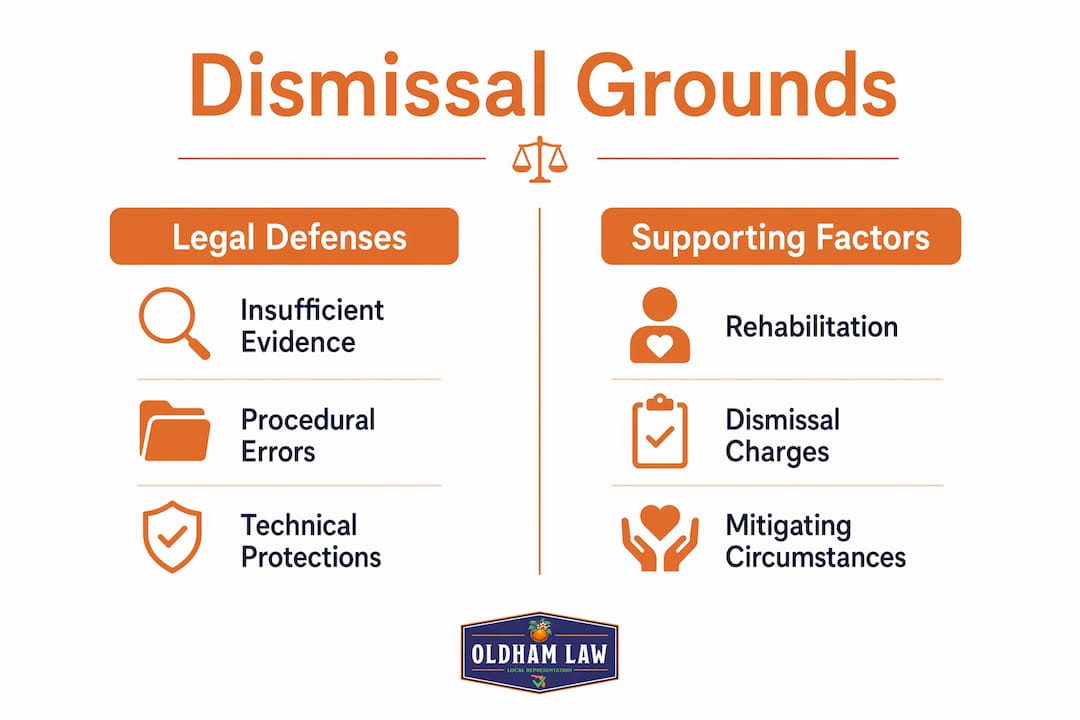
Insufficient evidence. The state must prove the violation by a preponderance of the evidence. If the evidence is weak, contradicted, or based solely on a probation officer’s unverified report, a motion to dismiss has real merit.
Procedural errors. Improper notification, failure to follow hearing procedures, or due process violations during arrest or initial appearance can each serve as independent grounds for dismissal.
Technical violation protections. Under Fla. Stat. § 948.06, if you are on probation (not community control), are not classified as a violent felony offender of special concern, and the violation is a low-risk technical one with no prior VOP finding during your current term, the court must modify rather than revoke. Raising this statutory limit is a concrete defense strategy.
Dismissal of underlying charges. One nuance many people miss: even if the new criminal charge that triggered your VOP is dismissed, the violation proceeding can continue independently. The burdens of proof are different. However, a dismissal of the underlying charge still weakens the state’s VOP case and should be argued.
Rehabilitation and mitigating circumstances. Documented compliance, completed treatment programs, or a verifiable emergency can shift a judge’s view, particularly for technical violations.
Expert legal insights on probation violations in Florida
Florida’s probation violation framework rewards those who act quickly and understand the procedural landscape. The VOP hearing is your primary defense forum, and unlike a criminal trial, there is no jury to persuade. Every argument lands directly with the judge.
One point that surprises many people: a VOP case can proceed and result in revocation even after the underlying criminal charges are dropped. The state uses a lower burden of proof in VOP proceedings, so the two cases are legally separate. Knowing this distinction early changes how your attorney builds your defense.
Pro Tip: Contact a Florida criminal defense attorney as soon as you learn a VOP affidavit has been filed. The window between filing and your initial hearing is often short, and early preparation, including gathering evidence of compliance or mitigating circumstances, can be the difference between dismissal and revocation.
Florida courts also exercise meaningful discretion in technical violation cases. Judges are not required to revoke probation for every misstep, and many will respond positively to evidence of genuine effort, steady employment, completed treatment, or a documented hardship that explains the violation.
Florida law requires that when a judge dismisses a VOP affidavit, the probationer receives credit for all time tolled during the proceedings, protecting against unfair extension of the supervision term.
What conditions and grounds support dismissal?
Dismissal is most likely when one or more of the following conditions are present. Courts look at the totality of circumstances, so multiple factors working together strengthen any motion.
- The state’s evidence does not meet the preponderance standard
- The VOP affidavit contains procedural defects or the probationer was not properly notified
- The violation is a low-risk technical one and the statutory criteria under Fla. Stat. § 948.06 for mandatory modification are met
- The probationer has documented rehabilitation, consistent compliance history, or a verifiable emergency explaining the alleged violation
- The underlying criminal charge that prompted the VOP has been dismissed, weakening the state’s factual basis
- Due process rights were violated during the arrest or initial hearing
When none of these grounds exist, outright dismissal is unlikely. But even then, the same facts often support a motion for modification rather than revocation, which keeps you out of jail and on supervision.
What are the deadlines for filing a motion to dismiss a probation violation?
Timing in VOP proceedings is tight, and missing key windows can limit your options. Florida law requires that hearings be held “as soon as practicable” after the initial appearance, which means delays work against you if you are in custody.
Practically speaking, your attorney should file a motion to dismiss before or at the full VOP hearing. There is no separate statutory deadline for the motion itself, but waiting until the hearing date to raise procedural defects or evidentiary challenges reduces their impact. Courts expect these arguments to be raised promptly.
For probation rules and conditions in Florida, understanding the full scope of your supervision terms before a violation is alleged gives you a stronger foundation to challenge any affidavit. If you are seeking early termination of probation, that petition is a separate process and must be filed with the court that originally sentenced you, typically after completing a meaningful portion of your term and demonstrating consistent compliance.
Facing a probation violation in Pinellas County or Tampa Bay?
A probation violation charge does not have to end in revocation. At Oldham Law PLLC, the criminal defense attorneys serving St. Petersburg, Pinellas Park, and the broader Tampa Bay area bring former prosecutor experience to every VOP case. That background means they know exactly how the state builds its case and where the weaknesses are.

Oldham Law PLLC handles VOP hearings with focused, case-specific preparation, reviewing the affidavit for procedural defects, gathering compliance evidence, and filing motions to dismiss when the grounds are there. The firm’s value-over-volume approach means your case gets direct attorney attention, not a paralegal and a form letter. If you are facing a violation in Pinellas County or anywhere in Tampa Bay, contact Oldham Law PLLC to discuss your options before your next court date.
FAQ
Can a probation violation be dismissed in Florida?
Yes. Under Fla. Stat. § 948.06, a judge can dismiss a VOP charge if the violation is not admitted and the state fails to prove it by a preponderance of the evidence, or if procedural defects exist.
How much jail time can you get for violating probation in Florida?
A judge can impose up to the maximum sentence allowed for the original offense. The actual time depends on the violation type, your record, and any mitigating factors the court considers.
Can you get a bond after a probation violation arrest in Florida?
Bond is not automatic after a VOP arrest. Judges weigh the circumstances before granting release, and for certain felony probationers, particularly those convicted of serious offenses, release may be denied until the hearing.
How do you avoid jail time for a probation violation?
The strongest approaches are challenging the evidence, raising procedural defects, demonstrating documented rehabilitation, and showing the violation was technical rather than substantive. Early engagement with a Florida criminal defense attorney significantly improves these outcomes.
What is the earliest you can get off probation in Florida?
Early termination requires a petition to the sentencing court and typically depends on completing a substantial portion of your term with consistent compliance. There is no fixed minimum, but judges look for demonstrated rehabilitation and a clean supervision record.
Key takeaways
A probation violation can be dismissed in Florida when the state’s evidence falls short, procedural errors occur, or statutory protections for technical violations apply under Fla. Stat. § 948.06.
| Point | Details |
|---|---|
| Dismissal is possible | Judges can dismiss VOP charges when evidence is insufficient or procedural defects exist. |
| Burden of proof is lower | The state only needs to prove a violation by a preponderance of the evidence, not beyond reasonable doubt. |
| Technical violations carry protections | Low-risk technical violations may require modification rather than revocation under Florida law. |
| Tolled time is credited | A dismissed VOP affidavit means you receive credit for all time tolled during the proceedings. |
| Oldham Law PLLC | Serves Pinellas County and Tampa Bay with former-prosecutor insight on VOP defense and dismissal motions. |
