
Breach of Contract Lawyers in Florida: Your 2026 Guide

TL;DR:
- Breach of contract lawyers in Florida enforce agreements and seek damages when obligations are not met.
- Successful cases require proving a valid contract, performance, material breach, and actual damages within strict deadlines.
Breach of contract lawyers are attorneys who specialize in enforcing agreements and recovering damages when one party fails to meet their contractual obligations. In Florida, these disputes arise constantly, from failed business deals and broken vendor agreements to real estate contracts gone sideways. The formal legal term is “breach of contract attorney,” and the right one can mean the difference between recovering what you are owed and walking away empty-handed. Florida’s contract law is specific about what you must prove, how long you have to file, and what remedies a court will actually award. Understanding those rules before you act protects your position.
What do breach of contract lawyers need to prove in Florida?
Florida courts require a plaintiff to establish four specific elements to win a breach of contract claim. Miss any one of them, and the case fails regardless of how unfair the other party’s conduct was.
The four elements are:
- Valid contract. There must be a real agreement with offer, acceptance, and consideration. Under Florida’s Statute of Frauds, certain contracts, including real estate sales, agreements lasting longer than one year, and guarantees, must be in writing and signed to be enforceable. Oral contracts outside those categories are valid but harder to prove.
- Your performance. You must show that you fulfilled your own obligations under the contract, or that you had a legally recognized excuse for not doing so.
- Material breach by the other party. The defendant must have failed to perform in a way that goes to the heart of the agreement. A minor deviation does not automatically give you the right to walk away or sue for full damages.
- Actual financial damages. Florida courts dismiss claims that rely on speculative losses. You need concrete, documented harm caused directly by the breach.
The third element, materiality, is where most cases get complicated. Florida courts apply the Restatement (Second) of Contracts standard to decide whether a breach is material. That assessment often determines whether a judge rules in your favor at the summary judgment stage, before the case ever reaches trial.
Pro Tip: Never stop performing your own obligations under a contract just because the other side has stumbled. Stopping performance in response to a minor breach can legally make you the breaching party in Florida courts.
What remedies can a contract dispute attorney pursue in Florida?
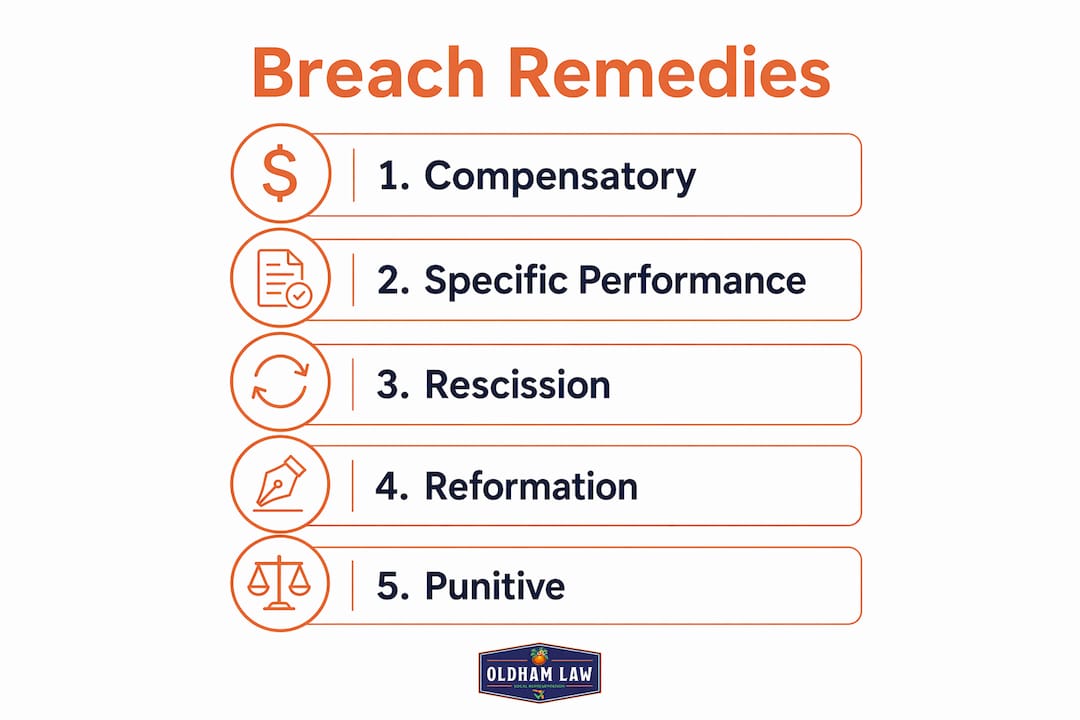
Florida offers several remedies for breach of contract, and the right one depends on what the contract covered and what outcome you actually need.
| Remedy | When it applies |
|---|---|
| Compensatory damages | The default remedy; designed to put you in the financial position you would have been in if the contract had been performed |
| Specific performance | Used when money is not enough, typically for unique goods or real estate transactions |
| Rescission | Cancels the contract and returns both parties to their original positions |
| Restitution | Requires the breaching party to return any benefit they received under the contract |
| Reformation | Court rewrites the contract to reflect the parties’ actual intent when a mutual mistake occurred |
| Liquidated damages | Pre-agreed damage amounts enforced if reasonably related to anticipated harm and not punitive |
Punitive damages are generally not available in a pure breach of contract case. To recover punitive damages, you typically need a separate tort claim alongside the contract claim. That distinction matters enormously when calculating whether litigation is worth the cost.
Attorney’s fees add another layer of complexity. Florida follows the American Rule, meaning attorney’s fees are not awarded automatically to the winning party. They must be authorized by the contract itself or by a specific statute. This reality shapes settlement decisions and litigation budgets significantly.
Pro Tip: If your contract includes a prevailing party attorney’s fees clause, that clause cuts both ways. Losing the case could mean paying the other side’s legal costs. A business contract lawyer should analyze that clause before you file.
How do procedural rules and deadlines affect Florida contract cases?
Filing deadlines in Florida are strict, and missing them ends your case permanently. The statute of limitations for breach of contract is five years for written contracts and four years for oral contracts under Florida Statutes § 95.11. Specific exceptions apply, including a two-year limit for certain property insurance breaches.
Beyond deadlines, Florida’s procedural rules impose requirements that trip up unprepared plaintiffs. Here is what a contract litigation attorney must handle correctly:
- Attach the contract to the complaint. Florida Rule of Civil Procedure 1.130(a) requires written contracts to be attached to the complaint or have material portions included. Failure to comply typically results in dismissal.
- Identify the specific breached provision. A vague allegation that “the contract was broken” is not enough. Courts require you to point to the exact clause the defendant violated.
- Comply with pre-suit notice requirements. Certain Florida contracts and statutes require written notice before filing suit. Construction defect claims, for example, require written notice and response periods under Florida’s construction defect statutes. Skipping this step can derail or delay your lawsuit entirely. Readers dealing with construction issues can find more detail in Oldham Law PLLC’s construction defect overview.
- Anticipate common defenses. The defendant may argue ambiguity in the contract language, waiver of the breached term, fraud in the inducement, or failure of a condition precedent. Each defense requires a specific counter-strategy.
- Document your mitigation efforts. Florida law requires plaintiffs to take reasonable steps to limit losses after a breach occurs. Failing to mitigate reduces the damages you can recover, sometimes substantially.
The procedural side of contract litigation is where cases are won or lost before a single witness testifies. A skilled contract dispute attorney builds the case file with these requirements in mind from day one.
What practical advice do breach of contract lawyers give Florida clients?
Choosing the right attorney and preparing properly before your first consultation saves time and money. Here is what experienced breach of contract lawyers recommend:
- Gather every document related to the contract. Bring the signed agreement, all amendments, emails, text messages, invoices, payment records, and any written communications about performance or complaints. Courts rely heavily on written evidence, and contract language and extrinsic evidence often determine how disputes are resolved.
- Identify whether the breach was material or minor. A material breach justifies stopping your own performance and suing for full damages. A minor breach may only entitle you to limited compensation. Confusing the two is one of the most common and costly mistakes clients make.
- Do not stop performing prematurely. Stopping performance in response to what turns out to be a minor breach can flip the legal outcome entirely, turning you into the party at fault.
- Understand the fee structure upfront. Ask whether the attorney charges hourly, a flat fee, or works on contingency. Understand how attorney’s fees interact with any fee-shifting clause in your contract before committing to litigation.
- Act before the deadline. The clock starts running from the date of the breach, not the date you discover it in most cases. Waiting too long eliminates your legal options entirely.
When evaluating a potential attorney, look for someone with specific Florida contract litigation experience, not just general business law knowledge. An attorney who has handled both sides of contract disputes, including defense work, understands the arguments the other side will raise and can prepare accordingly.
Key Takeaways
Winning a Florida breach of contract case requires proving all four legal elements, filing within the statute of limitations, and following strict procedural rules from the start.
| Point | Details |
|---|---|
| Four elements required | Prove a valid contract, your performance, a material breach, and actual financial damages. |
| Filing deadlines are firm | Written contracts have a five-year limit; oral contracts have four years under Florida Statutes § 95.11. |
| Remedies vary by situation | Compensatory damages are standard; specific performance applies to real estate and unique goods. |
| Procedural rules matter | Attach the contract to your complaint and comply with pre-suit notice requirements or risk dismissal. |
| Mitigation is mandatory | Florida law requires you to take reasonable steps to limit your losses after a breach occurs. |
What I have learned about contract disputes in Florida
After working through Florida contract disputes from multiple angles, including the plaintiff’s side, the defense side, and cases involving insurance carriers, one pattern stands out clearly. Clients who wait too long to get legal advice almost always hurt their own case before they walk through the door.
The materiality question is where I see the most damage done. A client will tolerate a series of small failures by the other party, then finally stop performing themselves, believing they are justified. By that point, the legal picture is murky at best. Courts look at the cumulative conduct of both parties, and a client who stopped performing, even for understandable reasons, may have handed the other side a defense.
The other consistent issue is documentation. Clients often assume that a signed contract is enough. It rarely is. Courts interpret ambiguous contract language by looking at emails, course of dealing, and industry custom. The client who kept detailed records of every communication and every performance milestone is in a fundamentally stronger position than the one who relied on handshake understandings layered on top of a written agreement.
My honest advice: treat the contract as a living document from the moment you sign it. Record every significant event, every deviation, and every conversation about performance. If something goes wrong, contact a Florida contract attorney before you respond to the other party. The first move after a breach often shapes the entire case.
— Oldham Law PLLC
How Oldham Law PLLC handles contract disputes in Tampa Bay
Oldham Law PLLC represents individuals and businesses across Pinellas County and the Tampa Bay area in breach of contract cases, from straightforward payment disputes to complex real estate and business agreement litigation. The firm’s attorneys bring experience from both the prosecution and insurance defense sides, which means they understand how opposing counsel thinks and where cases are most vulnerable.
If you are facing a broken agreement and need clear answers about your options, Oldham Law PLLC offers focused, personalized attention to every case. The firm’s business law practice covers contract enforcement, dispute resolution, and litigation across Florida. Schedule a consultation with Oldham Law PLLC to get a direct assessment of your claim, your deadlines, and your realistic path to recovery.
FAQ
What is a breach of contract in Florida?
A breach of contract occurs when one party fails to fulfill a material obligation under a valid agreement. Florida law requires the non-breaching party to prove four elements: a valid contract, their own performance, the other party’s material breach, and actual financial damages.
How long do I have to sue for breach of contract in Florida?
Florida gives you five years to file suit on a written contract and four years on an oral contract under Florida Statutes § 95.11. Certain exceptions apply, including shorter deadlines for property insurance disputes.
Can I get my attorney’s fees paid if I win a contract case in Florida?
Attorney’s fees are not automatically awarded to the winning party in Florida. They must be authorized by a clause in the contract itself or by a specific statute, so reviewing your contract language before filing is critical.
What is the difference between a material and a minor breach?
A material breach goes to the core of the contract and justifies stopping your own performance and suing for full damages. A minor breach entitles you only to limited compensation, and stopping your own performance in response to a minor breach can make you the breaching party.
Do I need to attach my contract to the lawsuit in Florida?
Yes. Florida Rule of Civil Procedure 1.130(a) requires you to attach the written contract or its material portions to your complaint. Failing to do so typically results in dismissal of the case.
