
Best Rated Personal Injury Attorney: Florida Guide 2026

TL;DR:
- A top personal injury attorney in Florida specializes in injury law, has trial experience, and maintains transparent communication.
- The 2023 tort reform made specialization more critical due to new rules on negligence and deadlines, increasing the importance of expert legal guidance.
A best rated personal injury attorney is defined as a licensed Florida lawyer who specializes in injury claims, demonstrates proven trial experience, and maintains transparent communication with clients throughout the legal process. The formal industry term is “personal injury attorney,” though you will also see the phrase “highly rated injury lawyer” used in client reviews and legal directories. After Florida’s sweeping 2023 tort reform, finding the right legal advocate matters more than ever. The wrong choice can cost you thousands of dollars and months of frustration. This guide walks you through exactly what separates a good personal injury attorney from an exceptional one, and how to make that call with confidence.
What criteria define a best rated personal injury attorney in Florida?
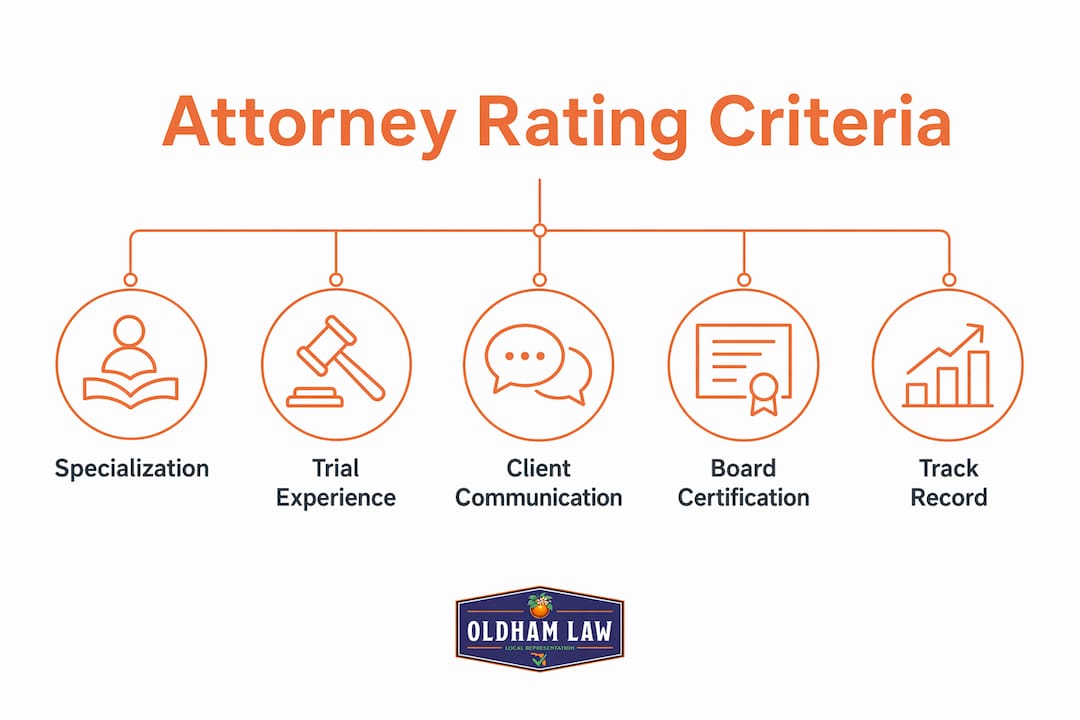
The strongest indicator of a top personal injury lawyer is daily, focused practice in injury law. A generalist who handles real estate closings on Monday and slip-and-fall cases on Friday simply cannot match the depth of someone who lives inside Florida’s injury statutes every day. Specialized attorneys understand comparative negligence rules, statutes of limitation, and insurer tactics at a level generalists rarely reach.
Here are the core criteria to evaluate when selecting a highly rated injury lawyer in Florida:
- Florida Bar certification. Look for board certification in civil trial law from the Florida Bar. This credential signals advanced expertise and is independently verified, not self-reported.
- Percentage of practice dedicated to injury law. Ask directly what share of the attorney’s caseload involves personal injury. Anything below 70% is a yellow flag.
- Trial experience. Board certification in civil trial law is a verifiable marker of trial capability. Insurers offer stronger settlements when they know an attorney will actually go to court.
- Client reviews and feedback. Look beyond star ratings. Read the text of reviews for patterns around communication, honesty about case value, and follow-through.
- Communication style. Communication frequency and clarity predict client satisfaction more reliably than headline settlement numbers. Ask how often you will receive updates and through what channels.
- Fee structure transparency. Florida Bar Rule 4-1.5 governs contingency fees. Any attorney who cannot clearly explain their fee arrangement in plain language is a concern.
One detail many clients overlook: large personal injury firms often delegate day-to-day case management to junior staff. Ask specifically who will handle your communications and legal steps, not just who will appear in court on your behalf.
How did Florida’s 2023 tort reform change personal injury claims?
Florida’s 2023 tort reform reshaped the personal injury legal landscape in ways that directly affect your claim’s value and your attorney’s strategy. The changes were significant, and they made attorney specialization far more critical than it was before.
The key changes include:
- Modified comparative negligence. Florida shifted from a pure comparative negligence system to a modified one. If you are found more than 50% at fault for your own injury, you are now barred from recovering any damages. This single change has major implications for how cases are built and argued.
- Reduced statute of limitations. The window to file a personal injury lawsuit dropped from four years to two years. Missing this deadline ends your claim entirely, regardless of its merit. You can review the current filing deadlines to confirm where your case stands.
- Changes to bad faith claims. Reforms tightened the rules around insurance bad faith litigation, making it harder to pursue insurers who act unreasonably in settling claims.
- Letter of protection restrictions. Limits were placed on how medical providers can use letters of protection, which affects how treatment costs are documented and presented in litigation.
Pro Tip: Write a detailed incident timeline before your first attorney meeting. Include the sequence of events, symptoms that appeared in the days after the injury, and any contact you had with insurance adjusters. This document helps an experienced injury attorney spot liability issues and weaknesses in the insurer’s position early.
Post-2023 tort reform, the complexity of Florida injury law demands an attorney who tracks these changes in real time, not one who learned the old rules and has not updated their practice.

What should you bring and ask at your first attorney consultation?
Initial consultations in Florida personal injury cases typically last 30–60 minutes and are free of charge. That meeting is your opportunity to evaluate the attorney as much as it is their opportunity to assess your case. Arrive prepared, and you will get far more useful information from the conversation.
Documents to bring:
- The formal police or incident report from the accident
- All medical records and bills related to your injury
- Photographs of the scene, your injuries, and any property damage
- Your insurance declarations page and any correspondence from adjusters
- A written timeline of events, symptoms, and any statements you made
These five documents allow an attorney to assess case strength accurately at the first meeting. Arriving without them forces the attorney to make assumptions, which reduces the quality of their initial evaluation.
Questions to ask the attorney:
- What percentage of your practice is personal injury?
- Have you taken cases like mine to trial, and what were the outcomes?
- Who will handle my day-to-day communications?
- How will you keep me informed about case progress?
- Can you walk me through exactly how fees and costs will be deducted from any recovery?
Pro Tip: Evaluate how the attorney answers your questions, not just what they say. An attorney who speaks in plain language, admits uncertainty where it exists, and does not promise specific settlement amounts is showing you ethical behavior, not weakness.
Attorneys are ethically prohibited from guaranteeing settlement amounts during consultations. If an attorney quotes you a specific number in the first meeting without reviewing all your records, treat that as a warning sign. You can schedule a free initial consultation to get a realistic picture of your case before committing to any firm.
How do attorney fees and costs work in Florida personal injury cases?
Florida personal injury attorneys work on a contingency fee basis, meaning you pay nothing unless they recover money for you. The fee structure is governed by Florida Bar Rule 4-1.5, which sets specific caps to protect clients.
| Stage | Standard contingency fee | Claimant’s guaranteed minimum |
|---|---|---|
| Pre-suit settlement | 33.33% of recovery | At least 70% of first $250K after costs |
| Post-answer (after lawsuit filed) | 40% of first $1M | At least 90% of amounts above $250K |
| Appeals or extraordinary work | Sliding scale reduction beyond $1M | Negotiated per Rule 4-1.5 |
The distinction between attorney fees and case costs trips up many clients. Attorney fees are the percentage the lawyer earns. Case costs are separate expenses: filing fees, expert witness fees, deposition transcripts, and medical record retrieval. These costs are deducted separately from your recovery and can meaningfully reduce your final check.
For example, if you settle for $100,000 and your attorney’s fee is 33.33%, that leaves $66,670. If case costs total $8,000, your net recovery drops to $58,670. That is a real number, and you deserve to know it before you sign a fee agreement. Ask your attorney for a written explanation of how both fees and costs will be calculated and deducted. You can also read a detailed breakdown of what lawyers take from settlements in Florida before your consultation.
Key Takeaways
The best rated personal injury attorney in Florida combines daily specialization in injury law, verifiable trial experience, and transparent fee communication to deliver the strongest possible outcome for your claim.
| Point | Details |
|---|---|
| Specialization matters most | Choose an attorney whose practice is focused on personal injury, not a generalist who handles it occasionally. |
| Trial experience drives settlements | Insurers track which attorneys litigate; firms willing to go to trial consistently secure stronger offers. |
| 2023 tort reform changed the rules | Florida’s modified comparative negligence and two-year filing deadline make specialized expertise non-negotiable. |
| Fee transparency protects you | Understand the difference between attorney fees and case costs before signing any agreement. |
| Consultation preparation pays off | Bringing the right documents and asking direct questions gives you a far more accurate case evaluation. |
What I have learned about choosing a personal injury attorney in Florida
After years of working inside Florida’s legal system, including time spent on the insurance defense side, one thing stands out clearly: the attorneys who get the best results for their clients are the ones insurers genuinely fear taking to trial. That fear is not built on advertising budgets or office size. It is built on a track record of actually walking into a courtroom.
Insurance companies track which firms litigate and which ones settle quickly. When an adjuster knows your attorney has a history of going to trial, the opening offer changes. That is not a theory. That is how the negotiation dynamic works in practice.
What I also see too often is clients choosing attorneys based on a single consultation where the attorney quoted the highest number. That number is not a promise. It is a marketing tool. The attorney who gives you a realistic range, explains the risks of the new comparative negligence rules, and tells you clearly who will handle your file day to day is showing you more integrity than the one promising a windfall.
My honest advice: weight trial willingness and communication clarity above everything else. Credentials matter, reviews matter, and fees matter. But an attorney who will fight for you in court and keep you informed along the way is the one who will actually deliver.
— Oldham Law PLLC
How Oldham Law PLLC can help with your Florida injury claim
If you are searching for a trusted legal partner in the Tampa Bay area, Oldham Law PLLC brings a perspective that most firms cannot offer. Our attorneys have worked on the insurance defense side, which means we know exactly how adjusters evaluate claims and where they look for weaknesses. That background translates directly into stronger case preparation for you.
We offer a free initial consultation with no fees unless we recover for you. Every client at Oldham Law PLLC receives direct attorney attention, not a handoff to a paralegal after the first meeting. If you are ready to have your case evaluated by an attorney who understands both sides of Florida injury law, visit Oldham Law PLLC to schedule your consultation today. You can also learn more about what to do after a car accident in Florida to protect your claim from the start.
FAQ
What makes a personal injury attorney “best rated” in Florida?
A best rated personal injury attorney in Florida is one with board certification or demonstrated specialization in injury law, a history of taking cases to trial, and strong client reviews focused on communication and honest case assessment.
How long do I have to file a personal injury claim in Florida?
Florida’s 2023 tort reform reduced the statute of limitations for personal injury claims to two years from the date of injury. Missing this deadline bars you from recovering any damages.
What is the standard contingency fee for a Florida personal injury attorney?
Under Florida Bar Rule 4-1.5, the standard contingency fee is 33.33% for pre-suit settlements and 40% of the first $1M after a lawsuit is filed. Claimants typically receive at least 70% of the first $250,000 after costs are deducted.
Should I be concerned if a large firm assigns my case to junior staff?
Yes. Large personal injury firms often delegate day-to-day case management to junior associates or paralegals. Ask directly at your consultation who will handle your communications and legal filings, not just who will appear at trial.
What is the difference between attorney fees and case costs in Florida?
Attorney fees are the percentage of your recovery the lawyer earns under the contingency agreement. Case costs, such as filing fees, expert witness fees, and deposition expenses, are separate and deducted from your recovery in addition to attorney fees.
