
Agreement Drafting Services for Florida Businesses

TL;DR:
- Professional contract drafting ensures enforceability and compliance with Florida law, reducing dispute risks. Using generic templates or AI tools can lead to errors that may result in costly legal conflicts. Oldham Law PLLC offers tailored services with Florida-specific expertise to protect small businesses’ interests.
Agreement drafting services are professional legal offerings that produce clear, customized contracts designed to protect your interests and comply with Florida law. The industry term is “contract drafting,” and whether you need a service agreement, a vendor contract, or an employment arrangement, the quality of that document determines whether you win or lose a dispute. Florida’s legal standards add a layer of complexity that generic templates and AI tools simply cannot handle. Oldham Law PLLC works with individuals and small business owners across Pinellas County and the Tampa Bay area to produce agreements built for real-world enforcement.
What are the essential components of a well-drafted agreement?
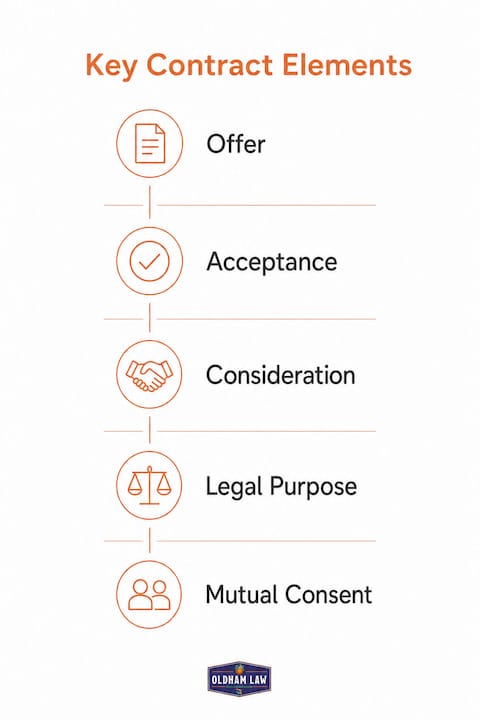
A professionally drafted contract does more than put words on paper. It creates a legally binding framework that tells every party exactly what they owe each other, and what happens when something goes wrong. Poorly drafted contracts lacking clear obligations create confusion, delays, and increased litigation risks for Florida businesses.
Every solid agreement includes these core elements:
- Party identification. Use full legal names, entity types (LLC, sole proprietor, corporation), and each party’s role. Vague identifiers like “the contractor” without a legal name create enforcement problems.
- Scope of services or goods. Define exactly what is being delivered, by when, and to what standard. Measurable benchmarks beat subjective descriptions every time.
- Payment terms. Specify amounts, due dates, late fees, and acceptable payment methods. Ambiguity here is the leading cause of small business payment disputes in Florida.
- Dispute resolution clause. State whether disputes go to mediation, arbitration, or court. Specify Florida as the governing law and the county for venue. A Florida dispute resolution clause tailored to your situation can save thousands in litigation costs.
- Termination provisions. Outline how either party can exit the agreement, required notice periods, and what happens to work in progress or deposits.
- Confidentiality and non-compete provisions. These protect your proprietary information and client relationships, but they must comply with Florida’s specific statutory requirements to be enforceable.
- Defined terms. Every technical or industry-specific word should be defined in a definitions section. Courts interpret undefined terms against the drafter.
Pro Tip: Ask your attorney to include a “severability clause.” If one provision is found unenforceable, this clause keeps the rest of the contract intact rather than voiding the whole agreement.
What are the risks of using generic templates or AI-generated contracts in Florida?
Generic templates and AI-generated contracts carry real legal risk, and Florida’s 2026 legal environment makes that risk higher than ever. The problem is not just that these documents look incomplete. The problem is that they often contain errors that look correct until a dispute arises.
Florida’s Artificial Intelligence Bill of Rights (SB 482) specifically flags AI-drafted contracts for containing fabricated arbitration rules and unlawful liquidated damages clauses. These errors increase litigation risks and produce costs that far exceed any savings from skipping attorney review.
Here is how these problems typically unfold for Florida business owners:
- Fabricated arbitration rules. AI tools sometimes cite arbitration bodies or procedural rules that do not exist. When a dispute arises and you try to invoke arbitration, the clause fails entirely, sending you to court instead.
- Unlawful damages clauses. Florida law limits certain types of liquidated damages. An AI-generated clause that exceeds those limits gets struck down, leaving you with no damages remedy at all.
- Conflicting provisions. AI-generated contracts commonly include non-existent or conflicting legal clauses, boosting dispute likelihood without human legal oversight. Two sections of the same contract can directly contradict each other, and neither party notices until litigation.
- Missing Florida-specific requirements. Florida has unique statutory requirements for non-compete agreements, contractor relationships, and commercial leases. A national template built for Delaware or California law will miss these entirely.
- Ambiguous language construed against you. Templates and generic contract forms often contain vague language that causes ambiguity and weakens enforceability under Florida law. Florida courts construe ambiguous provisions against the drafter, meaning you bear the cost of your own unclear writing.
Florida’s SB 482 requires review of AI-drafted legal documents for accuracy and compliance before acceptance. That requirement exists because the legislature recognized that AI errors in contracts are not hypothetical. They are common, and they are expensive. Attorney oversight is not a luxury for complex contracts. It is the minimum standard for any agreement with real financial exposure.
How does Florida law influence contract drafting and enforceability?

Florida applies the “four corners” rule to contract interpretation. Under this rule, courts look only at the written document itself to determine what the parties agreed to. They do not consider emails, verbal promises, or negotiation history unless the written contract is genuinely ambiguous. The four corners rule makes precision non-negotiable. Ambiguous contracts can cause you to lose control when courts insert outside evidence to interpret intent.
This rule has a direct practical consequence. If your contract says “reasonable time” instead of “within 14 calendar days,” a Florida court decides what “reasonable” means. That decision may not match what you intended. Explicit definitions and measurable standards are not just best practices in Florida. They are the difference between winning and losing a dispute.
| Florida contract principle | What it means for your agreement |
|---|---|
| Four corners rule | Courts read only the written document; every obligation must be stated clearly |
| Ambiguity construed against drafter | Vague terms hurt the party who wrote the contract |
| Non-compete enforceability (CHOICE Act) | Agreements can extend up to 4 years with proper procedural compliance |
| Governing law clause | Must specify Florida law and the county for venue to be enforceable locally |
| Severability | Unenforceable clauses can be removed without voiding the entire contract |
Florida’s 2026 CHOICE Act extended non-compete enforceability up to 4 years, provided the agreement meets procedural requirements including an employee review period and attorney consultation. Non-compliance with those procedural steps renders the clause unenforceable, regardless of how clearly the restriction is written. That is a costly mistake for any business that relies on protecting client relationships or trade secrets.
Pro Tip: Always include a “choice of law” clause that names Florida as the governing state and specifies the county for any legal proceedings. Without it, a dispute could end up in a jurisdiction with different rules.
How to choose professional agreement drafting services for your Florida business
Choosing the right contract writing services comes down to three factors: Florida-specific experience, customization, and the full range of services offered. Contracts involving substantial liability or complex relationships demand professional drafting to ensure enforceability and risk minimization in Florida.
When evaluating a provider, look for these qualities:
- Florida-specific experience. Your attorney should know Florida’s non-compete statutes, the four corners rule, and the procedural requirements under the CHOICE Act. General contract knowledge is not enough.
- Customization over templates. Attorney-drafted templates customized for your industry and compliance needs balance efficiency with legal protection. Ask whether the firm starts from scratch or adapts a base document to your situation.
- Full service range. A quality provider offers drafting, review of contracts presented to you by other parties, and negotiation support. You should not need three different providers for these related tasks.
- Proactive risk assessment. The best providers flag risks you have not thought of yet, such as indemnification gaps, missing insurance requirements, or unenforceable penalty clauses.
- Clear communication. Your attorney should explain every clause in plain English. If you cannot understand what you are signing, the drafting process has failed.
Questions worth asking before you hire: How many Florida business contracts do you draft per year? Do you handle both drafting and review? Can you explain how you handle non-compete clauses under the 2026 CHOICE Act? The answers reveal whether you are getting a specialist or a generalist.
Common types of agreements Florida individuals and small businesses need
Professional contract drafting services add the most value when the stakes are high and the relationship is ongoing. These are the agreements Florida individuals and small business owners most commonly need:
- Service agreements and independent contractor contracts. These define the scope of work, payment, and the contractor’s status under Florida and federal law. Misclassifying an employee as a contractor creates tax and liability exposure.
- Vendor and supplier agreements. These cover delivery timelines, quality standards, payment terms, and remedies for non-performance. A business operating agreement or vendor contract without clear performance standards is an invitation to dispute.
- Partnership and joint venture contracts. These define each party’s contribution, profit share, decision-making authority, and exit rights. Verbal partnerships end badly in Florida courts.
- Employment agreements. These include compensation, duties, termination conditions, and any non-compete or non-solicitation clauses that comply with Florida’s CHOICE Act requirements.
- Confidentiality and non-disclosure agreements. These protect trade secrets, client lists, and proprietary processes. They must define exactly what information is protected and for how long.
Each of these agreement types requires language specific to Florida law. A confidentiality agreement that works in Texas may not hold up in a Pinellas County courtroom. Customization is not optional. It is the entire point of professional drafting.
Key Takeaways
Professional agreement drafting services protect Florida individuals and small businesses by producing clear, enforceable contracts that comply with Florida’s four corners rule, CHOICE Act requirements, and SB 482 AI oversight standards.
| Point | Details |
|---|---|
| Florida’s four corners rule | Courts read only the written document, so every obligation must be stated with precision. |
| AI and template risks | Florida’s SB 482 flags AI contracts for fabricated arbitration rules and unlawful damages clauses. |
| CHOICE Act compliance | Non-compete clauses can extend up to 4 years only with full procedural compliance under Florida’s 2026 law. |
| Custom drafting beats templates | Attorney-customized agreements avoid the ambiguity pitfalls that generic forms create under Florida law. |
| Full-service providers | Choose a provider who drafts, reviews, and negotiates, not just one who fills in a template. |
What I have seen after years of drafting Florida contracts
After years of working with small business owners across Pinellas County and Tampa Bay, the pattern is consistent. The clients who end up in the most expensive disputes are rarely the ones who skipped a contract entirely. They are the ones who used a template they found online or ran a document through an AI tool and assumed it was good enough.
The four corners rule is not abstract legal theory. It is the reason a client once lost a payment dispute over the word “completion.” The contract said payment was due “upon completion,” but it never defined what completion meant. The court decided. The client did not like the answer.
The 2026 CHOICE Act changes to non-compete law are a good example of why Florida-specific knowledge matters. The extension to 4 years sounds like a win for employers. But the procedural requirements that come with it are easy to miss, and a non-compete that fails on procedure is worth nothing. Oldham Law PLLC has seen this play out in real disputes, and the cost of fixing a bad clause after the fact is always higher than drafting it correctly the first time.
My honest advice: treat contract drafting as risk management, not paperwork. A well-drafted agreement is the document that keeps a business dispute from becoming a lawsuit.
— Oldham Law PLLC
Oldham Law PLLC helps Florida businesses get contracts right
When a contract dispute arises, the quality of the original document determines almost everything. Oldham Law PLLC provides business law services for individuals and small business owners across St. Petersburg, Pinellas Park, and the broader Tampa Bay area, including drafting, reviewing, and negotiating agreements tailored to Florida law.
The firm’s attorneys bring experience from both prosecution and insurance defense, which means they read contracts the way opposing counsel will. That perspective catches problems before they become disputes. Whether you need a service agreement, a vendor contract, an employment agreement, or a confidentiality arrangement, Oldham Law PLLC builds documents designed to hold up. Visit Oldham Law PLLC to schedule a consultation and get a contract that actually protects you.
FAQ
What is contract drafting?
Contract drafting is the process of creating a written legal agreement that defines the rights, obligations, and remedies of each party. A professionally drafted contract uses precise language to prevent ambiguity and ensure enforceability under Florida law.
Why can’t I just use a free template for my Florida business?
Generic templates often contain vague language that Florida courts construe against the drafter, weakening your legal position. They also miss Florida-specific requirements, such as CHOICE Act procedural steps for non-compete clauses.
Are AI-generated contracts legal in Florida?
AI-generated contracts are not automatically invalid, but Florida’s SB 482 requires review of AI-drafted legal documents for accuracy and compliance before use. AI tools frequently produce fabricated arbitration rules and unlawful damages clauses that create costly disputes.
How long can a non-compete agreement last in Florida?
Under Florida’s 2026 CHOICE Act, a non-compete agreement can be enforceable for up to 4 years, provided the agreement meets all procedural requirements including an employee review period and attorney consultation.
How do I find agreement drafting services near me in Florida?
Look for a Florida-licensed attorney with specific experience in business contracts and knowledge of Florida’s four corners rule and CHOICE Act requirements. Oldham Law PLLC serves clients in Pinellas County, St. Petersburg, and the Tampa Bay area with customized contract drafting and review services.
