
You're reviewing a closing statement for a Florida sale, and one line item jumps out because it's larger than expected. It isn't a lender fee. It isn't property tax. It isn't something the title company invented. It's the Florida documentary stamp tax, and for buyers, sellers, investors, and FSBO owners, it often shows up late enough to feel like a surprise.
That surprise usually happens because people focus on price, repairs, loan terms, and possession dates. They don't spend much time asking how Florida taxes the documents tied to the transaction itself. But this tax can materially affect net proceeds, cash to close, and how a deal should be structured.
The good news is that the rules make more sense once you separate three issues: what triggers the tax, which document is being taxed, and who agreed to pay it. If you're trying to budget a closing in Pinellas County, Hillsborough County, Pasco County, or anywhere in the Tampa Bay area, a clear understanding of doc stamps helps you avoid confusion and negotiate from a stronger position.
An Introduction To A Key Florida Closing Cost
Most Florida buyers and sellers think in terms of headline numbers. Purchase price. Deposit. Loan amount. Commission. Repairs. Then closing approaches, and they find out that one of the largest transaction taxes is a one-time charge due when the deal is documented and recorded.
That charge is the Florida documentary stamp tax. It applies to certain documents involved in a real estate transfer or a debt obligation. Unlike annual real estate taxes, this is tied to the transaction itself. Once you understand that difference, a lot of the confusion disappears.
A practical way to think about it is this. Florida charges tax when the paperwork that transfers ownership or creates an obligation to pay money is finalized. If you're trying to sort out the broader allocation of expenses in a deal, a general overview of who typically pays Florida closing costs helps put doc stamps in context.
Practical rule: If you're estimating your closing costs without accounting for doc stamps, your estimate probably isn't complete.
This matters even more in FSBO transactions. Without an experienced broker or attorney flagging line items early, the deed tax or note tax can feel like a last-minute hit. In practice, that's where deals get tense. One side assumed the other would pay. The contract language is thin. The numbers no longer match expectations.
The simplest way to avoid that problem is to identify three things before closing:
- The document being taxed: deed, note, mortgage, or another written obligation.
- The taxable value: not just cash changing hands, but the broader consideration involved.
- The paying party: determined by contract practice and negotiation, not wishful thinking.
What Triggers The Documentary Stamp Tax
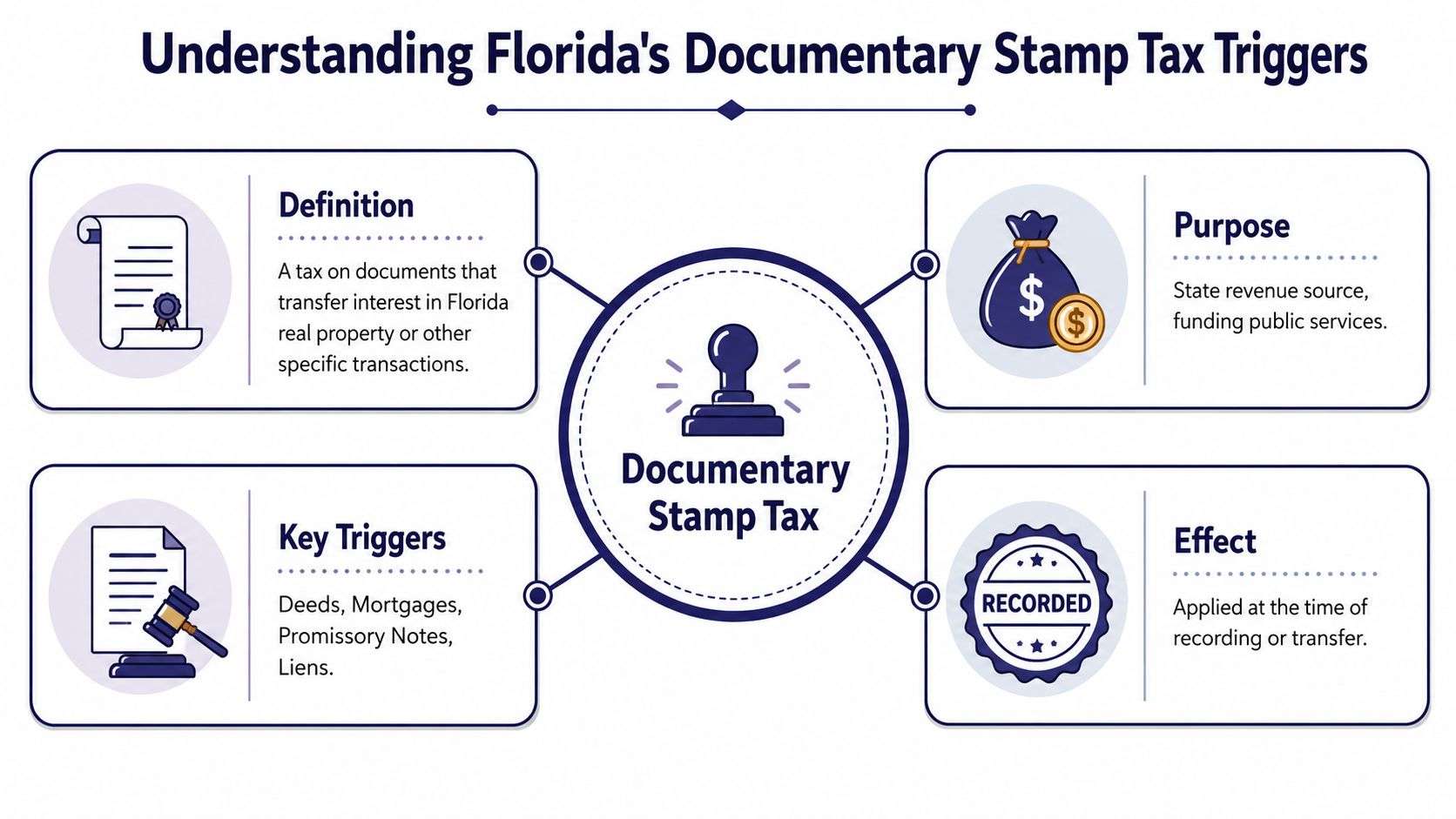
The Florida documentary stamp tax isn't a tax on owning real estate. It's a tax on certain documents and transactions. In real estate deals, the most common triggers are a deed that transfers an interest in property and written obligations to pay money, such as notes tied to financing.
Florida has been using this tax for a long time. Florida's Documentary Stamp Tax originated in November 1931 as a permanent revenue stream, initially levying a rate of $0.10 per $100 of consideration. The rate increased incrementally over the decades, finally settling at the current statewide rate of $0.70 per $100 effective August 1, 1992, where it has remained through 2026, according to the Polk County historical documentary stamp reference.
Deeds And Debt Documents Both Matter
A common mistake is assuming doc stamps apply only when a property is sold in the ordinary sense. That's too narrow. The tax can be triggered by:
- A deed transfer: when ownership or an interest in real property is conveyed
- A promissory note: when a written promise to repay money is created
- A mortgage or similar obligation: when debt is secured in connection with the transaction
- Other written obligations: depending on the nature of the document
This is why a person can say, “I'm not really selling, I'm just moving title around,” and still create a tax issue.
Consideration Is Broader Than Cash
Another point clients often miss is the meaning of consideration. For deed tax purposes, the state looks at the total value paid or agreed to be paid. That can include more than the amount wired at closing. The verified guidance allows consideration to include mortgages, liens, and other agreed-upon value as part of the taxable amount.
That matters in real transactions. If a buyer takes title subject to debt, or if a transfer involves non-cash value, the tax analysis doesn't stop with the purchase price line in the contract.
The safest habit is to ask what value changed hands in the full transaction, not just what changed hands in cash.
The timing also matters. This tax is generally paid when the relevant document is recorded, and in deed transfers it's paid to the clerk upon recording the deed. While this issue commonly appears at closing, critical planning should occur earlier when the contract is being drafted and reviewed.
Doc Stamp Tax Rates For Deeds Mortgages And Notes
The biggest source of confusion is that Florida doesn't use one flat documentary stamp tax rate for every document. The rate depends on what you're recording or executing. If you treat deed tax and note tax as interchangeable, your estimate will be wrong.
Deed Rate
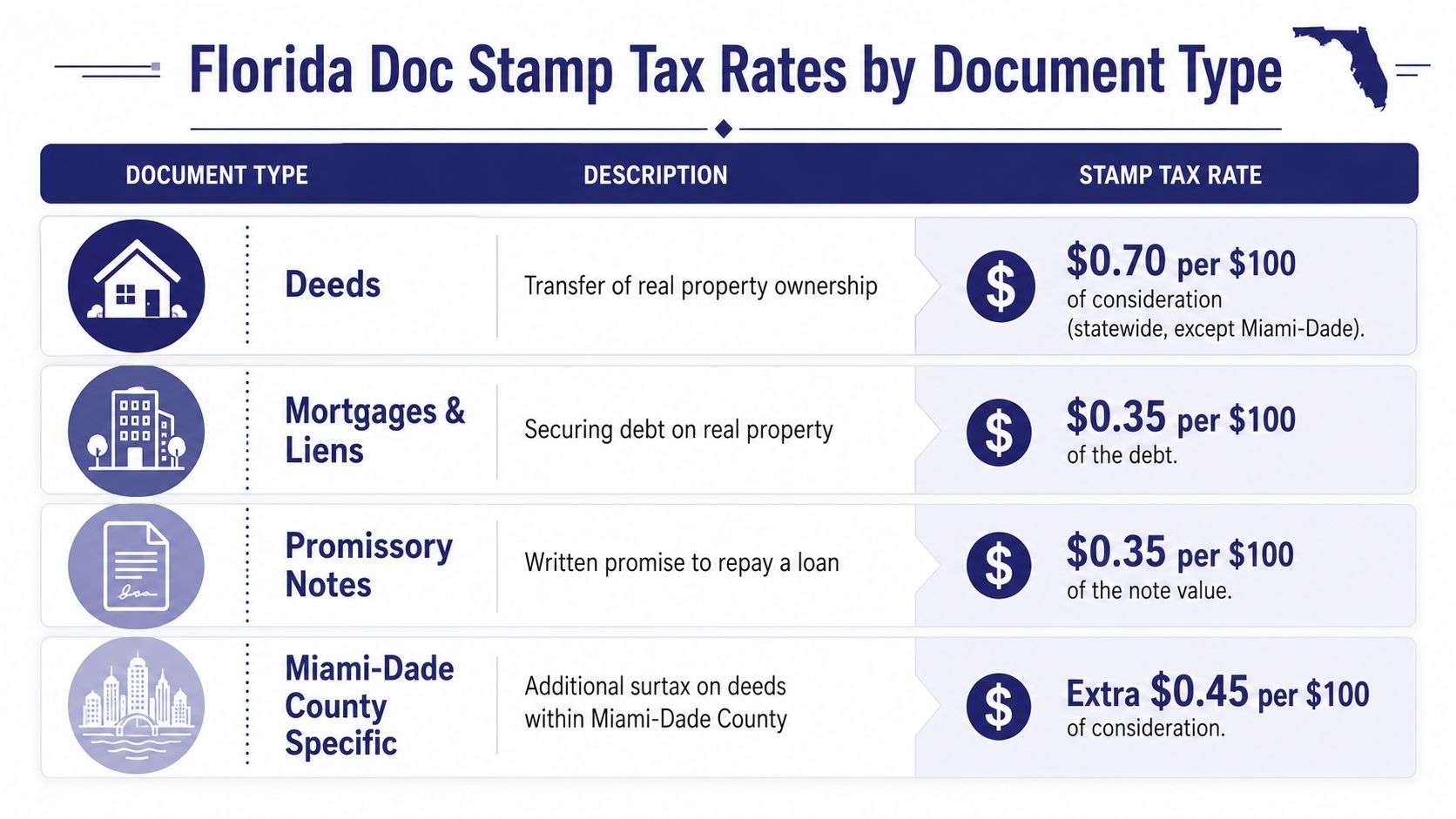
For deeds transferring real property, the general statewide rate is $0.70 per $100 of total consideration. There is no cap on the tax for deeds.
Miami-Dade is the important county-specific exception. The verified data states that Miami-Dade uses a base rate of $0.60 per $100, plus a $0.45 surtax for non-single-family residences, for a total of $1.05 per $100 on those properties.
Notes And Written Obligations
The rate changes when the document is a note or other written obligation to pay money. The tax on notes and other written obligations to pay money is levied at $0.35 per $100 of indebtedness but is capped at a maximum of $2,450. In contrast, the tax on deeds is $0.70 per $100 of the total consideration and has no cap, as summarized by Koontz & Associates' Florida documentary stamp tax overview.
That cap matters in larger transactions. On high-value deals, the deed tax can keep rising while the note tax stops increasing once it hits the cap.
Why The Distinction Changes Deal Planning
This isn't academic. It affects how buyers, sellers, lenders, and investors budget the transaction.
Consider the practical differences:
- A cash deal: usually raises deed tax issues, but not the same note-tax issue because there may be no taxable note to record.
- A financed residential deal: often involves tax on the deed and separate tax on the financing documents.
- A commercial or owner-financed deal: may require closer analysis because the form of the obligation changes the tax result.
For sellers considering structured financing, owner financing in Florida can create flexibility, but it also makes document classification more important. If the paperwork is drafted casually, the parties may misunderstand which taxes apply and which do not.
Key takeaway: In Florida, “doc stamps” is a shorthand label. It doesn't mean one tax with one rate. It means different taxes attached to different documents.
How To Calculate The Documentary Stamp Tax
The cleanest way to understand the Florida documentary stamp tax is to run the numbers separately for the deed and the financing. Combining them too early is where people lose track of what they're paying for.

Example One For The Deed
Assume a Tampa Bay area home sale in Pinellas County with a purchase price of $400,000.
For the deed, use the statewide deed rate discussed above:
- Divide the consideration by 100
- Multiply that result by $0.70
The math looks like this:
- $400,000 ÷ 100 = 4,000
- 4,000 × $0.70 = $2,800
So the documentary stamp tax on the deed is $2,800 in that example.
This is why sellers need to pay attention to their expected proceeds. A sale price may look fine on paper, but if the seller hasn't accounted for transfer taxes and other charges, the actual net number can be lower than expected.
Example Two For The Note
Now assume the buyer is obtaining a $320,000 mortgage.
For the note, use the notes-and-obligations rate:
- Divide the indebtedness by 100
- Multiply that result by $0.35
The math:
- $320,000 ÷ 100 = 3,200
- 3,200 × $0.35 = $1,120
So the documentary stamp tax on the note is $1,120 in this example.
Keep The Two Calculations Separate
That separation matters because the deed and the note are not taxed the same way.
A useful checklist at closing looks like this:
- Verify the deed tax base: Is it the full consideration?
- Verify the note amount: Does it match the actual indebtedness?
- Check county treatment: Miami-Dade requires special attention.
- Review the settlement statement carefully: The tax line should match the document being taxed.
If you're dealing with a retail residential sale, those calculations are usually straightforward. In a more layered transaction, such as a mixed-use acquisition or a financed investment purchase, the closing statement may require more careful review. A broader discussion of commercial property closing costs in Florida is often useful because commercial deals tend to stack more variables into the tax analysis.
Don't rely on a rough verbal estimate. Run the deed math and the note math separately, then compare those figures to the closing disclosure or settlement statement.
Who Pays The Documentary Stamp Tax Buyer Or Seller
This is one of the first questions people ask, and the short answer is simple. Florida requires the tax to be paid, but the contract usually decides who pays which part.
In everyday practice, custom fills the gap when the contract doesn't say much. In many Florida transactions, the seller typically pays the documentary stamp tax on the deed, while the buyer typically pays the tax tied to the note or mortgage financing. But that's a custom, not a universal command that overrides the parties' agreement.
What Usually Happens In Real Deals
In a standard residential closing, parties often follow local convention because it keeps negotiations moving. That works fine when everyone already expects the same result.
Problems start when:
- The deal is FSBO: one side uses a generic contract and assumes local custom will fill in missing terms.
- The contract is vague: it mentions closing costs generally but doesn't assign document taxes clearly.
- The transaction is unusual: seller financing, family transfers, LLC buyers, and investment deals often break from ordinary expectations.
Why Negotiation Matters
Doc stamps are a legitimate negotiating point. A buyer trying to conserve cash may ask the seller to absorb more of the closing burden. A seller in a strong market may refuse. Neither side is wrong for raising it.
The practical lesson is to assign responsibility in writing, early and clearly. If you're selling without an agent, FSBO closing guidance in Florida becomes especially valuable because document tax assumptions often turn into avoidable disputes.
A short list of smart habits helps:
- Spell it out in the contract: don't rely on “usual practice”
- Match the contract to the settlement statement: inconsistencies should be corrected before closing
- Address financing taxes separately: deed taxes and note taxes shouldn't be lumped together casually
When clients ask who pays, the best answer is this: the party who agreed to pay in the signed contract, or the party at a disadvantage if no one clarified it soon enough.
Common Exemptions And Overlooked Pitfalls
Most online explanations of the Florida documentary stamp tax stop at the rate chart. That's where readers get into trouble. The expensive mistakes usually come from transfers that look simple on the surface but aren't.
Common Situations People Assume Are Exempt
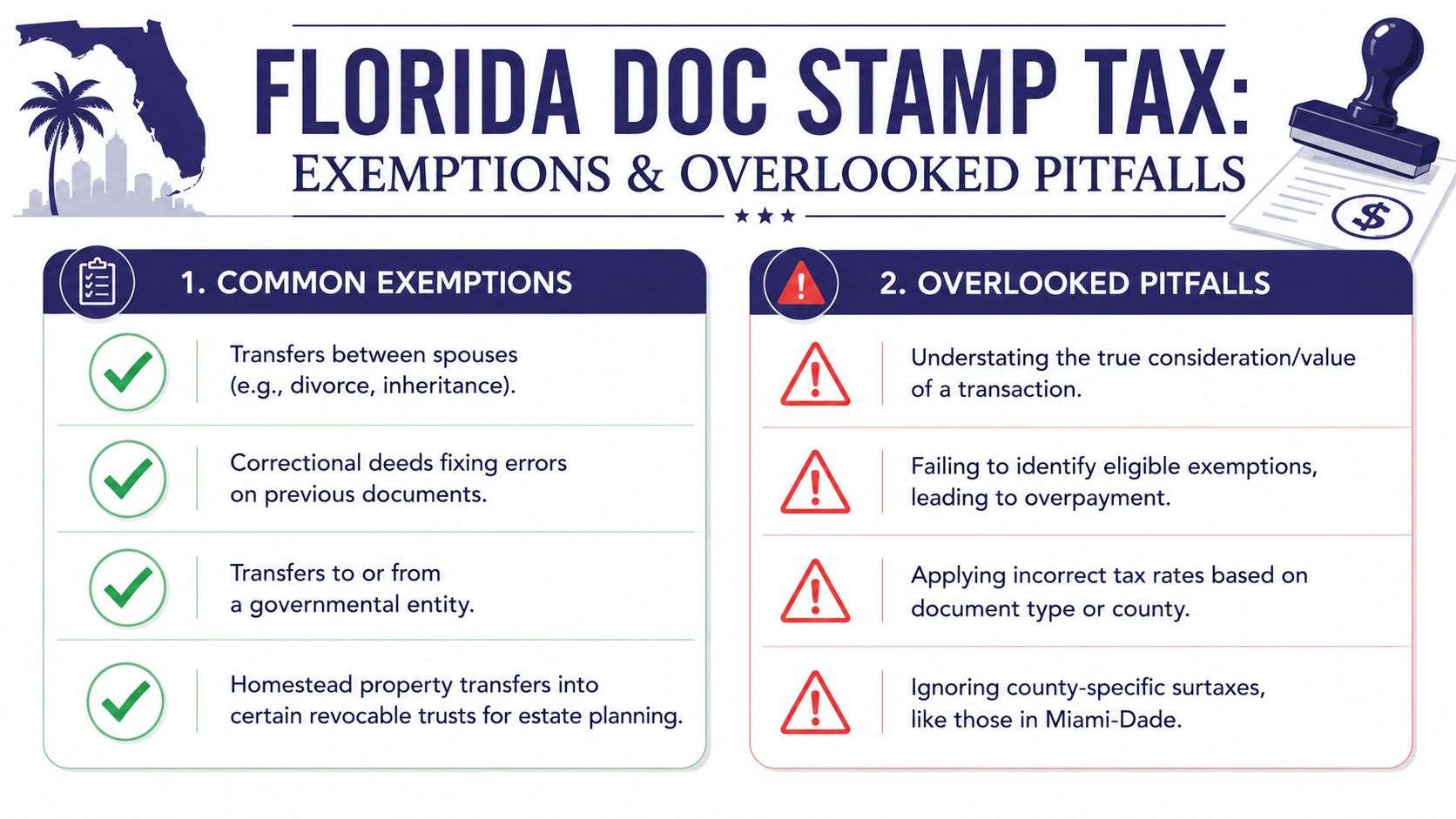
Some transfers may be exempt or may involve little to no tax depending on the facts. Examples often discussed in Florida practice include:
- Transfers between spouses: especially in divorce-related settings or other no-consideration transfers
- Correction deeds: when the document is only fixing an earlier recording issue
- Transfers involving government entities: where one party may be exempt
- Certain estate-planning transfers: such as homestead transfers into some revocable trust arrangements
The hard part is that labels don't control. Calling something a gift, corrective deed, or trust transfer doesn't automatically make it exempt. The underlying facts still matter.
The Three Year Lookback On Entity Transfers
One of the least understood traps involves entity ownership. People often believe that selling an LLC interest is automatically outside deed-based documentary stamp tax because the property itself isn't being deeded at that moment. That assumption can fail.
The Florida Supreme Court's ruling in Crescent allowed certain conveyances to conduit entities to be non-taxable, but the legislature amended the statute in 2009 to impose tax on the subsequent sale of ownership interests if property was conveyed to the entity within the previous three years, as discussed in the Florida Bar Journal article on the post-Crescent legislative change.
That issue matters in real life for:
- Investors selling LLC interests
- Families transferring ownership through entity structures
- Commercial owners trying to simplify title transfers
- FSBO sellers who think an entity sale avoids transfer tax analysis
If property was moved into an entity recently and the ownership interests are sold afterward, the transaction needs careful review. This is one of the easiest places for a seller to underestimate tax exposure.
A transfer can be “off deed” in form and still demand serious doc stamp analysis in substance.
Non Traditional Financing Can Cut The Other Way
Another overlooked area involves financing documents that don't fit the standard residential mold. Most general guides talk about promissory notes and mortgages, then stop there. That leaves lenders, private sellers, and small business borrowers guessing.
The verified guidance notes that certain written obligations like installment loan agreements and conversion loans are explicitly exempt under Florida Technical Assistance Advisement TAA 24B4-001, issued April 12, 2024, as described in this Florida TAA summary regarding written obligations to pay.
That doesn't mean every creative financing document is exempt. It means the document type matters enough that a generic “all loan papers are taxable” rule can produce the wrong answer.
Practical Pitfalls That Cause Problems
In practice, these are the mistakes that cost people money:
- Using the wrong tax base: counting only cash and ignoring assumed debt or other consideration
- Assuming every note is taxed the same way: document-specific exemptions may change the analysis
- Overlooking recent entity transfers: especially where property was conveyed into an LLC or trust-like structure before an ownership sale
- Treating county differences casually: Miami-Dade requires separate attention
- Relying on outdated online summaries: they often miss newer financing guidance and entity-transfer nuances
For investors and FSBO sellers in Tampa Bay, legal review demonstrates its value. The routine sale is rarely the issue. The issue is the transaction that looks routine until someone reads the documents closely.
When To Consult A Tampa Bay Real Estate Attorney
Some closings are straightforward. A standard residential sale with a clear contract, ordinary financing, and no unusual title history usually moves without much drama. But several Florida documentary stamp tax issues don't become obvious until someone reviews the deed history, the entity structure, or the financing documents line by line.
Situations That Deserve Legal Review
You should strongly consider getting a Florida real estate attorney involved when the deal includes any of the following:
- An LLC, corporation, trust, or partnership in the ownership chain
- A recent transfer into an entity before a membership or ownership sale
- Seller financing or non-standard lending documents
- A FSBO contract with vague cost-allocation language
- A family transfer where the parties assume it's exempt
- A dispute over who is paying deed-related or note-related doc stamps
These aren't edge cases in the Tampa Bay area. They come up regularly in investor deals, intra-family transfers, small commercial sales, and transactions where parties use forms that weren't drafted for the actual structure of the deal.
Why Local Experience Matters
County practice still matters. So does knowing how local closing agents, lenders, and clerks handle issues in practice. A lawyer familiar with closings in Pinellas County, Hillsborough County, and surrounding areas can often identify problems before they become recording delays or post-closing disputes.
That local perspective is especially useful when the transaction is being handled without a traditional broker. If you need transaction-specific help in this area, Tampa Bay real estate closing counsel in Pinellas Park and St. Petersburg can be the difference between a clean closing and an avoidable mess.
When the document structure is unusual, the cheapest mistake is often the attorney review you skipped.
The right time to ask about doc stamps isn't after the closing statement is final. It's when the contract is being drafted, the transfer structure is being chosen, or the financing documents are still flexible. That's especially true for investors trying to transfer entity interests, lenders using alternative loan products, and FSBO sellers who want clarity before they commit to terms they don't fully understand.
The tax itself isn't mysterious once you isolate the trigger, the document, and the taxable amount. The risk comes from assuming your transaction is simpler than it is.
If you're buying, selling, transferring, or financing Florida property and want clear advice before closing, Oldham Law PLLC can help you review the contract, identify documentary stamp tax issues early, and avoid the kind of surprises that derail closings in St. Petersburg, Pinellas Park, and the greater Tampa Bay area.
