
Florida Home: What Is Financing Contingency?

A financing contingency is a protective clause in a real estate contract that lets a buyer legally back out of the deal and recover the earnest money deposit if the buyer can't secure a mortgage. In most transactions, that means the buyer must obtain mortgage approval within 21 to 30 days, although negotiations can extend that period to 60 days depending on the loan and appraisal process.
If you're buying your first home in Florida, this usually comes up right after your offer is accepted. You're excited, you've put down earnest money, and then a long contract lands in your inbox full of terms that sound technical but carry real financial risk. One of the most important is the financing contingency.
This clause matters because a pre-approval letter is not the same as a completed loan. Buyers often assume that once a lender says they look qualified, the financing side is basically done. It isn't. Underwriting, appraisal, document requests, and final loan conditions still stand between you and closing.
That gap is where the financing contingency protects you. It gives you a defined window to secure financing on the terms the contract requires, and if financing fails through no fault of your own, it can preserve your right to exit without losing your deposit. In Florida, the timeline and notice requirements are where buyers get into trouble. The language may look routine, but the deadline is not forgiving.
Your Guide To The Most Important Clause In Your Contract
Most first-time buyers focus on the purchase price, the monthly payment, and whether the seller accepted the offer. Those are important. But once the contract is signed, the next question is simpler and more urgent. What happens if the loan doesn't come through?
That's where the financing contingency earns its place. In practical terms, it is your contractual safety net. It says your obligation to buy the property depends on obtaining financing that fits the deal. If the lender ultimately denies the loan, approves less than the contract requires, or the financing terms don't line up with the agreement, this clause may allow you to end the contract without breaching it.
Without that protection, a failed mortgage application can become a legal and financial problem fast. A buyer may be forced to close without the planned financing or face losing the deposit. In a difficult dispute, the seller may also claim the buyer defaulted.
Why Buyers Miss The Risk
First-time buyers usually aren't careless. They're busy. They assume the lender, agent, and title company are all tracking the same dates and that someone will warn them before a protection expires.
Sometimes that happens. Sometimes it doesn't.
Practical rule: Never treat a financing contingency as automatic protection. It works only if the contract language, timeline, and notice steps are followed exactly.
A Florida contract doesn't reward assumptions. It rewards deadlines, written communication, and careful review before signatures go on the page.
What You Need To Watch Closely
The financing contingency becomes especially important when:
- Your loan file is document-heavy and underwriting may take longer than expected.
- The property appraisal is uncertain and value could affect the lender's approval.
- Your income or assets need explanation because self-employment, bonuses, or recent account activity can trigger added review.
- You're relying on specific loan terms and can't switch to a different structure at the last minute.
If you understand one clause before signing a Florida purchase contract, make it this one.
Understanding The Core Concept Of A Financing Contingency
A buyer's offer can be firm on price and still be conditional on financing. That is the core idea behind a financing contingency. The contract remains in place, but the buyer's duty to close depends on getting the loan required for the purchase.
That's why many lawyers describe it as an escape hatch, although safety net may be the better phrase for first-time buyers. The contingency doesn't let a buyer walk away for any reason at all. It protects the buyer from a specific problem. The mortgage needed to complete the purchase does not materialize on the required terms.
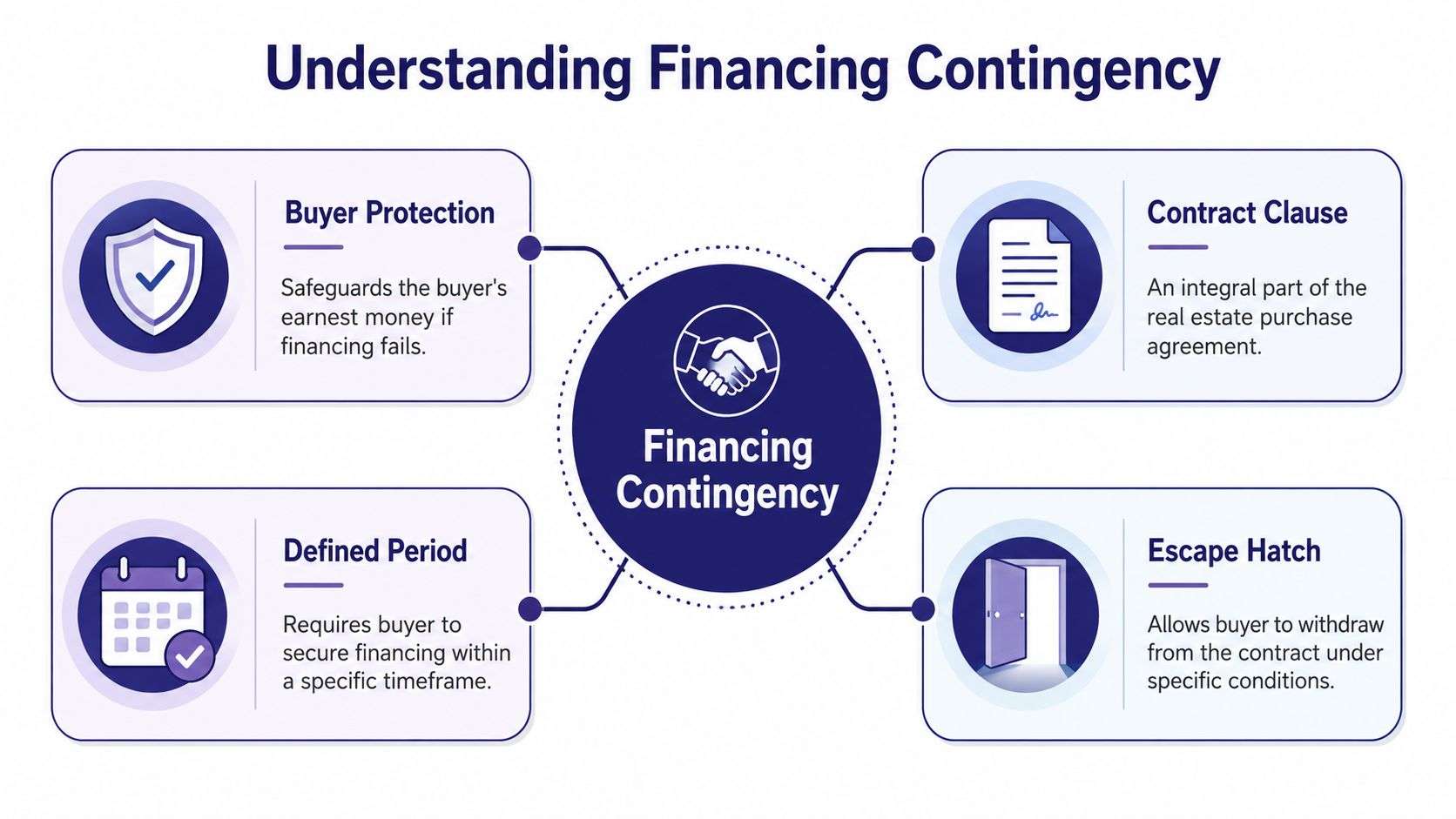
A widely used explanation of the concept states that a financing contingency is a critical clause in a real estate purchase contract that typically requires the buyer to secure mortgage approval within 21 to 30 days, with some deals extending to 60 days based on loan complexity and appraisal timing, as discussed in this overview of financing contingency timeframes in real estate contracts.
What The Clause Actually Protects
The practical purpose is straightforward. If the lender denies the mortgage during underwriting, the buyer may be able to terminate the contract lawfully and avoid forfeiting the earnest money deposit. That matters because earnest money is supposed to show commitment, not become a penalty for a loan failure outside the buyer's control.
This clause also protects against a quieter problem that buyers often miss. Sometimes the lender doesn't deny the loan outright but approves less than the contract requires. If the deal depends on a certain loan amount, interest structure, or loan type, a shortfall can leave the buyer unable to close on the agreed terms.
A financing contingency is designed to address that risk before it becomes a default.
What It Does Not Cover
A financing contingency isn't a general cancellation button. It doesn't excuse inaction, delay, or failure to cooperate with the lender. Buyers still need to apply promptly, provide requested documents, and keep close track of the deadline.
It's also separate from other protections in the contract. For example, the inspection period on a real estate contract addresses the property's condition, not whether the lender will fund the purchase. Buyers sometimes blur those issues together, but the contract treats them differently.
The safest approach is to assume every contingency has its own job, its own deadline, and its own notice requirements.
The Real-World Meaning
When buyers ask what is financing contingency, the best plain-English answer is this:
- It makes the purchase conditional on getting the required mortgage.
- It protects the deposit if financing fails under the contract's terms.
- It creates a deadline by which the buyer must secure approval or act.
- It gives the seller clarity too, because the seller knows when financing uncertainty should be resolved.
That balance is why the clause is common. It protects the buyer without leaving the seller in limbo forever.
How The Financing Contingency Process Works In Florida
Florida buyers need to think about the financing contingency as a sequence, not a single sentence in the contract. The protection starts at signing, but it only works if the buyer moves through each stage on time.
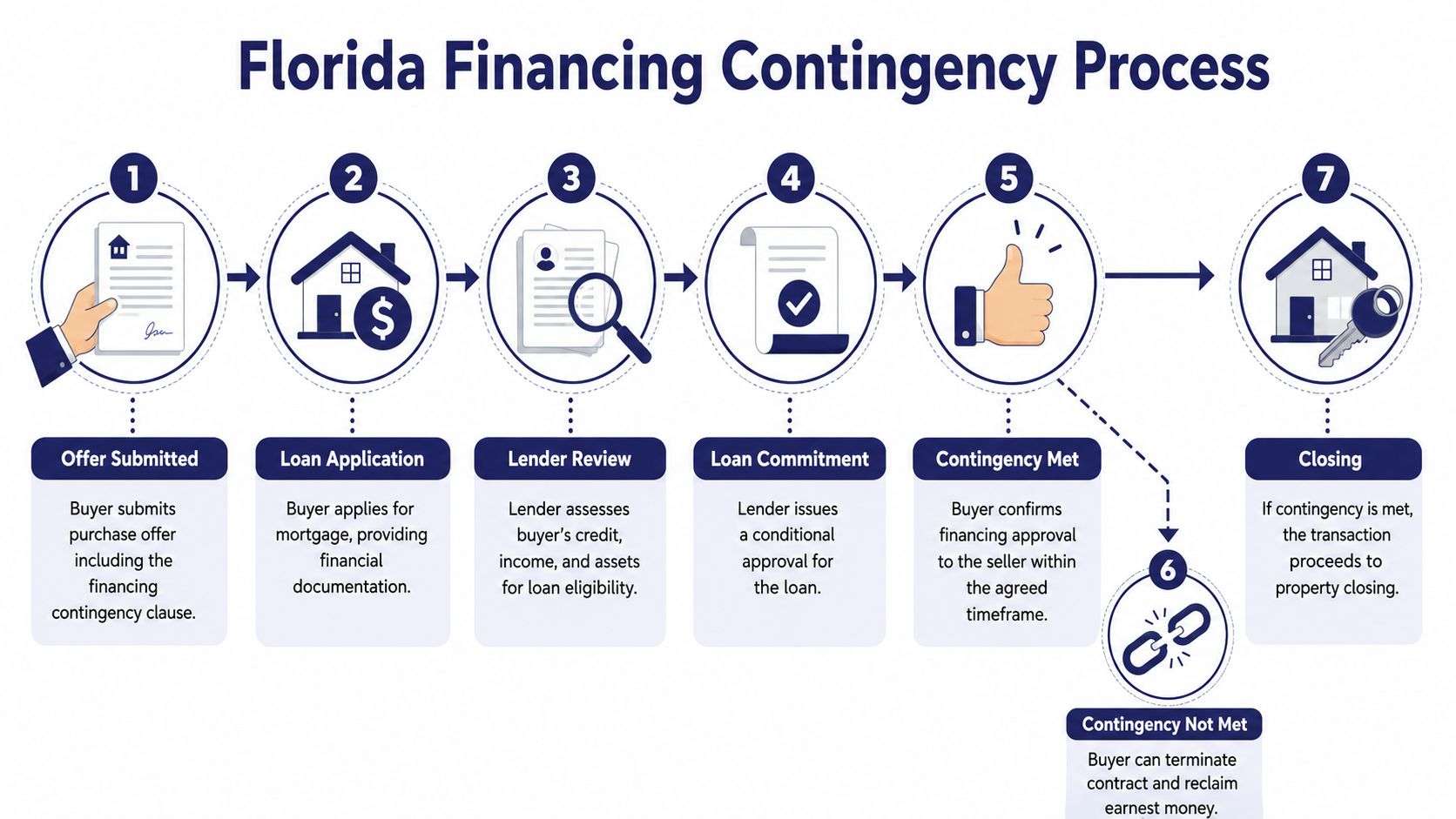
Under Florida practice, the standard contracts tie this issue to a specific approval deadline. The Florida Realtors discussion of the topic explains that in the standard and “AS IS” forms, the financing contingency appears in Section 8(b), requires the buyer to obtain both loan approval and a satisfactory appraisal by the loan approval deadline, and if the buyer does not give written notice before that deadline, the contract converts to a cash transaction without financing protection. You can read that explanation in this Florida-based analysis of the financing contingency in the AS IS contract.
The Loan Approval Period
The key concept is the Loan Approval Period. That is the timeframe the parties agree to for the buyer to secure mortgage commitment. In day-to-day practice, this period is one of the most important dates in the entire transaction.
Here is how that process usually unfolds:
The offer is signed with financing terms. The contract states that the buyer intends to obtain financing rather than purchase with cash.
The buyer submits the full loan application. The lender then collects income records, asset statements, credit information, and supporting documents.
The property appraisal is ordered and reviewed. A lender may be comfortable with the borrower, but still withhold approval if the property does not appraise satisfactorily.
Underwriting reviews the file. At this stage, many surprises often emerge. Missing documents, unexplained deposits, job changes, debt issues, or appraisal concerns can slow or derail the file.
The buyer either obtains approval or gives notice before the contract deadline if financing has not been secured.
Pre-Approval Is Not Final Approval
First-time buyers often develop a false sense of security at this stage. A pre-approval letter helps you shop and make an offer. It does not end the lender's review.
A true loan commitment comes later, after the lender has examined the borrower and the property much more closely. That difference is one reason buyers who seemed “fully qualified” at the start can still run into trouble before closing. Buyers rebuilding after past credit issues often face extra lender scrutiny, which is one reason this overview on buying a house after bankruptcy in Florida is useful background reading.
A buyer should never assume the file is safe just because a lender issued a pre-approval letter at the beginning of the deal.
What Happens If The Deadline Is Missed
In Florida, missing the financing deadline can be far more serious than many generic homebuying guides suggest. If the contract requires written notice and the buyer stays silent, the financing protection can disappear. At that point, the contract may continue as if the buyer agreed to close without financing protection.
That creates a harsh result. The buyer may still not have a workable loan, but the contractual right to cancel without penalty may already be gone.
The Notice Has To Be Done Correctly
The notice piece is where transactions often break down. Buyers may tell the loan officer they are having trouble, text the agent, or assume everyone knows the financing isn't ready. That is not the same as giving contract notice.
Florida contracts are document-driven. If financing cannot be obtained within the approved period, the buyer needs to follow the notice procedure the contract requires, and that usually means formal written notice delivered correctly and on time.
A strong financing contingency protects a buyer. A missed notice deadline protects no one.
Negotiating Your Financing Contingency Clause
The financing contingency isn't just boilerplate. It is a negotiated risk allocation between buyer and seller. Buyers who understand that tend to get better contract terms and fewer surprises later.
Sellers want certainty. Buyers need room for the lender to complete underwriting. Those goals conflict, but they can be balanced.

How Buyers Should Think About The Timeline
A short approval period can make an offer look stronger. It tells the seller the buyer expects financing to move quickly. That can help in a competitive deal.
But there is a trade-off. If the deadline is too aggressive for the loan type, borrower profile, or appraisal timeline, the clause stops being protection and starts becoming a trap.
A realistic negotiation should consider:
- Loan complexity: A straightforward conventional file may move differently than a file with layered income or asset questions.
- Property issues: Condominiums, unique properties, and homes with valuation questions can slow lender review.
- Lender performance: Some lenders communicate clearly and move files steadily. Others don't.
- Buyer readiness: Organized documents and stable finances make a shorter period more reasonable.
What Usually Works Better
The best negotiation position is not “give me the longest period possible.” It is “give me the period this loan needs.”
That sounds simple, but it's where many deals go wrong. Buyers chase acceptance by agreeing to terms that look good on paper and become unmanageable in practice. Sellers do the same in reverse when they reject any flexibility and end up back on the market after a preventable financing failure.
If you're buying directly from an owner without a listing agent, contract language becomes even more important. In those transactions, buyers and sellers should pay close attention to the structure of the agreement, including the financing terms, as part of reviewing a for sale by owner contract in Florida.
A well-negotiated financing contingency does two things at once. It gives the buyer a fair chance to secure the loan, and it gives the seller a clear date for knowing whether the deal is moving forward.
What Sellers Look For
Sellers are more likely to accept a reasonable contingency period when the buyer presents a solid file from the start. That often includes a strong pre-approval letter, prompt communication, and financial documentation that appears stable and complete.
From the seller's side, a buyer asking for more time is easier to trust when the request matches the realities of the loan. From the buyer's side, asking for less time than the lender needs is rarely a smart way to “win” a deal.
The stronger move is honesty backed by preparation.
The High Stakes Of Waiving Or Failing The Contingency
Some buyers are tempted to waive the financing contingency to make their offer stand out. In certain markets, that can make the offer more attractive to a seller. It also removes one of the most important protections in the contract.
That risk is not theoretical. If the buyer waives financing protection and the lender later refuses to fund, the buyer may still be obligated to close or face the contractual consequences of default.

Florida guidance on contingency clauses explains that these provisions usually include a defined Loan Approval Period, and the buyer may terminate and recover the earnest money deposit only by providing proper written notice before the deadline expires, following the contract's notice procedures. That Florida-specific point is summarized in this discussion of earnest money deposits and contingency clauses.
Waiving The Clause Changes Who Carries The Risk
With a financing contingency in place, the contract recognizes that the mortgage is still being evaluated. Without it, the buyer carries that risk personally.
That means the buyer is effectively saying, “If the lender backs out, I will still perform or absorb the fallout.” For a buyer with substantial cash reserves, that may be a deliberate decision. For a first-time buyer depending on mortgage financing, it is often a dangerous one.
Consider the practical consequences of waiving:
- Deposit exposure: The earnest money may no longer be protected if the loan fails.
- Closing pressure: The seller can still expect performance even when the lender doesn't cooperate.
- Dispute risk: A failed closing can turn into a default claim.
- Less bargaining power: Once the contingency is gone, the buyer has fewer clean exit options.
Missing The Deadline Can Be Just As Dangerous
Many buyers would never knowingly waive the contingency, but they lose it anyway by missing the notice deadline. That usually happens because they rely on informal updates instead of contract-compliant notice.
Common mistakes include:
- Telling only the lender: The lender is not the party who receives contractual notice for the seller.
- Assuming the agent handled it: Unless the notice was properly given under the contract, assumptions don't help.
- Waiting for one more underwriting update: Buyers often delay because they hope approval is coming tomorrow.
- Ignoring delivery rules: Method and timing matter.
Silence is not neutral in a financing contingency. Silence can cost the buyer the protection.
When Buyers Explore Alternatives
If traditional financing starts to unravel, some buyers look at other deal structures, including owner financing homes in Florida. That can be useful in the right transaction, but it is not a last-minute cure for a missed financing deadline in a standard purchase contract. The existing contract still controls unless the parties amend it properly.
The Strongest Practical Habit
Track the financing deadline from the day the contract is signed. Then track it again. Buyers should know the exact date, ask the lender for status updates well before it arrives, and be ready to act in writing if approval is not in hand.
The danger isn't only loan denial. The danger is loan uncertainty combined with inaction.
Protecting Your Purchase With Expert Legal Guidance
A financing contingency is one of the most valuable buyer protections in a Florida real estate contract, but only when it is drafted, negotiated, and used correctly. The clause has to fit the deal. The deadline has to be realistic. The notice has to be timely and delivered the way the contract requires.
That is why legal review matters most before a problem develops, not after. Buyers benefit from counsel when they are comparing offers, negotiating the loan approval period, reviewing the “AS IS” contract, or dealing with a lender who is slow to issue final approval. Sellers benefit too, especially when they need clarity on whether a buyer's financing issue is a valid termination or a default.
When Legal Help Is Most Valuable
A contract review is especially worthwhile when:
- You are signing your first Florida purchase agreement and want to understand your real exposure.
- The loan file has complications involving underwriting, appraisal, or timing.
- The other side wants a shorter timeline than your lender is likely to meet.
- A deadline is approaching and financing still isn't resolved.
- You are preparing for closing and want a lawyer involved in the transaction from start to finish through experienced Pinellas Park and St. Petersburg real estate closing lawyers.
A missed date can cost far more than a careful review. In real estate, small drafting choices often control large financial consequences.
If you are buying or selling in St. Petersburg, Tampa Bay, or Central Florida, experienced legal guidance can help you move forward with much more confidence and much less risk.
If you're buying, selling, or reviewing a Florida real estate contract, Oldham Law PLLC can help you understand the financing contingency, protect your earnest money, and avoid costly deadline mistakes. Contact the firm for a free consultation and a practical game plan for your transaction.
