
Wrongful Death Statute Florida: A Complete Guide
A lot of families start searching for the wrongful death statute florida after the hardest phone call of their lives. They’re trying to handle funeral decisions, questions from insurance adjusters, probate paperwork, and pressure from relatives who all want answers right away.
At that point, a law school lecture is less helpful than a clear path. In Florida, wrongful death claims follow a structured legal process, and that structure matters because the wrong move early can limit what the family can recover later. The practical question isn’t just whether someone caused the death. It’s who can bring the claim, what damages are available, how fault will be disputed, and how quickly the family has to act.
Understanding Florida’s Wrongful Death Act
A wrongful death case exists when someone dies because of another party’s negligence or misconduct. In plain terms, if the person who died could have brought a personal injury claim had they lived, Florida law may allow a wrongful death claim after their death.
Florida’s legal framework comes from the Florida Wrongful Death Act, which was enacted in 1972 and is codified in Florida Statutes Sections 768.16 through 768.26, according to the University of Miami Law Review discussion of the Act’s development. That same source notes the law established a strict 2-year statute of limitations from the date of death for filing a claim.
That matters because this area of law isn’t just about proving that something terrible happened. It’s about fitting the facts into a statute that controls who can recover, what losses can be claimed, and how the case must be filed.
What The Act Is Meant To Do
The law recognizes that a fatal injury creates more than one kind of loss. A family may be dealing with lost income, medical bills, funeral expenses, and the personal loss of companionship, guidance, and support.
The Act was designed to create a workable civil remedy for those losses. Before that major revision, Florida law was less complete in how it handled damages tied to a death.
Practical rule: A wrongful death claim is not a general complaint about unfairness. It’s a specific civil case built under a specific statute.
Why The Early Game Plan Matters
The first stage usually isn’t courtroom drama. It’s information control.
A strong case often starts with these steps:
- Confirm The Legal Theory: Was the death tied to a crash, unsafe property, a dangerous product, or another negligent act?
- Identify The Proper Filing Party: Families often assume the closest relative files. That’s not how Florida’s process works.
- Preserve Evidence Quickly: Records, scene evidence, and witness accounts don’t get stronger with time.
- Review Insurance Early: In many cases, coverage issues shape the strategy from the beginning.
Families dealing with a fatal negligence case often end up addressing both the wrongful death claim and related insurance questions at the same time. That overlap is why many start by reviewing resources on Florida personal injury representation.
Who Can File A Wrongful Death Claim In Florida
One of the most common points of confusion is also one of the most important. In Florida, the spouse, child, or parent usually does not file the lawsuit in their own name as an individual plaintiff.
The claim must be brought by the court-appointed personal representative of the estate. The law uses one filing party to present the case for all eligible survivors and the estate as a whole.
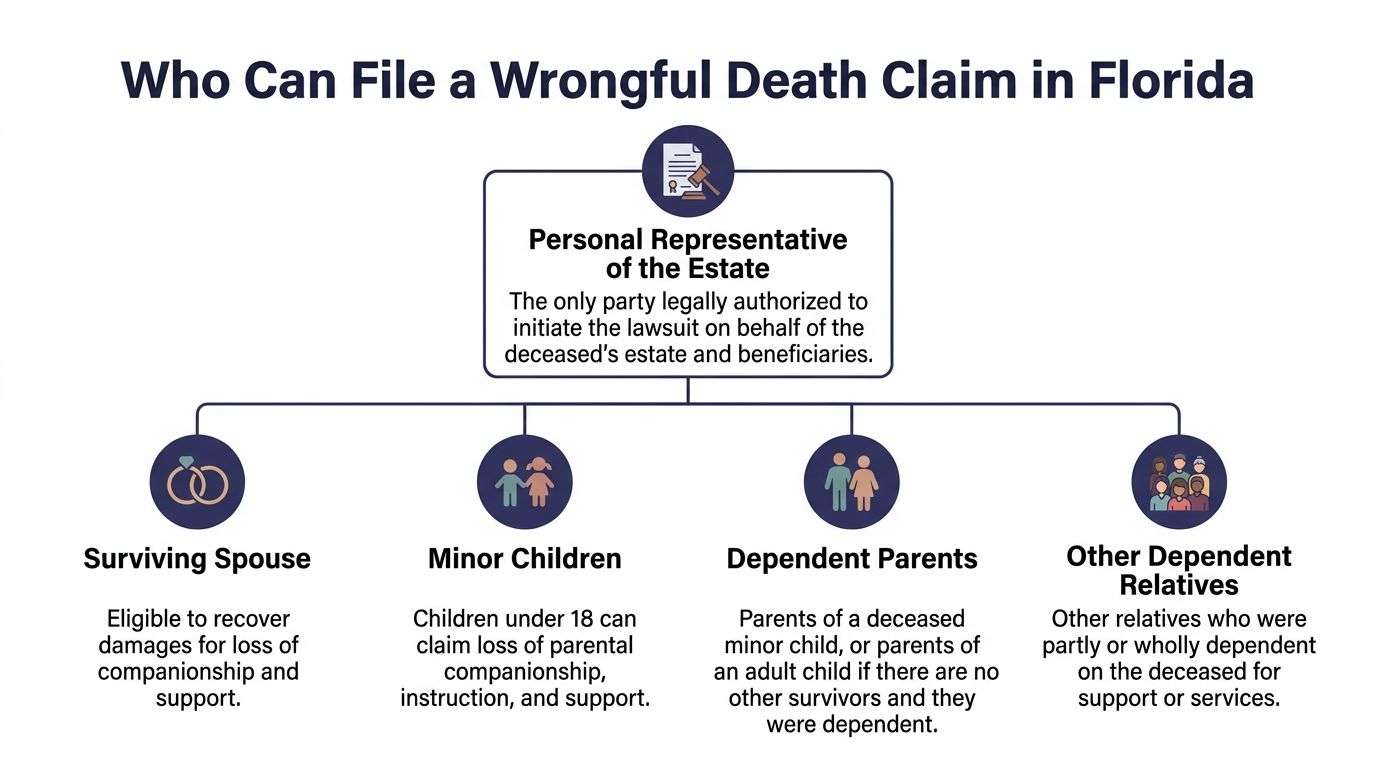
The clearest way to think about it is this. The personal representative is the team captain. The survivors are the people whose losses are being presented in the case. The captain files the case, but the recovery may include damages for multiple family members depending on their relationship to the person who died.
The Personal Representative’s Role
Florida’s wrongful death framework requires centralized control. The Florida practitioner overview discussing the Wrongful Death Act explains that claims must be initiated exclusively by the court-appointed personal representative on behalf of designated survivors, and that this structure prevents fragmented litigation because survivors cannot sue independently.
That rule solves one problem and creates another. It reduces multiple competing lawsuits, but it also means probate issues can delay the case if no representative has been appointed yet.
In practice, that early appointment matters because:
- The Case Can’t Properly Move Forward Without The Right Party
- Potential Survivors Need To Be Identified Early
- Settlement Authority Is Cleaner When One Legal Representative Speaks For The Estate
- Delays Can Burn Valuable Time While The filing deadline keeps running
If the family spends months arguing over who should handle the estate, the defense still benefits from every lost week.
Who May Benefit As Survivors
Eligibility depends on the family structure. Florida law prioritizes survivors in a statutory hierarchy, with the spouse first, followed by children, parents, and in some circumstances other blood relatives.
Typical categories include:
- Surviving Spouse: Often has a central claim for loss-related damages.
- Minor Children: Their rights can differ from those of adult children.
- Parents Of A Minor Child: They may have recognized survivor claims.
- Other Qualifying Relatives: In some situations, blood relatives who were dependent on the decedent may be included.
The practical trade-off is that not every grieving relative has a legal claim, even if the emotional loss is real. Florida’s statute doesn’t compensate every family relationship equally. It compensates only the relationships the law recognizes.
What Usually Works Best Early
Families often do better when they treat the opening phase as both a probate issue and an injury case. That means gathering the will if one exists, identifying all survivors, preserving records, and making sure one coordinated legal strategy controls the matter from the start.
Recoverable Damages In A Florida Wrongful Death Case
Families often assume a wrongful death case is limited to reimbursing bills. It’s broader than that. Florida law separates damages into two tracks. Some belong to the estate. Others belong to the survivors.
That distinction affects both strategy and expectations. It also affects how lawyers organize evidence, because proof of financial loss to the estate isn’t the same as proof of personal loss suffered by a spouse, child, or parent.
Damages That May Belong To The Estate
Under the Florida Wrongful Death Act as summarized in the verified material, estate-related damages can include losses tied to the decedent’s earnings and certain expenses connected to the death.
These commonly include:
- Pre-Death Medical Expenses: The Act explicitly allowed recovery for pre-death medical expenses by survivors as part of the revised framework.
- Funeral Expenses: These are often one of the first out-of-pocket losses families face.
- Lost Earnings Between Injury And Death: If the person survived for a period after the incident, there may be a claim tied to that lost income.
- Prospective Net Accumulations: Florida law recognizes estate losses tied to what the decedent likely would have accumulated.
The legal language can sound technical, especially with concepts like present value and net accumulations. In practice, those issues usually require a disciplined review of work history, earning pattern, and family support structure.
Damages That May Belong To Survivors
Separate damages may be available to survivors for their own losses. Under the verified statutory summary, recoverable survivor damages can include loss of support and services, mental pain and suffering for qualifying survivors, and for a spouse, loss of companionship and protection.
That’s an important distinction. The law doesn’t only look backward at what the family paid. It also looks at what the family lost moving forward.
A practical way to organize survivor damages is this:
- Financial Support: What did the decedent contribute to the household?
- Services: What practical help did the decedent provide?
- Relationship Loss: For certain survivors, the law recognizes the personal loss that follows a death caused by negligence.
The strongest damages presentation is usually the one that turns daily life into evidence. Who handled childcare, transportation, household management, income support, and care for other relatives?
What Works And What Doesn’t
What works is specificity. Vague statements like “he helped everyone” or “she did everything for the family” don’t carry much force by themselves.
What tends to work better is a concrete damages file that includes:
- Employment And Income Records
- Medical And Funeral Billing
- Household Role Evidence
- Statements From Family And Other Witnesses
- Insurance Materials, Including Applicable Uninsured Motorist Coverage Issues
What doesn’t work is treating damages as an afterthought. In wrongful death litigation, damages are not just the end of the case. They shape the value of the case from the start.
The Critical Two-Year Deadline For Filing
Many legal deadlines have some flexibility in practice. This one usually doesn’t.
Florida wrongful death claims are subject to a 2-year statute of limitations from the date of death. If that deadline is missed, the claim can be permanently barred. The verified data above identifies that deadline as a core feature of Florida’s Act and explains why prompt action matters when evidence begins to degrade over time.

Why Families Lose Time Without Realizing It
The calendar doesn’t start when the family feels ready. It starts from the date of death.
That creates a serious problem because families often spend the early months dealing with:
- Funeral And Immediate Family Matters
- Insurance Calls
- Probate Delays
- Disagreements About Who Should Act As Personal Representative
Each of those is understandable. None of them pauses the deadline automatically.
Rare Exceptions Are Not A Strategy
You may hear the term tolling. That refers to situations where the law may pause or extend a deadline. The verified material notes that tolling can arise in limited circumstances, including certain issues involving minors, fraudulent concealment, or mental incapacity.
Those exceptions are narrow and fact-sensitive. Depending on them without a careful legal review is risky.
Waiting to “see how things develop” is one of the most expensive choices a family can make in a wrongful death case.
The Better Approach
The better approach is early legal review, even if the family hasn’t decided whether to sue. Early review allows counsel to identify the correct filing party, preserve evidence, and avoid the avoidable problem of losing the claim to a deadline rather than to the facts.
Important Legal Rules And Common Defenses
The wrongful death statute florida doesn’t operate in a vacuum. Even when liability seems obvious to the family, the defense will usually look for ways to reduce or defeat the claim.
One of the biggest battlegrounds is comparative fault. In wrongful death cases, the defense often argues that the person who died contributed to the incident.
How Modified Comparative Negligence Changes The Case
Florida uses a modified comparative negligence rule. The verified data states that under Fla. Stat. §768.81(6), recovery is barred if the decedent is found to be more than 50% at fault, and that this rule is especially important in truck and rideshare cases where defendants often argue shared blame. The same verified material states that expert evidence can be essential to proper fault allocation, as discussed in the Florida wrongful death statute explanation focused on comparative fault.
The practical effect is straightforward:
- If Fault Is 50% Or Less: The claim may still proceed, but damages can be reduced.
- If Fault Is Above 50%: Recovery can be barred.
- If The Defense Controls The Story Early: The case can lose value quickly.
The verified data gives a simple example. If fault is assigned at 30%, damages are reduced by 30%.
Where These Fights Usually Show Up
This issue comes up often in cases involving:
- Truck collisions
- Rideshare crashes
- Pedestrian fatalities
- Cases involving allegations of speeding, distraction, or impairment
The family may think the central question is who caused the death. The defense may focus instead on whether they can push enough fault onto the decedent to shrink or eliminate the claim.
Other Defense Themes Families Should Expect
Defendants and insurers also commonly dispute:
- Causation: They may argue the death was not legally caused by the event in question.
- Damages Scope: They may challenge the relationship-based losses claimed by survivors.
- Coverage Issues: In some cases the fight is as much about insurance obligations as liability itself.
That’s one reason insurance conduct matters so much in serious fatality cases. A family dealing with coverage disputes may also need to understand related bad faith insurance issues in Florida.
Proving Your Case And Deciding To Settle Or Go To Trial
A wrongful death claim is built with evidence, not assumptions. Grief may make the facts feel obvious to the family, but insurers and defense lawyers evaluate the case by what can be proven.
In many Florida fatal crash cases, the first evidence file starts with the roadway investigation. The verified data states that motor vehicle crashes are a leading source of wrongful death claims in Florida and that crash reports tied to the state’s average of 770 daily crashes are fundamental to proving negligence and damages, as noted in this Florida discussion of common wrongful death cases.
What Proof Usually Matters Most
The evidence usually has to prove two separate things. First, that someone is legally responsible. Second, that the death created compensable losses under Florida law.
That often means collecting:
- Crash Or Incident Reports
- Witness Statements
- Medical Records
- Photographs, Video, Or Scene Documentation
- Employment And Financial Records
- Expert Analysis When Fault Or Damages Are Contested
A case with thin liability proof and strong damages proof is still vulnerable. The reverse is also true. Strong liability with weak damages support can still produce a disappointing result.
Settlement Versus Trial
Families often ask which path is better. The honest answer is that it depends on the evidence, the defendant, the insurance structure, and the family’s goals.
A simple comparison helps:
| Issue | Settlement | Trial |
|---|---|---|
| Timing | Usually more controlled | Often slower and less predictable |
| Privacy | More private resolution | Public courtroom process |
| Risk | Lower uncertainty | Greater uncertainty |
| Leverage | Depends on preparation and coverage | Depends on proof and jury presentation |
Settlement works best when the liability proof is clear, damages are organized, and the defense has enough exposure to take the claim seriously. Trial becomes more likely when the defense refuses to value the loss fairly or insists on blaming the decedent without support.
A good settlement strategy is never passive. The cases that settle well are usually the cases prepared as if they’re going to trial.
For families trying to evaluate an insurer’s early position, practical guidance on what to do after getting an insurance offer can help frame the decision.
When You Need An Experienced Florida Wrongful Death Attorney
Wrongful death cases are demanding even when liability seems clear. They combine probate procedure, survivor identification, damages analysis, evidence preservation, fault allocation, and insurance strategy. A family can be completely justified in its grief and still lose legal ground if the case isn’t built correctly.
That’s why legal help matters early. The lawyer’s role isn’t only to file papers. It’s to control the sequence of decisions so the family doesn’t get boxed in by delay, incomplete evidence, or a defense narrative that takes hold before the full facts are assembled.
What Experienced Counsel Actually Does
In a Florida wrongful death case, experienced counsel typically helps with several tasks at once:
- Coordinate The Personal Representative Issue
- Identify All Potential Survivors
- Preserve Evidence Before It Disappears
- Develop The Damages Record
- Push Back On Comparative Fault Arguments
- Evaluate Settlement Position Versus Trial Readiness
For local families, one available option is Oldham Law PLLC, a Florida firm that handles wrongful death matters and related personal injury disputes in the Tampa Bay area. The firm’s background includes former prosecutors and insurance defense attorneys, which can matter when the case turns on evidence disputes, insurer tactics, or courtroom presentation.
When Waiting Hurts The Most
Some families wait because they don’t want to be “the kind of people who sue.” Others wait because they assume the insurer will sort things out. Some wait because the relatives haven’t agreed on probate issues yet.
Those delays usually help the other side, not the family.
The strongest time to get legal advice is when you still have choices. That means before key evidence disappears, before avoidable statements get made to insurers, and before the filing deadline becomes the main issue in the case.
If you need to talk through the facts privately and get a practical assessment of what Florida law may allow, you can schedule a consultation.
If your family is dealing with a death caused by negligence and you need clear guidance on the wrongful death statute florida, contact Oldham Law PLLC. A consultation can help you understand who may file, what deadlines apply, what evidence should be preserved, and what next step makes sense for your specific situation.
